Eight models · Four capacity comparisons
Display fridge size and capacity: litres vs dimensions
Match cabinet width, depth and height to your layout, then compare litres and the usable shelf drawing separately. These four pairs show where those measurements lead to different shortlists.
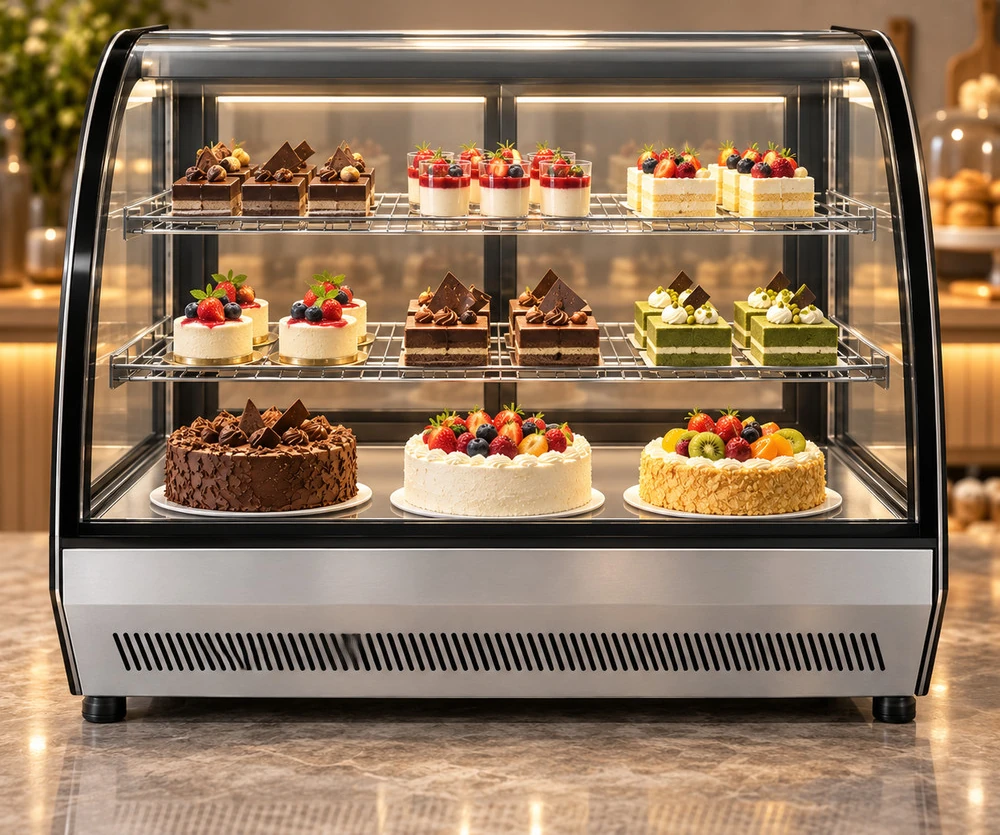
Same exterior size, different listed litres
| JINYU model | Outside size (mm) | Capacity | Outside footprint (m2) | Shelves | Doors | Temperature | Rated power |
|---|---|---|---|---|---|---|---|
| GN-900CT | 900 × 530 × 730 | 120 L | 0.477 | 2 chrome-plated shelves | 2 sliding doors at rear | 2-8 °C | 350 W |
| GN-900RT | 900 × 530 × 730 | 140 L | 0.477 | 2 | 2 sliding doors at rear | 2-8 °C | 350 W |
Same 425 L capacity, different cabinet widths
| JINYU model | Outside size (mm) | Capacity | Outside footprint (m2) | Shelves | Doors | Temperature | Rated power |
|---|---|---|---|---|---|---|---|
| GN-1200RF2 | 1200 × 730 × 1200 | 425 L | 0.876 | 2 glass shelves | 2 sliding doors on the service side | 2-8°C | 455 W |
| GN-1000RK2 | 1000 × 740 × 1200 | 425 L | 0.740 | 2 glass shelves | 2 sliding doors on the service side | 2-8°C | 455 W |
One two-door cooler or two single-door cabinets
| JINYU model | Outside size (mm) | Capacity | Outside footprint (m2) | Shelves | Doors | Temperature | Rated power |
|---|---|---|---|---|---|---|---|
| GN-620FS | 620 × 700 × 2018 | 410 L | 0.434 | 4 wire shelves | Hinged glass door | 0-10°C | 210 W |
| GN-868FM | 1220 × 690 × 2048 | 960 L | 0.842 | 4 shelves | 2 hinged glass doors | 0-10 °C | 300 W |
Wider cabinet within the open-front L family
| JINYU model | Outside size (mm) | Capacity | Outside footprint (m2) | Shelves | Doors | Temperature | Rated power |
|---|---|---|---|---|---|---|---|
| GN-900L | 900 × 740 × 1400 | 235 L | 0.666 | 2 shelves plus base deck | Open front | 2-8 °C | 820 W |
| GN-1200L | 1200 × 740 × 1400 | 295 L | 0.888 | 2 shelves plus base deck | Open front | 2-8 °C | 950 W |
Does a larger litre capacity mean a larger display fridge?
A larger listed capacity does not always mean a wider or deeper cabinet. JINYU GN-900CT and GN-900RT both measure 900 × 530 × 730 mm, but record 120 L and 140 L respectively. Their identical outside dimensions accompany different front-glass profiles and different listed capacities. The curved-front CT and straight-glass RT therefore occupy the same exterior rectangle without providing the same capacity entry.
Start a display fridge size comparison with three separate records: the exterior cabinet dimensions, the listed litres and the usable shelf drawing. The first describes the appliance outline. The second identifies the catalogued capacity. The third is needed to lay out the actual products. Keeping these records separate prevents a capacity figure from becoming an unsupported promise about cake, bottle or sandwich-pack counts.
Can two cabinets have the same capacity but different widths?
GN-1200RF2 and GN-1000RK2 both list 425 L and two glass shelves. RF2 measures 1200 × 730 × 1200 mm; RK2 measures 1000 × 740 × 1200 mm. The RF2 cabinet is 200 mm wider and 10 mm shallower, while the overall heights match. Equal capacity does not identify an interchangeable cabinet position.
Their calculated outside footprints are 0.876 and 0.740 square metres respectively. The difference is 0.136 square metres, before installation clearances and staff access. Sketch each rectangle at the proposed location and retain its full model code. Ask for usable shelf width and depth against that same code. A 425 L request on its own leaves both the room layout and the display arrangement unresolved.
How does one two-door drinks cooler compare with two single-door coolers?
GN-620FS is 620 × 700 × 2018 mm with 410 L capacity, four wire shelves and one hinged glass door. GN-868FM is 1220 × 690 × 2048 mm with 960 L, four shelves and two hinged glass doors. Two FS cabinets total 1240 mm of bare cabinet width and 820 L of listed capacity. One FM is 20 mm narrower than that combined width and lists 140 L more.
Those totals exclude spacing around and between cabinets. They also do not describe usable shelf area or the width of each door opening. Draw the actual door movement, customer approach and replenishment position for each arrangement. Keep two separate equipment records for a two-cabinet option; the combined frontage does not turn two independent appliances into one installation.
What changes when an open-front chiller grows from 900 to 1200 mm?
GN-900L lists 235 L at 900 × 740 × 1400 mm. GN-1200L lists 295 L at 1200 × 740 × 1400 mm. Both have two shelves plus a base deck. The wider model adds 300 mm of frontage and 60 L of listed capacity while retaining the same exterior depth and height. Its cabinet footprint grows from 0.666 to 0.888 square metres.
That is a useful comparison within one family, but it does not produce a universal litres-per-millimetre rule. Mark the open front on the plan and show the route used to replenish it. Compare the measured pack assortment on the returned shelf drawing. Extra frontage helps only when the proposed display arrangement and the surrounding customer route can use it.
Can I calculate tray or bottle capacity from litres?
Listed litres alone do not establish how many finished products will fit. A cake board has an outside diameter and a decorated height; a bottle has a cap, body width and chosen display orientation. Shelf supports, the glass profile and the usable opening also affect how an item can be placed. Request usable width, depth, vertical spacing and shelf-load information for each intended level.
For a geometry example, four rectangular packs measuring 180 mm across and 120 mm deep would occupy 720 × 120 mm in a single straight row before gaps. This is an illustrative pack layout, not a capacity claim for any cabinet in the table. Compare actual packs, including lids and projecting closures, with the supplied shelf drawing. Record a separate arrangement for each level rather than converting the cabinet litres into a product count.
Which dimensions belong in the counter or floor plan?
Use width × depth × height in millimetres throughout the equipment schedule. For the matched 900 mm countertop pair, the outside footprint is 0.900 × 0.530 = 0.477 square metres. That figure describes the cabinet outline on the counter. It does not identify base contact points, cabinet weight or the load the supporting counter must carry.
Draw installation spacing, service access and adjacent furniture beyond that outline using the selected model instructions. For a countertop display, request weight and the base arrangement for the counter review. For a hinged-door cooler, add its door-opening drawing. Keep packed dimensions on the delivery schedule: the bare cabinet measurements in this comparison do not establish whether its shipping package will pass through a doorway.
Does a larger capacity establish colder operation or lower running costs?
Capacity, temperature range and rated power are different specifications. The two countertop models in this comparison each list 2-8°C and 350 W, despite their different capacities. GN-620FS and GN-868FM each list 0-10°C, with rated powers of 210 W and 300 W respectively. Those ratings stay attached to their individual models and configurations.
The table does not rank energy efficiency or establish measured daily energy consumption. Ask for model-specific operating and energy documentation when those figures form part of the purchase comparison. Keep the intended contents and required holding conditions in the inquiry too. A higher litre figure supplies no evidence that one cabinet is suitable for a different food-holding requirement.
What should I send with a capacity and size inquiry?
Send JINYU, Shaanxi Jinyu Kitchenware Co., Ltd. (陕西金宇厨具有限公司), the exact model shortlist and a dimensioned plan. Add the finished pack or tray measurements, intended display levels and the number of visible positions you want. Identify customer access, staff loading and reserve stock separately. Include the destination and site electrical supply with the same project reference.
Request a model drawing, usable shelf dimensions, shelf-load information and installation instructions for each candidate. Keep the returned documents beside the matching capacity and exterior measurements. If the proposed model changes, update all three records before comparing the layout again. This gives the inquiry a measurable question: which offered cabinet and shelf arrangement accommodates the actual assortment at the proposed site?