620-900 mm widths · Four cabinet formats
Display Fridges Under 1 Metre Wide: Seven JINYU Sizes
Compare seven cabinets below 1000 mm wide. Depths span 530-740 mm and heights 730-2018 mm; supporting counters, access sides and door movements determine how each fits the room.
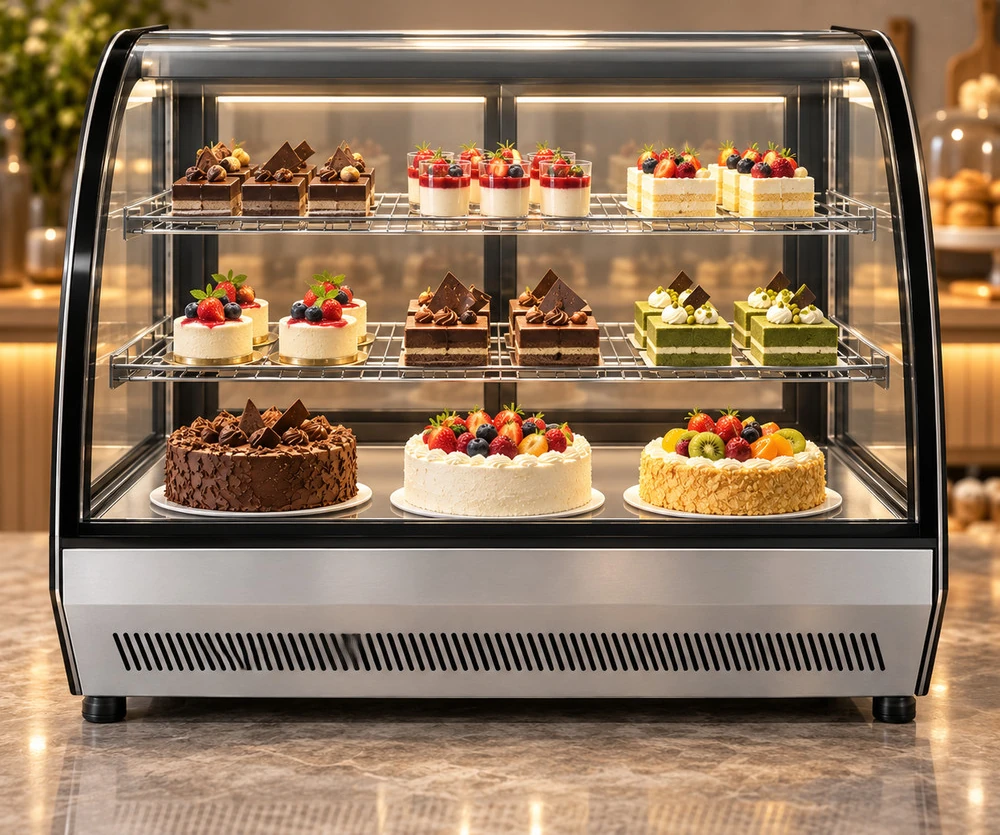
Countertop displays
Three supported cabinets at 660 or 900 mm width; each is 530 mm deep and 730 mm high.
| JINYU model | W × D × H | Capacity | Shelves | Access | Temperature | Rated power |
|---|---|---|---|---|---|---|
| GN-660RT | 660 x 530 x 730 mm | 102 L | 2 | Sliding doors at back | 2-8 °C | 250 W |
| GN-900CT | 900 x 530 x 730 mm | 120 L | 2 chrome-plated shelves | 2 sliding doors at rear | 2-8 °C | 350 W |
| GN-900RT | 900 x 530 x 730 mm | 140 L | 2 | 2 sliding doors at rear | 2-8 °C | 350 W |
Enclosed floor-standing cake display
A 900 mm frontage with three glass shelves and service-side sliding doors.
| JINYU model | W × D × H | Capacity | Shelves | Access | Temperature | Rated power |
|---|---|---|---|---|---|---|
| GN-900C3 | 900 x 730 x 1300 mm | 355 L | 3 glass shelves | 2 sliding doors on the service side | 2-8 °C | 460 W |
Open-front floor-standing displays
Two 900 mm cabinets with two shelves plus a base deck and direct front access.
| JINYU model | W × D × H | Capacity | Shelves | Access | Temperature | Rated power |
|---|---|---|---|---|---|---|
| GN-900L | 900 x 740 x 1400 mm | 235 L | 2 shelves plus base deck | Open front, no door | 2-8 °C | 820 W |
| GN-900LG | 900 x 740 x 1350 mm | 200 L | 2 shelves plus base deck | Open front, no door | 2-8 °C | 820 W |
Upright beverage cooler
A 620 mm frontage with a 2018 mm cabinet height and hinged glass door.
| JINYU model | W × D × H | Capacity | Shelves | Access | Temperature | Rated power |
|---|---|---|---|---|---|---|
| GN-620FS | 620 x 700 x 2018 mm | 410 L | 4 wire shelves | Hinged glass door | 0-10°C | 210 W |
Which display fridge sizes are less than one metre wide?
Seven JINYU models in this comparison have cabinet widths below 1000 mm. GN-620FS is 620 mm wide and GN-660RT is 660 mm wide. The other five are 900 mm wide: GN-900CT, GN-900RT, GN-900C3, GN-900L and GN-900LG. They span countertop cake displays, an enclosed floor-standing cake cabinet, open-front displays and a single-door upright beverage cooler.
Choose the service format before comparing litres. A narrow upright cabinet needs a tall position and space for its hinged door. A countertop cabinet needs a supporting surface. Open-front equipment places the selection directly within customer reach. The same frontage limit can therefore produce very different equipment schedules and room layouts.
Which of these narrow cabinets needs a supporting counter?
GN-660RT, GN-900CT and GN-900RT are countertop models, each 530 mm deep and 730 mm high. GN-660RT lists 102 L at 660 mm width. GN-900CT lists 120 L and GN-900RT lists 140 L at the same 900 mm width. Their exterior support rectangles are 0.350 and 0.477 square metres respectively, rounded to three decimal places.
Draw the support separately from the cabinet. With a hypothetical 900 mm-high supporting surface, each cabinet top would stand 1630 mm above the floor. This calculation describes the combined height in that example. Request equipment weight, support details and installation spaces for the chosen model before specifying the counter. Include the staff position behind the sliding doors in the plan.
How do the three 900 mm floor-standing displays differ?
GN-900C3 measures 900 × 730 × 1300 mm, lists 355 L and has three glass shelves with two service-side sliding doors. GN-900L measures 900 × 740 × 1400 mm and lists 235 L. GN-900LG measures 900 × 740 × 1350 mm and lists 200 L. L and LG both record two shelves plus a base deck and open-front access.
C3 occupies a calculated 0.657 square metres; L and LG each occupy 0.666 square metres. Those similar floor rectangles conceal different service arrangements. Mark whether staff retrieve products through the rear doors or customers select through the front. Compare the elevation as well: L stands 100 mm taller than C3, while LG stands 50 mm taller.
Can a narrower upright cooler hold more listed litres?
GN-620FS records 410 L at 620 × 700 × 2018 mm. Its exterior floor rectangle is 0.434 square metres, smaller than the other floor-standing cabinets in this table. It also stands 618 mm taller than GN-900L and 718 mm taller than GN-900C3. The published capacity belongs to a tall beverage-cooler construction with four wire shelves and a hinged glass door.
Keep the intended assortment visible when comparing those figures. A bottle layout and a decorated-cake layout ask different questions about shelf height, depth and removal space. Request usable shelf measurements for the exact packs. The 410 L capacity does not establish a bottle count, and the cabinet's height does not describe the usable opening at each shelf setting.
Does a cabinet under one metre wide fit a one metre equipment bay?
Width alone describes only one edge of the cabinet. In a hypothetical 1000 mm-wide position, a 900 mm cabinet leaves 100 mm total before installation allowances, end panels or surrounding fixtures. A 660 mm cabinet leaves 340 mm and the 620 mm upright leaves 380 mm. These are simple differences between the stated bay and cabinet widths, without an allocation to either side.
Draw the complete depth too. The countertop models project 530 mm from the frontage line; C3 projects 730 mm and L or LG 740 mm. Obtain the selected model's ventilation and service requirements, then add customer circulation, staff loading and door movement. Request packed dimensions separately when checking the receiving route. Cabinet dimensions describe unpacked equipment.
What changes between curved and straight glass at 900 mm width?
GN-900CT and GN-900RT both measure 900 × 530 × 730 mm and list 350 W rated power. CT records curved front glass with glass sides and two chrome-plated shelves. RT records straight, square glass sides and two shelves. Their listed capacities are 120 L and 140 L respectively, a difference of 20 L within the same exterior outline.
Both records specify two rear sliding doors. Keep the complete model code on the counter drawing and request the corresponding shelf layout. Matching outside dimensions make the initial counter rectangles comparable. They do not establish identical shelf geometry, usable display openings or the same arrangement of finished products. Place the same cake boards and packaged desserts on each returned layout.
Which temperature and electrical figures belong in the shortlist?
GN-620FS records a 0-10°C temperature range and 210 W rated power. The other six models record 2-8°C ranges, with powers from 250 W on GN-660RT to 820 W on GN-900L and GN-900LG. GN-900C3 records 460 W; GN-900CT and GN-900RT each record 350 W. All seven list 220-240V/50Hz.
Keep each figure beside its model reference in the schedule. Rated power does not measure daily energy consumption, and the cabinet range does not establish the temperature of every product in service. Include the destination supply and the intended assortment in the inquiry. Request the electrical and operating documents for each offered configuration so the installation and product requirements can be reviewed together.
What should I send with a narrow display fridge inquiry?
Send a shortlist of complete model codes, the maximum available width, measured room depth and a front elevation. Identify a supporting counter where required, the customer-facing side, staff retrieval position and adjacent doors. Add finished-pack dimensions and photos, the destination electrical supply and the receiving-route measurements. State which documents you need: shelf drawings, installation spacing, equipment weight and packed dimensions.
Address the inquiry to JINYU, Shaanxi Jinyu Kitchenware Co., Ltd. (陕西金宇厨具有限公司). Keep the returned documents with the same drawing revision and model references. If an alternative is proposed, compare its full width, depth, height, access arrangement and shelves before carrying the earlier layout forward. A smaller model number alone does not identify a narrower cabinet.