What is the difference between FRO and FCO grab-and-go counters?
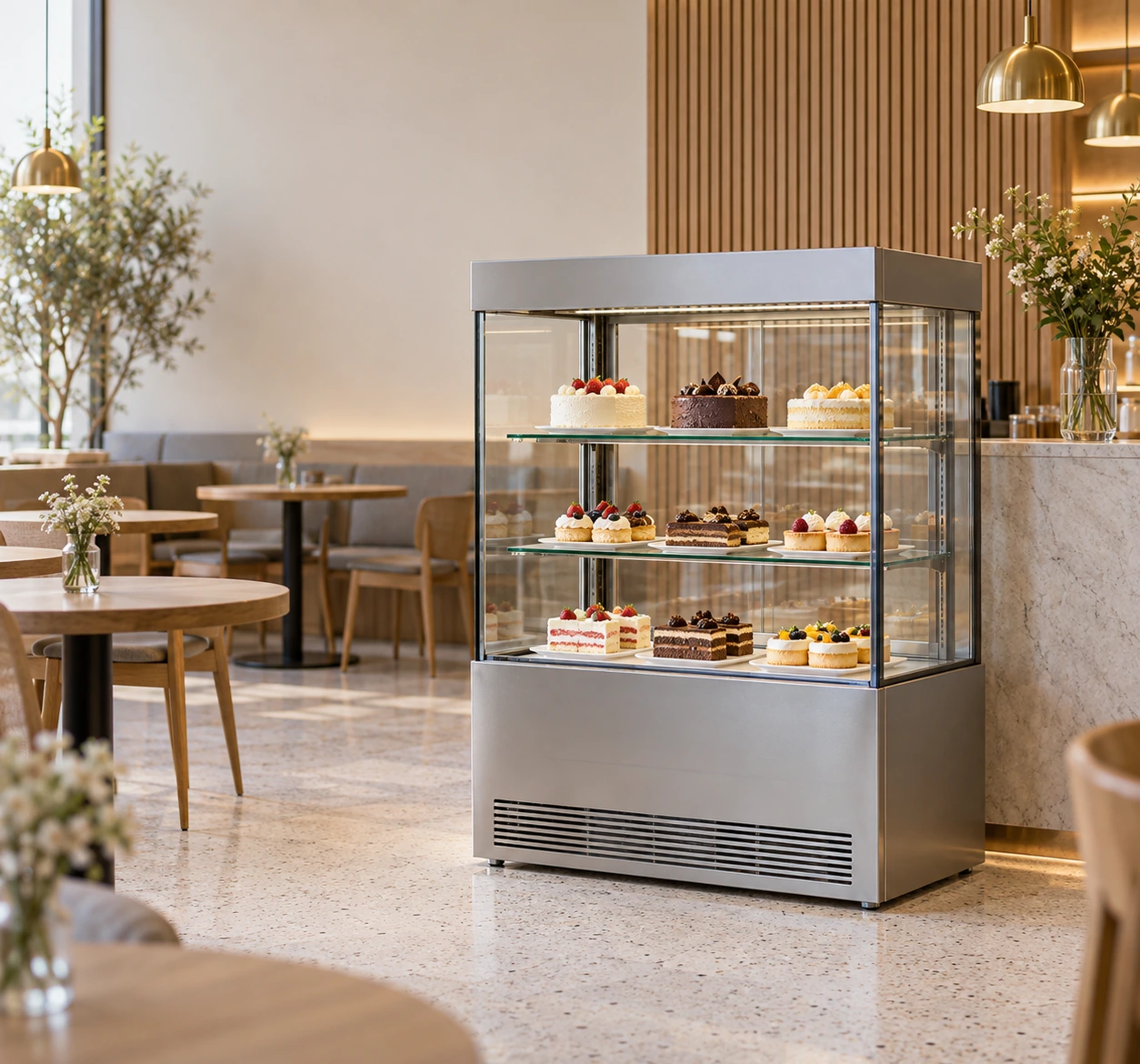
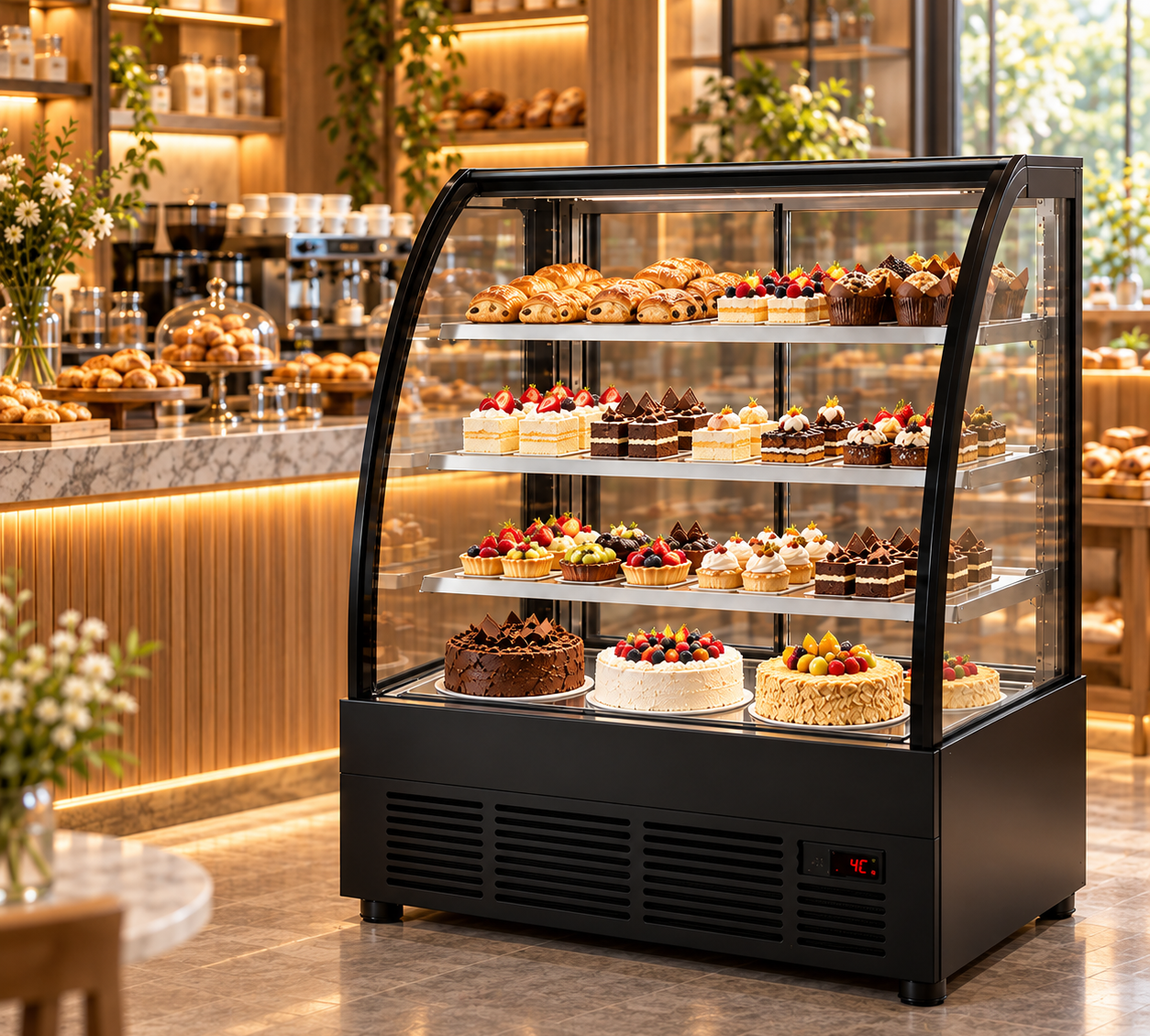
FRO has straight glass side panels and two glass shelves plus a base deck. FCO has curved glass side panels and three shelves plus a base deck. Both families provide an open front. At a matching width, the recorded outside dimensions are identical: 1000 × 730 × 1300 mm for the smaller pair and 1200 × 730 × 1300 mm for the larger pair.
This makes the comparison useful when a café has already allocated a cabinet outline but has not chosen its display arrangement. FCO adds a shelf and records more capacity within that outline. Compare the shelf drawings and your actual products before selecting the layout. The cake and pastry family names do not, by themselves, establish which individual food products belong in the display.
How much capacity does FCO add at the same outside size?
GN-1000FRO records 390 L and GN-1000FCO records 535 L, a difference of 145 L at the same 1000 mm width. GN-1200FRO records 480 L and GN-1200FCO records 650 L, a difference of 170 L at the same 1200 mm width. The comparison table calculates these differences directly from the model records.
Those litres describe listed cabinet capacity, not a count of cakes, trays or retail packs. The additional shelf changes the way products can be arranged, but outside dimensions and litres do not reveal the usable clearance at every display level. Send the dimensions of your tallest pack and widest tray, including lids and projecting rims, and request the shelf layout and loading-opening measurements for each candidate.
Does the extra FCO shelf mean more room for tall products?
An extra shelf creates another display level; it does not establish greater height between levels. FRO records two glass shelves plus the base, while FCO records three shelves plus the base. Both cabinets are 1300 mm high overall. Their internal shelf positions and usable clearances need to be assessed from the selected model drawing.
Make a product list with a pack identifier, outside width, depth and height, then assign each product to a proposed level. Keep the base deck as its own row so it is not counted as an additional supplied shelf. Ask how the proposed arrangement accommodates the tallest pack and permits removal from the open front. Review the drawing with the pack list rather than multiplying a photographed pack count across every level.
What changes when I move from 1000 to 1200 mm width?
Within either family, the wider option adds 200 mm of frontage while retaining 730 mm depth and 1300 mm height. The exterior body footprint increases from 0.730 to 0.876 square metres, calculated as width multiplied by depth. That is an additional 0.146 square metres of cabinet outline. FRO capacity rises by 90 L, from 390 to 480 L; FCO rises by 115 L, from 535 to 650 L.
For an illustrative 1400 mm-wide equipment run, a 1000 mm body leaves a total width balance of 400 mm and a 1200 mm body leaves 200 mm. These balances are arithmetic examples, not installation clearances. Locate the cabinet on the plan, then add the surrounding space required by its installation documents and the customer and staff working positions.
How do the electrical records compare across the four models?
GN-1000FRO records 470 W rated power and GN-1200FRO records 480 W. Both FCO models record 450 W. At 1000 mm width, the FCO rating is 20 W lower than the FRO rating; at 1200 mm, it is 30 W lower. All four recorded configurations list 220-240V/50Hz. Retain the complete model code with each electrical line.
Rated power is not measured daily energy use. These figures do not establish which cabinet consumes less electricity in your shop or determine the required circuit arrangement. Request the electrical data and installation instructions for the configuration being offered. Give those documents and the site supply information to the person reviewing the connection, and retain any configuration change beside the original model request.
Do FRO and FCO have different recorded temperature ranges?
All four models list a 2-8 °C temperature range, fan cooling and R290 refrigerant. Temperature range therefore does not separate these two families in the recorded comparison. Their documented differences here are the shelf arrangement, side-glass profile, capacity and rated power. Keep those distinctions visible when reviewing an alternative model suggested in response to an inquiry.
Choose the products you intend to display and give their storage requirements to the equipment reviewer. The cabinet range is not a measurement of food temperature during service. Request the operating and installation documents for the exact model, with the proposed room arrangement attached. Record the monitoring and replenishment procedure with your operating plan so a cabinet substitution is reviewed against both the equipment documents and the intended assortment.
What should I send JINYU to compare FRO and FCO for my café?
Send Shaanxi Jinyu Kitchenware Co., Ltd. (陕西金宇厨具有限公司) the two model codes you want compared, requested quantity, destination and a measured counter-area plan. Include pack and tray dimensions, the proposed shelf allocation, the site electrical supply and photographs showing the customer approach. Identify the chosen cabinet width before asking for a model-specific drawing.
Use the worksheet below to request the shelf, installation and electrical documents against the same candidate pair. Keep the receiving route and packed shipment dimensions in a separate delivery record. When the response proposes a different width or shelf arrangement, update the model line and the product allocation together. The resulting comparison should identify which physical cabinet, drawing and display arrangement you are discussing before you assemble the written order specification.