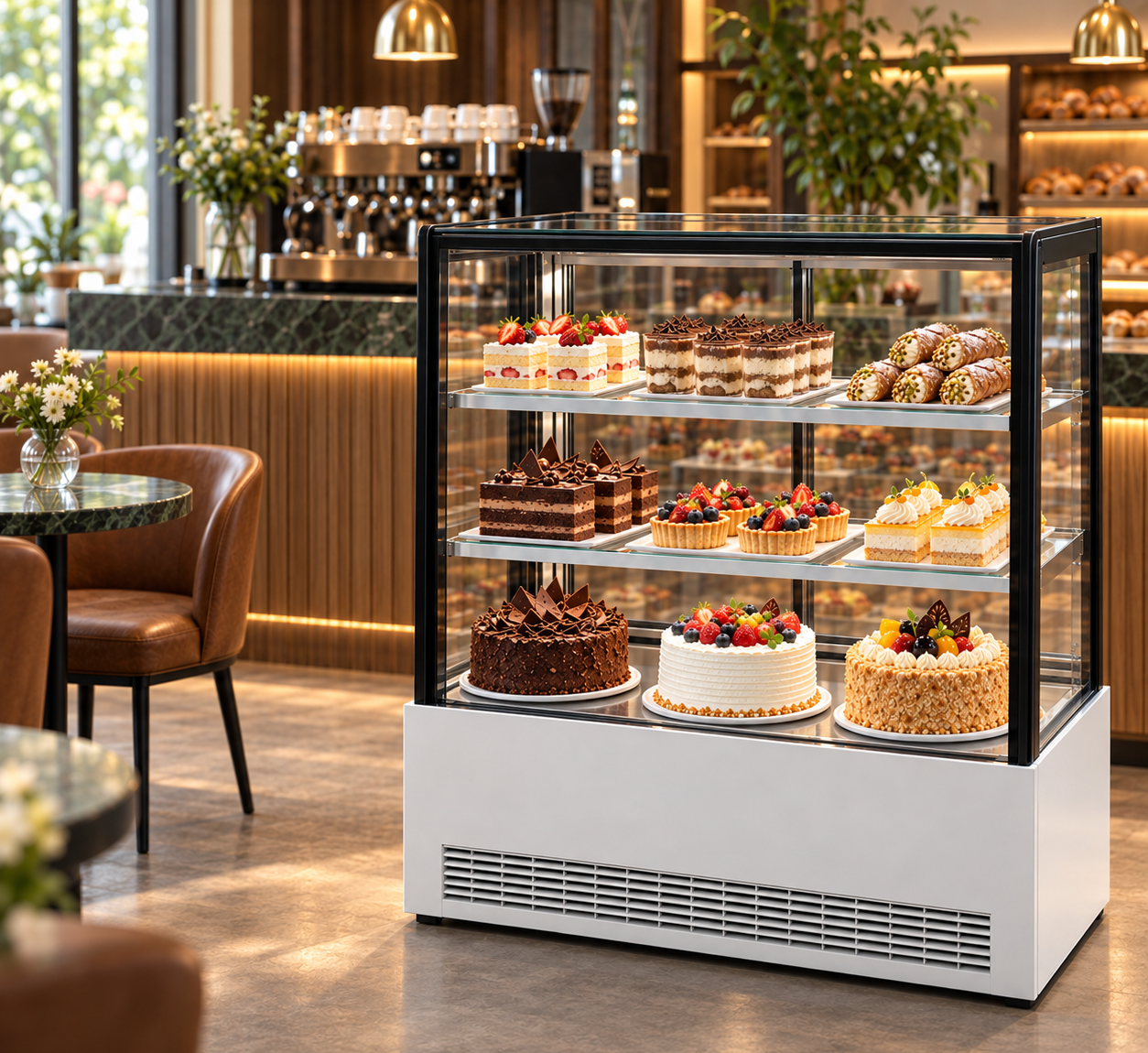
Which RD2 and RF2 display fridge sizes can I compare?
Compare three freestanding cabinets with two glass shelves and two service-side sliding doors. GN-1000RD2 measures 1000 × 730 × 1200 mm and lists 425 L. GN-1200RD2 measures 1200 × 730 × 1200 mm and lists 515 L. GN-1200RF2 also measures 1200 × 730 × 1200 mm, with 425 L listed capacity. Dimensions are width × depth × height throughout this page.
There are two useful comparisons here. The two RD2 models show a width change within one series. The two 1200 mm models show a capacity difference within an identical exterior outline. Start with the comparison that answers your purchasing question: reducing the occupied frontage, or choosing between cabinets for an already allocated position. Keep the full model code on the drawing and on the inquiry.
Do GN-1200RD2 and GN-1200RF2 occupy the same floor area?
Their recorded cabinet bodies have the same 1200 mm width, 730 mm depth and 1200 mm height. Each calculated body footprint is 0.876 square metres: 1.2 m multiplied by 0.73 m. You can therefore use the same body rectangle for an initial floor-plan comparison. Label the alternatives separately so the capacity, glass description and electrical entries stay attached to the correct model.
The common rectangle does not establish identical usable interiors or the complete installation envelope. Both have service-side sliding doors, so show staff access behind the cabinet. Add the installation clearances from the documents returned for the selected configuration. Draw surrounding joinery independently and retain access to the equipment. The exterior dimensions alone do not describe the space needed for loading a tray, cleaning or servicing.
Why does the same 1200 mm outline have 425 L or 515 L?
The recorded capacity for GN-1200RD2 is 515 L; GN-1200RF2 lists 425 L. The difference is 90 L. Those figures belong to the individual model records. The available specifications do not explain the measurement method or provide an internal compartment drawing, so the difference should remain a listed-capacity comparison rather than an explanation of cabinet construction.
For a cake assortment, request usable shelf width and depth, shelf spacing and clear door-opening measurements for both models. Supply the actual tray and stand dimensions with the request. Two glass shelves in each cabinet does not establish equal shelf area, equal cake count or equal loading limits. Put the returned measurements beside each proposed product position before deciding whether the additional listed litres help your particular display.
What changes when I reduce the width from 1200 to 1000 mm?
Within RD2, GN-1000RD2 reduces frontage by 200 mm relative to GN-1200RD2. Depth remains 730 mm and height remains 1200 mm. The smaller body footprint is 0.730 square metres, a reduction of 0.146 square metres. Listed capacity changes from 515 L to 425 L. Both recorded models retain two glass shelves and service-side sliding doors.
GN-1000RD2 and GN-1200RF2 happen to share the 425 L figure despite their different widths. That makes them a useful second check when a buyer starts from a litre requirement. The 1000 mm cabinet occupies less frontage, but the figure alone does not establish interchangeable product arrangements. Compare the shelves and loading opening against the same assortment, using one set of tray measurements for both responses.
How would a three-model shortlist work in a 1400 mm bay?
Consider an illustrative straight bay with 1400 mm of measured frontage. Subtracting cabinet width leaves 400 mm beside GN-1000RD2 and 200 mm beside either 1200 mm cabinet. These are arithmetic balances for the body outline. They are not approved ventilation spaces or a recommendation to divide the remainder equally between both sides. The worksheet below keeps that distinction visible.
Next mark the service side, adjoining furniture and the intended packing surface. Record the measured bay depth and any overhead feature on the same drawing. Ask for the selected model's installation requirements and compare them with the remaining space. If the bay changes, revise its measured width in all three rows. Keep the cabinet code on each row rather than replacing it with a general label such as 425 L display.
Which glass and electrical details distinguish the shortlisted cabinets?
RD2 records flat glass at the front, sides and top. RF2 records straight glass at the front and sides. Use the model photographs and requested elevation drawing to review the appearance beside your counter. The wording does not establish differences in glass thickness, insulation or visibility under your shop lighting. Include your customer-facing elevation if the cabinet must align visually with adjoining displays.
The recorded rated power is 450 W for both RD2 models and 455 W for GN-1200RF2. All three list a 220-240 V, 50 Hz configuration and a 2-8°C temperature range. Rated watts are not measured daily energy consumption. Send the model code and site electrical supply together for a configuration response; keep electrical connection details with the model-specific documents rather than selecting an outlet from the wattage comparison alone.
What should I send JINYU to choose between RD2 and RF2?
Send the three model codes, your measured bay drawing and the trays, stands and finished products proposed for each shelf. Identify whether the priority is a 1000 mm frontage, a 1200 mm frontage or a particular product arrangement. Ask for usable shelf and loading-opening measurements, the installation drawing and the included-accessory description for each model still on the shortlist.
Address the inquiry to JINYU, Shaanxi Jinyu Kitchenware Co., Ltd. (陕西金宇厨具有限公司). Attach the site supply details and receiving-route measurements alongside the display plan. Compare each returned response against the same numbered requirements. Retain the chosen model code, drawing revision and assortment schedule together so the purchasing contact and counter designer work from the same cabinet selection.