Two single-door beverage coolers or one double-door cooler? Compare 1240 vs 1220 mm body frontage, 820 vs 960 L and separate drinks locations, with a downloadable arrangement schedule.
Three models · three access layouts
Upright Beverage Display Fridge Size Comparison: FS, FM and CM
Compare single-door, two-door and open-front beverage displays using recorded dimensions and model-specific shelf layouts.
Compare all three models →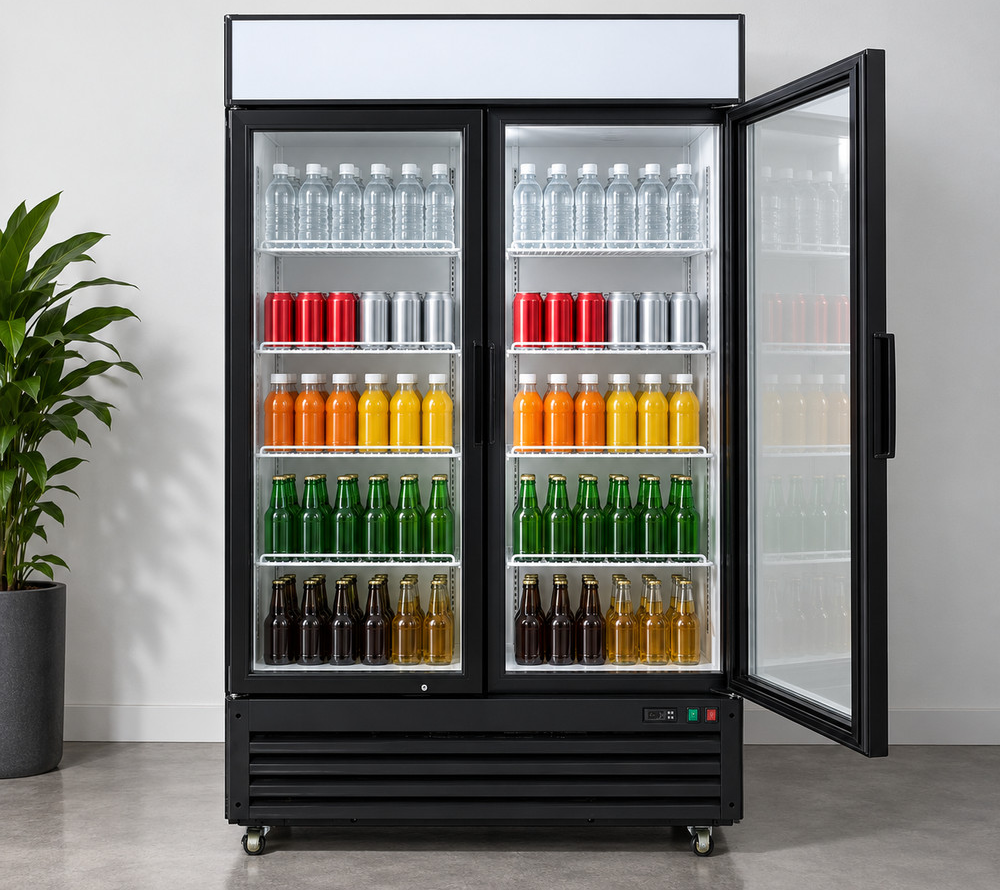
Upright beverage display dimensions and specifications
| JINYU model | Front access | W × D × H (mm) | Capacity | Exterior footprint (m2) | Rated power | Shelves | Temperature range |
|---|---|---|---|---|---|---|---|
| GN-868FM | 2 hinged glass doors | 1220 × 690 × 2048 mm | 960 L | 0.842 | 300 W | 4 shelves | 0-10 °C |
| GN-620FS | Hinged glass door | 620 × 700 × 2018 mm | 410 L | 0.434 | 210 W | 4 wire shelves | 0-10°C |
| GN-1200CM | Open front, no front door | 1200 × 840 × 2000 mm | 490 L | 1.008 | 1320 W | 4 shelves plus base deck | 2-8°C |
All three records list freestanding installation, fan cooling, automatic defrost, R290 refrigerant and 220-240V/50Hz. Exterior footprints exclude installation clearances and circulation space.
Which upright beverage display fridge sizes can I compare?
The three JINYU cabinets in this comparison span 620 to 1220 mm in width and 2000 to 2048 mm in height. GN-620FS is a single-door cooler, GN-868FM has two hinged glass doors, and GN-1200CM has an open front with glass side panels. Their depths are 700, 690 and 840 mm respectively. Each model is freestanding, so its overall height is measured as a complete cabinet rather than a display placed on a separate counter.
Begin with the access arrangement and then compare the outside dimensions. A drinks wall served through hinged doors needs a door-opening plan. An open-front position needs a customer approach and replenishment plan. Keep the full model code on both drawings so the selected access arrangement stays attached to the correct dimensions.
How do the two roughly 1200 mm cabinets differ?
GN-868FM measures 1220 × 690 × 2048 mm and records 960 L. GN-1200CM measures 1200 × 840 × 2000 mm and records 490 L. The two-door FM is 20 mm wider, 150 mm shallower and 48 mm taller. The CM has four shelves plus a base deck; the FM record lists four shelves. These are separate cabinet constructions with different front access and internal arrangements.
Their similar widths make them useful alternatives to draw at the same drinks-wall position. Compare the 150 mm depth difference on a plan before considering capacity. The listed litres do not establish an interchangeable assortment, bottle count or usable shelf area. Request shelf drawings for the actual bottles and cartons planned for each cabinet.
What floor footprint does each upright cooler occupy?
Multiplying the recorded cabinet width by depth gives an exterior rectangle of 0.434 square metres for GN-620FS, 0.842 square metres for GN-868FM and 1.008 square metres for GN-1200CM, rounded to three decimal places. The CM rectangle is approximately 0.166 square metres larger than the FM rectangle despite its slightly narrower frontage. That difference comes from its greater depth.
Plot each rectangle at scale with the front edge facing the customer route. Add installation spacing, door movement where applicable, customer standing space and restocking access as separate areas. The arithmetic represents the outside cabinet outline. Use the installation drawing for the selected configuration to place adjacent shelving and walls; the footprint figures alone do not define a finished installation opening.
Can two single-door coolers replace one two-door cabinet?
Two GN-620FS cabinets have a combined bare width of 1240 mm, compared with 1220 mm for GN-868FM. Their combined listed capacity is 820 L, compared with 960 L for the FM. Their combined exterior rectangle is 0.868 square metres before allowing spacing, while the FM rectangle is 0.8418 square metres. Two FS cabinets also retain the FS height of 2018 mm, which is 30 mm below the FM height.
Treat this as a layout comparison when deciding how to divide the drinks assortment. Two cabinets have separate doors and separate electrical connections. Request the relevant installation and connection documents before arranging them together. Combined dimensions and litres do not establish that the two-cabinet layout can occupy the same prepared opening or use the same electrical arrangement.
How should I measure bottles for four-shelf displays?
GN-620FS records four wire shelves, GN-868FM records four shelves, and GN-1200CM records four shelves plus a base deck. Make an assortment sheet with the maximum bottle diameter, overall height including closure and any projecting label or packaging. Include the outside dimensions of multipacks and cartons. Allocate the proposed products by shelf on a drawing so the requested measurements correspond to actual stock.
Ask for usable shelf width and depth, vertical openings and shelf-load information for the chosen model. Keep the base deck identified separately on the CM drawing. A four-shelf description does not establish identical shelf dimensions across these three cabinets. Use the returned dimensions to calculate facings and rows, then retain a practical removal path for each product when reviewing the arrangement.
Which temperature and electrical specifications differ?
The FS and FM records specify 0-10°C, while CM specifies 2-8°C. All three list fan cooling, automatic defrost, R290 refrigerant and 220-240V/50Hz. Rated power is 210 W for GN-620FS, 300 W for GN-868FM and 1320 W for GN-1200CM. Put these model-specific figures on the equipment schedule beside the site supply and the proposed product assortment.
Rated power is not a daily electricity-use measurement, and the recorded temperature range does not describe the temperature history of a particular drink. Request operating and installation documentation for the offered configuration. Evaluate the assortment against its own storage requirements, retaining the exact model and electrical configuration on the returned documents rather than applying one cabinet's rating to another.
What changes when the front has hinged doors or stays open?
The FS record identifies one hinged glass door and the FM record identifies two hinged glass doors. The CM front is open with no front door. For FS and FM, request the door-opening dimensions and place them on the shop drawing alongside the customer approach. Keep door movement clear of nearby fixtures when reviewing the returned installation plan.
For CM, draw the shopper reaching toward the open shelves and the route used to replenish each shelf and the base deck. Include nearby equipment and the intended position in site photographs supplied with the inquiry. The open-front specification establishes the access type; it does not establish suitability for every site condition. Compare installation instructions and the planned assortment before finalising that position.
What should I send with an upright display fridge inquiry?
Send the complete shortlisted model codes, a measured floor plan and photographs showing the proposed position. Add the bottle and carton assortment sheet, shelf allocation, destination and site electrical supply. Show the customer-facing side and the restocking route. For receiving access, measure doorways, turns and lifts separately and request packed dimensions, package weights and handling instructions for the offered configuration.
Submit the brief through the JINYU inquiry form to Shaanxi Jinyu Kitchenware Co., Ltd. (陕西金宇厨具有限公司). Keep the returned shelf drawings, door-opening measurements, installation instructions and packing details with the same model identity. The linked individual model pages provide the photographs and specifications; the three series hubs provide a direct route back to each cabinet family.