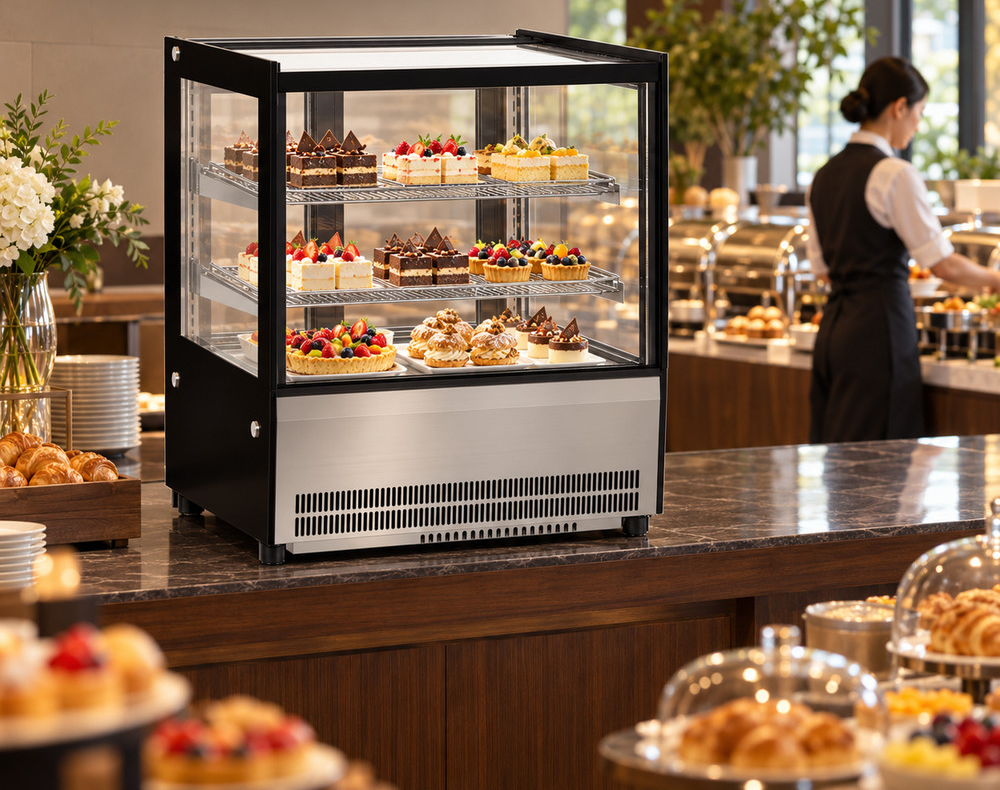
How do I read a display fridge size in inches?
Read each size as outside width × depth × height, keeping the same order when converting units. Divide every millimetre dimension by 25.4. For example, GN-900RT measures 900 × 530 × 730 mm, approximately 35.43 × 20.87 × 28.74 inches. The conversion describes the cabinet body. It does not describe shelf space, a shipping crate or the complete installation envelope.
Keep the original metric figures beside the converted values in your equipment schedule. Two decimal places make this chart easier to compare; use the original dimensions and the selected installation drawing when reviewing a close fit. Give the cabinet a position number on the room plan so an inch dimension in a joinery drawing remains tied to the correct model.
Is a 900 mm display fridge the same as a 36 inch display?
A 900 mm cabinet is approximately 35.43 inches wide. A 36 inch bay is 914.4 mm wide, leaving 14.4 mm of gross difference. Those measurements are close, but the difference is not an approved installation allowance. GN-900RT and GN-900CT both have a 900 mm body width; each also needs a review of the proposed support, ventilation and service access.
Put 914.4 mm in the bay-width field and 900 mm in the cabinet-width field. Record the 14.4 mm difference separately. If trim or a neighbouring fixture occupies part of the bay, use the measured clear opening instead of the nominal furniture size. Request the model-specific installation information before treating a nominal 36 inch position as suitable for either cabinet.
Will a 1200 mm display fit a 48 inch counter position?
A 48 inch position equals 1219.2 mm. A 1200 mm cabinet leaves 19.2 mm of gross width difference. This arithmetic is the same for GN-1200RT, GN-1200CT and GN-1200RK3, because each has the same recorded width. Their depths and heights differ: RT and CT are 530 mm deep and 730 mm high; RK3 is 740 mm deep and 1300 mm high.
The RT and CT models are countertop cabinets. RK3 is freestanding. Put the support arrangement and cabinet elevation beside the width calculation rather than substituting one model solely because the frontage matches. The available position must also accommodate the chosen depth, access and installation arrangement. A shared 1200 mm label describes one dimension, not a complete replacement specification.
What does a 72 inch bay leave beside an 1800 mm cabinet?
Seventy-two inches equals 1828.8 mm. GN-1800RK3 is 1800 mm wide, giving a gross difference of 28.8 mm. Its depth is 740 mm, approximately 29.13 inches, and its height is 1300 mm, approximately 51.18 inches. Use all three dimensions to draw the cabinet body in the proposed floor position.
Label the 28.8 mm result as bay width minus cabinet body, with installation space still to be assessed from the selected documentation. Include wall finishes, skirting and fixed furniture in the measured opening. A nominal six-foot run can have a smaller clear opening after those details are installed. Keep the drawing revision with the equipment schedule so the project team can see which bay measurement was used.
How do I compare a 24 inch-deep worktop with a 530 mm-deep countertop fridge?
A 24 inch worktop is 609.6 mm deep. Subtracting a 530 mm cabinet body leaves 79.6 mm, approximately 3.13 inches, in the depth direction. GN-660RT, GN-900RT, GN-1200RT, GN-900CT and GN-1200CT all have that recorded cabinet depth. The arithmetic gives a body-outline difference before considering placement and installation details.
Draw the actual worktop edge, rear wall and proposed cabinet position in a side view. Ask for the support and installation drawing, including the relationship between the base and supporting surface. Show the rear sliding-door service side on the plan. The 79.6 mm difference does not establish ventilation clearance or working room behind the cabinet; keep those requirements as separate dimensions when reviewing the arrangement.
Can I use converted outside dimensions to choose trays or plan delivery?
Outside dimensions help locate the cabinet body, while trays need the usable interior dimensions and delivery needs the actual packed dimensions. Keep three records: cabinet width × depth × height, usable shelf dimensions, and shipment package dimensions. Changing from metric to inches does not make one record serve all three purposes.
For example, the GN-1200CT and GN-1200RT bodies are both 1200 × 530 × 730 mm, but their published capacities are 162 L and 190 L respectively. That difference illustrates why a common exterior outline cannot establish identical interiors. Request shelf drawings and compare the actual trays with them. For transport planning, obtain the package schedule and assess the measured route against the packages and proposed handling method.
What should an inch-based display fridge inquiry include?
Send the full model code, original metric dimensions and the inch-based site drawing to Shaanxi Jinyu Kitchenware Co., Ltd. (陕西金宇厨具有限公司). State whether each site figure is a nominal furniture size or a measured clear opening. Identify width, depth and height explicitly, and include the support height for a countertop cabinet. Attach photographs showing the display position and service side.
Keep the gross bay differences from this chart separate from installation requirements. Ask for the selected configuration's installation drawing, usable shelf dimensions and electrical specification against the same model code. If the project moves from a 900 mm to a 1200 mm cabinet, revise the drawing and equipment row together. This gives the reply a specific cabinet, position and document revision to address.