Buyer planning guide
Non-Woven Bag Size Chart: Printable 1:5 Front and Base Outlines
Print six real JINYU non-woven bag sizes at 1:5 on A4. Compare front and base outlines, check the 50 mm calibration line and download source dimensions as CSV.
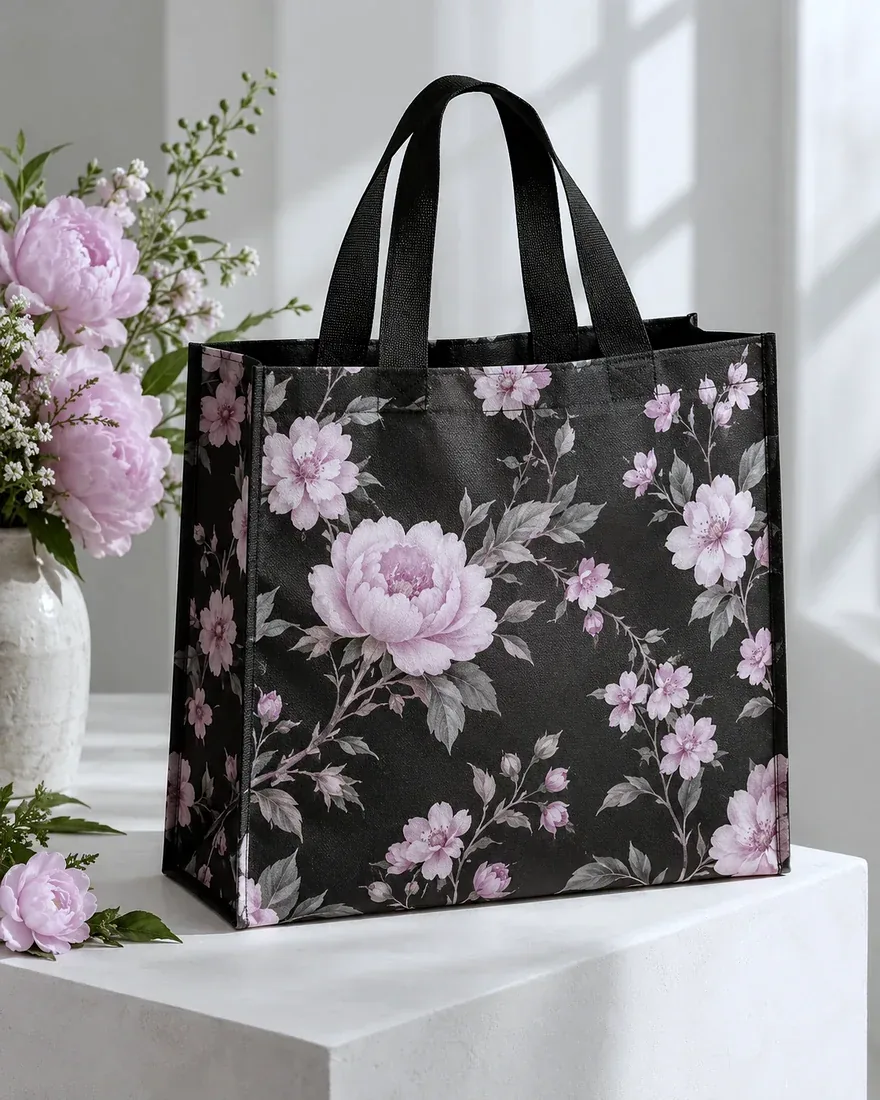
Six catalogue bodies at 1:5 scale
Download A4 scale outlines (SVG) → Download size calculations (CSV) →
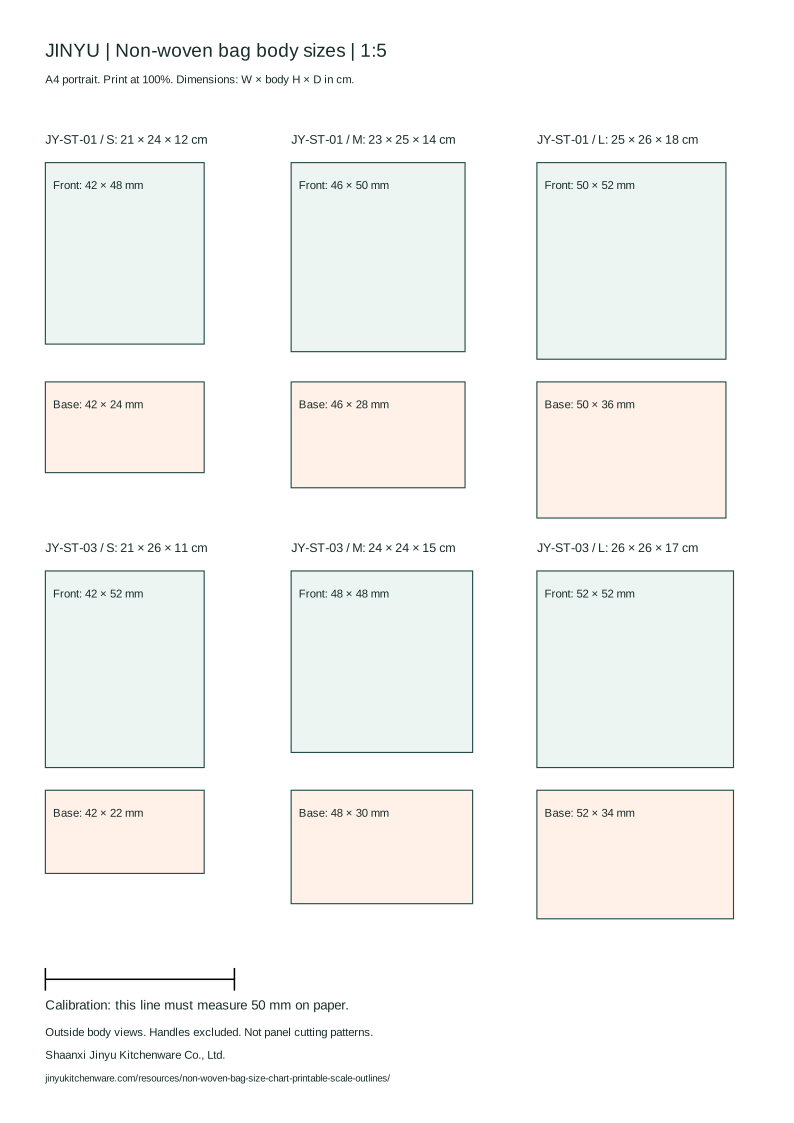
Print on A4 portrait at 100% and measure the 50 mm calibration line. Rectangles show front and base views of outside bag bodies; handles are excluded.
| SKU / variant | Catalogue body (cm) | Front on paper (mm) | Base on paper (mm) |
|---|---|---|---|
| JY-ST-01 / S | 21 × 24 × 12 | 42 × 48 | 42 × 24 |
| JY-ST-01 / M | 23 × 25 × 14 | 46 × 50 | 46 × 28 |
| JY-ST-01 / L | 25 × 26 × 18 | 50 × 52 | 50 × 36 |
| JY-ST-03 / S | 21 × 26 × 11 | 42 × 52 | 42 × 22 |
| JY-ST-03 / M | 24 × 24 × 15 | 48 × 48 | 48 × 30 |
| JY-ST-03 / L | 26 × 26 × 17 | 52 × 52 | 52 × 34 |
What does this non-woven bag size chart let me print?
Download the A4 sheet to compare six JINYU catalogue bag bodies at 1:5 scale. Each reference has two dimensioned rectangles: a front view showing width and body height, and a base view showing width and gusset depth. Three takeaway shopper sizes and three self-seal insulated bag sizes appear on the same sheet. Their SKU and variant remain beside both views, so a paper rectangle stays attached to its product reference.
The drawings use the catalogue outside dimensions. They give a purchasing team a consistent visual scale when discussing a shortlist. A 25 cm body height appears as 50 mm on the sheet; a 14 cm depth appears as 28 mm. The front and base rectangles describe different views of that same reference. Download the accompanying CSV when you need the source centimetres and calculated paper dimensions in separate spreadsheet columns.
How do I print the outlines at the stated scale?
Open the SVG download in a viewer that preserves its A4 page size, then select A4 portrait and 100% or actual-size printing. Disable fit-to-page scaling for the first print. Measure the calibration line with a ruler: the line labelled 50 mm should measure 50 mm on the paper. Its length is a printed-page measurement, independent of the bag catalogue dimensions. Retain that check with the sheet before comparing any outlines.
If the line measures 48 mm, the page printed at 96% of its intended size: 48 divided by 50 equals 0.96. Correct the print setting and print again. At that reduced setting, a front outline intended to measure 46 mm would measure 44.16 mm. The printed numbers would still read correctly, but the physical drawing would no longer be at 1:5. Screens and document previews also resize drawings; measure the printed calibration line.
Which real bag sizes are represented in the two views?
Takeaway shopper JY-ST-01 has S at 21 × 24 × 12 cm, M at 23 × 25 × 14 cm and L at 25 × 26 × 18 cm. The order is width × body height × gusset depth. At 1:5, those front rectangles measure 42 × 48, 46 × 50 and 50 × 52 mm. Their base rectangles measure 42 × 24, 46 × 28 and 50 × 36 mm respectively. All calculations multiply catalogue centimetres by ten, then divide by five.
Self-seal insulated bag JY-ST-03 contributes S at 21 × 26 × 11 cm, M at 24 × 24 × 15 cm and L at 26 × 26 × 17 cm. Its front rectangles are 42 × 52, 48 × 48 and 52 × 52 mm; the bases are 42 × 22, 48 × 30 and 52 × 34 mm. The style also has an XL catalogue variant, which is outside this six-reference comparison. Follow the linked catalogue for its separate record.
What can the paper comparison reveal about S, M and L?
Compare the S references first. Both have a 21 cm outside width, so their front rectangles share the same printed width. The self-seal S body is 2 cm taller and its base is 1 cm shallower than takeaway S. On this sheet those differences become 4 mm of front height and 2 mm of base depth. Shared letters therefore do not identify an interchangeable body across the two styles.
The M pair illustrates a different trade-off. Self-seal M is 1 cm wider, 1 cm shorter and 1 cm deeper than takeaway M. Its square front outline contrasts with the taller takeaway M outline. Read the front and base together before marking a preferred reference. Preserve the style description as well: the takeaway record has an open top and separate loop handles, while the self-seal record identifies a different closure. Matching dimensions alone does not preserve construction.
Can I use the rectangles as a sewing pattern or a load test?
Use these drawings to compare the recorded outside body sizes. Panel cutting dimensions need seam allowances, fold details, closure construction and attachment positions that these rectangles do not contain. A front rectangle is a dimensioned view of a finished body, rather than a panel pattern. Keep the source dimensions intact when requesting a construction drawing or reviewing an offered sample. Handles are excluded from these body-height outlines.
A paper base rectangle also supplies no measurement of the usable bag interior. Material thickness, seams, folds and the way a bag opens affect the space available to the actual contents. Measure a physical sample with the intended packed goods when reviewing loading and carrying. Record its reference and measurement endpoints. The catalogue dimensions and the scale sheet supply neither a carrying-load rating nor evidence of thermal performance for the insulated style.
How should I turn the marked sheet into a stock inquiry?
Mark the full SKU and variant beside each selected pair of views. Add the requested colour, quantity and destination on a separate inquiry line. Attach the marked sheet with any sample reference and packed-item measurements that explain the request. Keep the original CSV with your working file so another buyer can distinguish the catalogue dimensions from notes added during the review. If you draw an additional size, label it as your requested size and keep it separate from the six catalogue records.
Send the selection to Shaanxi Jinyu Kitchenware Co., Ltd. (陕西金宇厨具有限公司) through the inquiry page. Small-quantity non-woven requests use existing stock options; ask the response to identify the offered stock reference and construction. Preserve any proposed substitution beside the requested row. Canvas totes, backpacks and travel bags use separate custom specifications. A marked paper outline helps identify a discussion, while the returned item description and sample establish what the buyer is reviewing.
Reference sources
- Browse stock non-woven bag styles
- Print the complete numerical size chart
- Download all catalogue size rows
- Measure an existing sample
- Send a stock inquiry
Regional references support general planning; model-specific specifications come from the published JINYU model tables.