Buyer planning guide
Non-Woven Bag Size Chart: How to Measure an Existing Sample
Measure non-woven bag body width, height, gusset depth, handles and closures. Compare three real JINYU stock references with an eight-row sample worksheet.
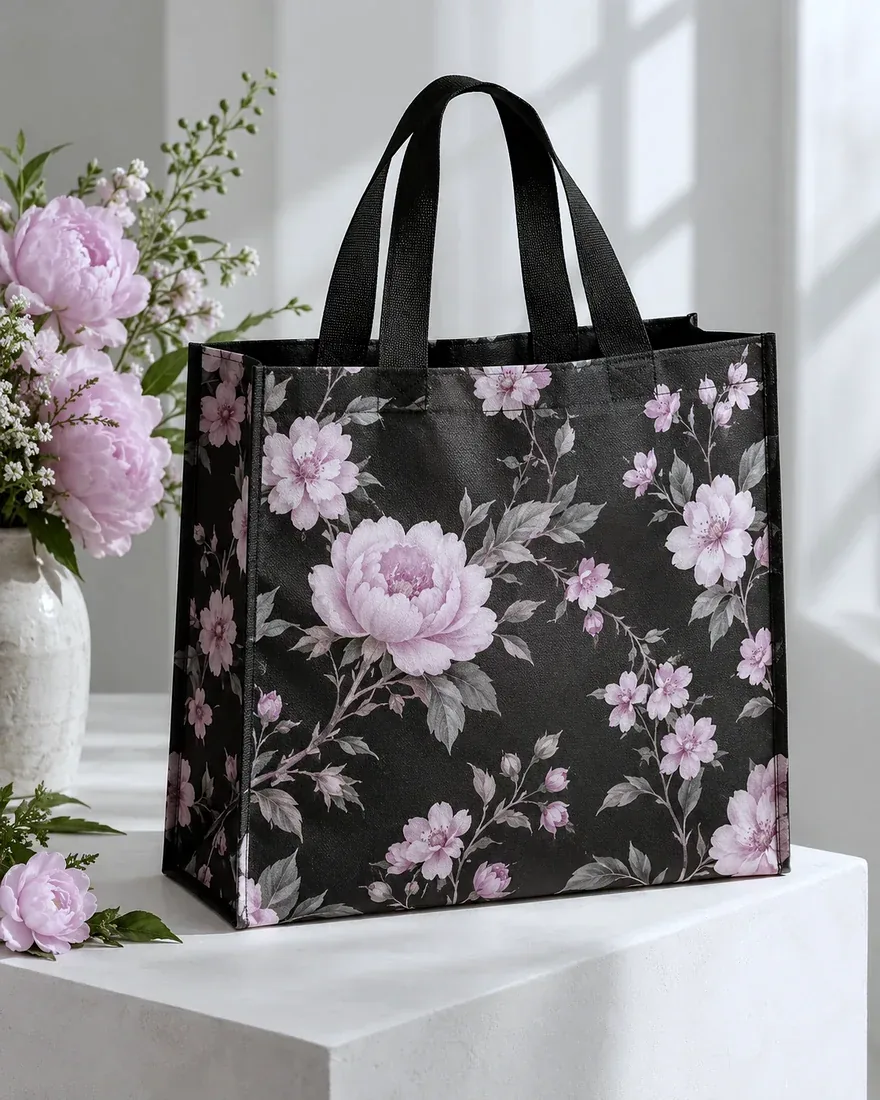
Three catalogue references for a measured-sample comparison
Dimensions below are catalogue body fields in width × height × depth order. Handle drop, flap extension and usable interior dimensions require separate records.
| Style | Variant | W × H × D | Closure and handle construction |
|---|---|---|---|
| Gusseted Non-Woven Shopper | STD | 40 × 35 × 15 cm | Open top, side and base gussets, separate loop handles |
| Non-Woven Takeaway Bag | M | 23 × 25 × 14 cm | Open top, separate loop handles and a gusseted base |
| Self-Seal Foil-Lined Bag | M | 24 × 24 × 15 cm | Adhesive flap with separate loop handles; final strip position checked with your pack |
Sample-measurement worksheet
Copy these rows into your inquiry sheet. Add columns for observed value, unit, requested change, offered value and photograph or drawing reference.
| Record | Endpoints or identity | Supporting view |
|---|---|---|
| Sample identity | Sample ID, date, front/side/base/opening photographs | Same ID on every photograph and sheet |
| Body width | Two marked endpoints across the front face | Front face laid flat without stretching |
| Body height | Named bottom reference to top-body edge | Handles and flap extension recorded separately |
| Opened depth | Front-to-back distance at a named base location | Opened side/base view with ruler |
| Folded gusset | Exact folded section being measured | Separate from the opened-depth reading |
| Handles | Strap width, complete length endpoints and drop endpoints | Attachment detail and stated measurement setup |
| Closure | Flap fold, extension, strip location and closed opening | Open and closed photographs of the same sample |
| Requested and offered reference | Style, variant, requested changes and offered drawing revision | Keep observation, request and response in separate columns |
How do I measure an existing non-woven bag for a size-chart comparison?
Give the sample an identifier, empty it and photograph the front, side, base and opening. Put a ruler in the same plane as the dimension being photographed. Record the unit beside each reading. Use separate fields for body width, body height, opened depth, handle measurements and closure details. A single photograph with a tape laid diagonally across the bag leaves the measurement endpoints unclear.
Use the sample record to compare catalogue references, then ask for a drawing of the proposed bag. For small non-woven orders, begin with available stock options. An existing sample's measurements describe that object; they do not establish that an identical stock size, colour or construction is available. Keep the observed sample and the offered stock reference in separate columns.
Where should width and body-height measurements start and end?
Identify the front face and mark the two width endpoints on its photograph. Lay that face flat without pulling the fabric taut, then record the distance between those marks. Measure the body height from the chosen bottom-body reference to the top-body edge and label both points. Keep loop handles outside this body-height measurement. If a seam, folded edge or curved base makes an endpoint ambiguous, show it in a close-up and state which edge you used.
The JINYU plain gusset shopper STD reference is listed as 40 × 35 × 15 cm in width × height × depth order. That chart entry records a 35 cm body height. It supplies no handle-drop measurement. Request handle dimensions separately rather than adding an assumed handle length to the catalogue height.
How do I record gusset depth without counting a folded panel twice?
Open the sample base into its intended shape and photograph the side and base. Mark front-to-back depth across the opened body at a named location. Record any folded-gusset reading separately, with a photograph showing whether it covers one folded section or the complete opened panel. Ask the respondent to use the same endpoints on its drawing. Different folded constructions can make a flat side view difficult to interpret.
JINYU takeaway shopper M is listed as 23 × 25 × 14 cm. Here 14 cm is the catalogue depth field; it is not a seam allowance or an instruction to double a measurement. Use that reference when requesting the stock drawing. Retain your observed opened-base measurement beside the supplier's dimension so the comparison shows any difference in measurement method.
What changes when the sample has a flap or adhesive closure?
Record the open body and closure as different features. Photograph the flap open, identify its fold line and adhesive strip, and photograph the same sample closed. Mark where the body-height reading ends. Add separate fields for flap extension, strip location and the opening available with the closure in use. These observations let the respondent explain its own drawing without treating every vertical measurement as one interchangeable height.
The self-seal foil-lined M reference is 24 × 24 × 15 cm and has an adhesive flap with separate loop handles. Its catalogue dimensions do not specify a usable closed height, flap extension or adhesive overlap. Request those measurements for the proposed stock reference. The foil-lined construction also needs its own sample record; an exterior dimension does not describe the space taken by folds and lining.
How should I measure handles alongside the bag body?
Identify each handle and its attachment points on a front photograph. Record strap width and the measurement endpoints for the complete handle. For a drop measurement, show a perpendicular distance from a named top-body reference to the inside of the raised handle. State whether the bag is empty and the handle simply raised or measured under a described load. Keep that setup with the result so another person can repeat the observation.
A handle's complete strap length and its drop measure different geometries. Neither can be recovered from a width × height × depth chart. For the STD shopper example, retain 40 × 35 × 15 cm as the body reference and request the offered handle drawing separately. Include an attachment close-up if matching the existing carrying arrangement is part of the inquiry.
How do I compare the sample record with three real catalogue references?
Use the table below as a short reference set, with every dimension labelled in centimetres. Plain gusset shopper STD is 40 × 35 × 15 cm; takeaway shopper M is 23 × 25 × 14 cm; self-seal foil-lined M is 24 × 24 × 15 cm. These are three different styles. The shared M label on the latter two does not identify an equivalent body or closure.
For an illustrative observed sample of 24 × 25 × 15 cm, the self-seal M differs by 0 cm in width, -1 cm in height and 0 cm in depth. Takeaway M differs by -1, 0 and -1 cm respectively. These signed differences mean catalogue minus observed sample. They compare exterior fields only. Keep construction, closure and handle differences alongside the arithmetic before selecting a reference for a response.
What belongs in a repeatable sample-measurement worksheet?
Use one row for each feature, naming its endpoints, observed value, unit and photograph. Add the sample identifier and the measurement date to every sheet. Preserve the original reading when a second person measures the sample; put the second result in its own column. If the readings differ, compare endpoints and sample position before replacing either result. The worksheet below lists eight records that can travel with an inquiry.
Keep measured values separate from requested changes. For example, record an observed 25 cm body height in the sample column and a requested 24 cm body height in another column. Ask the respondent to identify the offered stock body and explain its dimension convention. An observed difference is a question to resolve, rather than an agreed manufacturing tolerance or a statement that a finished bag will match the sample.
What should I send JINYU with the completed measurements?
Send the identified sample photographs, worksheet and intended use to Shaanxi Jinyu Kitchenware Co., Ltd. (陕西金宇厨具有限公司). Include the chosen catalogue style and variant code, requested quantity by colour, closure description and any artwork requirement. Mark which sample features you want to retain and which may change. For small non-woven quantities, ask which stock references are available against that request.
Ask the response to include a dimension drawing with the same endpoints, a material description, handle details and closure measurements. Keep the offered reference and response revision beside your observed sample record. Follow the size-chart links for other body formats and use the inquiry page to send the comparison. Retain the returned drawing with the sample photographs so later discussions use the same reference object.
Reference sources
- Check inch rounding against source millimetres
- Compare non-woven bag dimensions and formats
- Separate finished-body sizes from cut panels
- Browse stock non-woven references
- Send a sample measurement inquiry
Regional references support general planning; model-specific specifications come from the published JINYU model tables.