Buyer planning guide
Travel Bag Shoulder Strap: Connector and Ring Compatibility
Compare travel bag strap connectors with bag rings using labelled A/B pairings, component drawings, sample evidence and a substitution worksheet.
Connector and bag ring inquiry worksheet
| Part | Identity and views | Measurement or observation |
|---|---|---|
| Connector A / B | Component reference; drawing revision; open and closed views | Opening and closed interior, with labelled endpoints and units |
| Bag ring A / B | Component reference; section shape; attachment view | Section at the contact point and relevant inside dimensions |
| Bag attachment | Bag drawing revision; location; construction view | Relationship to a fixed seam or drawing reference |
| Complete pairing | Connector reference + ring reference + sample identifier | Attach, close and requested movement observations |
Worked substitution record: same connector, different ring
Illustrative document references only. C1, R1, R2, S1 and P2 do not identify JINYU catalogue components or available configurations. The table demonstrates why the earlier C1/R1 record leaves a C1/R2 pairing unresolved.
| Record | Strap end | Connector | Ring | Evidence reference or requested response |
|---|---|---|---|---|
| Sample S1 | A | C1 | R1 | Pairing photographs A-01 to A-03 |
| Sample S1 | B | C1 | R1 | Pairing photographs B-01 to B-03 |
| Proposal P2 | A / B | C1 | R2 | Request revised ring drawing and C1/R2 sample record |
Carry each changed part into the response
| Change | Drawing information | Response record |
|---|---|---|
| Ring R1 → R2 | Ring drawing and contact section | Connector C1 attached to R2; both strap ends identified |
| Connector C1 → C2 | Opening, closed interior and bearing endpoints | C2 paired with the proposed ring; complete strap length record |
| Sewn attachment revision | Bag location and attachment construction | Revised bag sample; pairing and requested performance evidence references |
Use the inquiry page to identify your complete custom travel bag project and the component pairing question. Keep the drawing and sample references in that project brief.
How do I check whether a travel bag shoulder strap matches the bag attachments?
Treat the strap connector and the bag attachment as a pair. Label the two strap ends A and B, then give the corresponding bag rings the same labels. Request drawings or close photographs of both parts, including the connector open and closed around the proposed ring. Keep the complete travel bag drawing beside those component records. A photograph of a detachable strap by itself leaves the mating attachment unidentified.
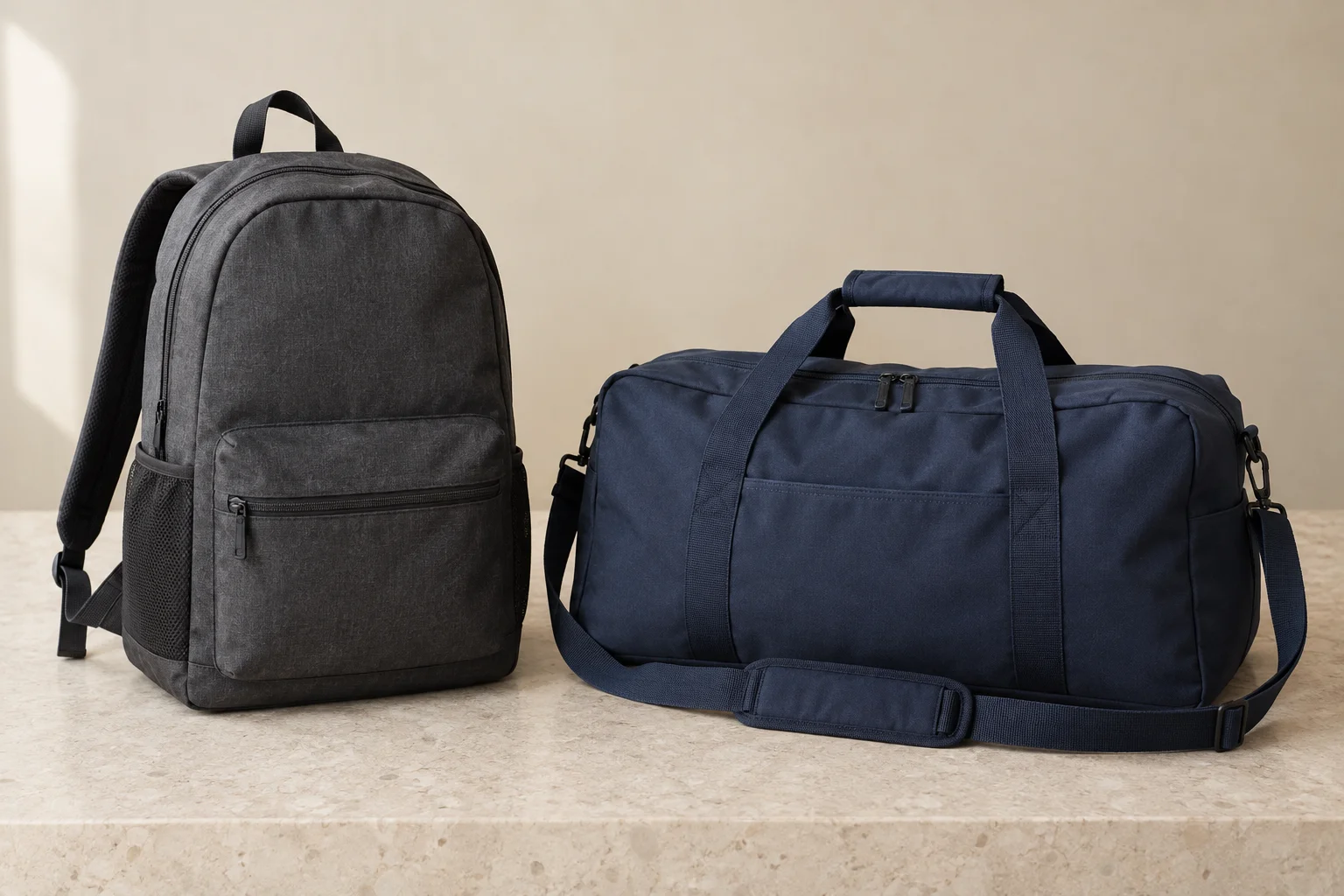
For a custom travel bag inquiry, ask the response to identify the offered connector, ring and attachment construction separately. Then connect them through a pairing record such as A: connector C1 with ring R1. Repeat that record for end B. JINYU's custom backpacks and travel bags are project-based products; the reference photograph on this page does not establish connector dimensions or a particular interchangeable component.
Which connector and ring measurements belong in the inquiry?
Show the connector opening, the space inside the closed connector and the part of the bag ring that passes through the opening. Identify the ring section shape as well as its measured thickness at that contact point. Mark each measurement on a drawing rather than placing an unexplained dimension beside a hardware photograph. Include the measurement unit, component reference and document revision with each reading.
Keep the ring's attachment to the bag visible in a second view. A close-up can show where fabric, webbing or stitching sits relative to the connector during attachment. Ask the respondent to describe the complete pairing, including any contact with the gate or adjustment fitting. Matching one opening measurement only answers one geometric question; the closed position and surrounding construction still need their own review.
Can matching nominal sizes prove that two fittings are compatible?
Compare the measurement labels before comparing the numbers. One response might use a webbing width as its hardware size, while another identifies a ring's outside width. Those descriptions refer to different parts of the assembly. Retain both original descriptions in the comparison and ask each respondent for the same marked dimensions. A shared nominal size does not provide that missing drawing information.
The worked record below illustrates a different mismatch: connector C1 was reviewed with ring R1 on sample S1, but a later proposal lists ring R2. Keep the earlier pairing record intact. Ask for R2's drawing and a record showing C1 attached to R2 before treating the revised proposal as the assembly already examined. These identifiers are illustrative purchasing references, rather than catalogue fitting codes or statements about available JINYU hardware.
What should the sample record show at each strap end?
Give the complete sample an identifier and record the bag drawing, strap drawing, connector and ring revisions it represents. Photograph each end before attachment, during the opening movement and in the closed position. Include a view of the surrounding bag attachment. Record which end was examined in every image so an A-end observation is not silently reused for a different B-end construction.
Describe what was actually observed: whether the connector could be attached by the intended movement, whether the gate returned to its closed position, and where the connector rested against the ring. If the project requests rotation, record that movement separately. Keep the setup and any contents used with those observations. These records describe the sample handling exercise; a quantified carrying or durability claim needs evidence identifying the assembly and test method.
How do I handle a connector, ring or attachment substitution?
Ask the revised proposal to list the changed component and the drawing revision affected. Preserve the original component reference in a previous-value column. If only the ring changes, retain the connector reference but create a new pairing entry. If the bag attachment location or its construction changes, update the bag drawing as well. A colour match does not explain whether the underlying component or attachment has changed.
Use the change table below to request the evidence associated with each revision. A ring change calls for its dimensions and a review of the revised pairing. A connector change calls for its opening and closed-position records. A change to the sewn attachment calls for the relevant construction drawing and sample reference. Keep the project response tied to the actual proposed combination instead of assembling an approval record from unrelated component photographs.
How are connector compatibility, strap length and carrying requirements kept together?
Use separate rows for pairing, adjustment length and performance evidence, with the same assembly revision across all three. Measure the complete strap using the endpoints agreed on its drawing. When a connector changes, check whether those endpoints or their distance have changed. A webbing-only length can remain identical while a different end fitting changes the complete assembly measurement.
State the intended contents and carrying arrangement in the project brief. If a performance requirement is part of the request, ask what evidence covers the proposed connector, ring, sewn attachment and complete bag. Identify the sample and method represented by the reply. The compatibility record documents the selected mating parts and observed movement; it does not turn a component description or a closed-gate photograph into a carrying-capacity rating.
What should I send JINYU for a shoulder-strap connector review?
Send the complete bag reference, labelled A/B attachment views, strap drawing and the component pairing table. Include the project quantity by bag version, colour references and destination with the original inquiry. Where there is a substitution, name both the earlier and proposed component references. Ask the response to identify its included parts and to repeat the drawing revisions used for the proposal.
Address the project to JINYU, Shaanxi Jinyu Kitchenware Co., Ltd. (陕西金宇厨具有限公司). Identify whether you are discussing a complete custom travel bag with a detachable strap or a separate component request, so the returned scope is explicit. Retain the accepted proposal, component drawings and sample record together. That gives the people reviewing the bag body, strap adjustment and packing description one consistent assembly reference.
Reference sources
- Write the complete shoulder strap specification
- Measure complete strap length and endpoints
- Review a complete bag and strap sample
- Explore custom backpacks and travel bags
Regional references support general planning; model-specific specifications come from the published JINYU model tables.