Which display fridge dimensions matter at a doorway?
Start with all three exterior dimensions and the direction of travel. The six JINYU models in the table cover countertop cake displays, a freestanding cake cabinet and upright beverage coolers. Their widths range from 620 to 1220 mm, depths from 530 to 730 mm and heights from 730 to 2048 mm. A model's frontage on the sales floor can face across the doorway or along the direction of travel, changing which horizontal dimension you compare with the opening.
Keep the receiving survey separate from the installation drawing. These are recorded cabinet dimensions, while the shipment may include a pallet, crate or protective packaging. Ask for the offered shipment's packed dimensions and handling instructions before agreeing a receiving route. Use the cabinet table to identify questions for that survey, then assess the actual shipment envelope with the receiving team.
Why can a wider display have a smaller horizontal transport outline?
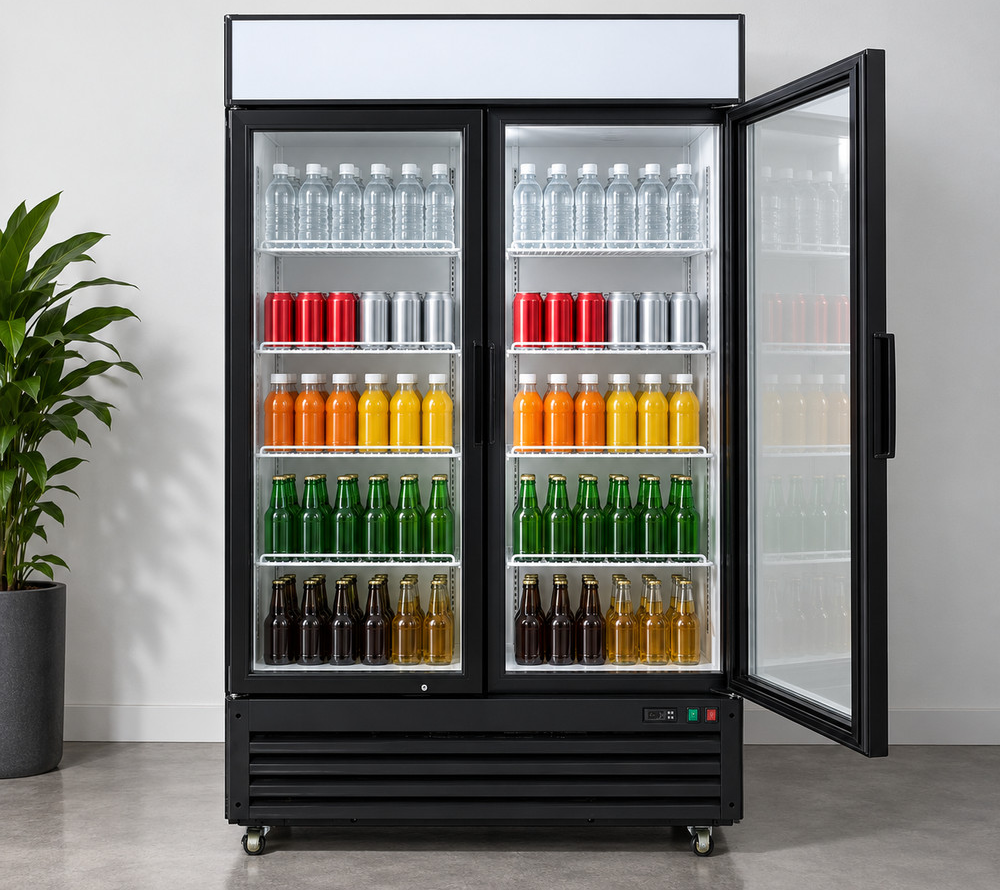
GN-620FS is 620 mm wide and 700 mm deep. GN-868FM is 1220 mm wide but 690 mm deep. When comparing the smaller horizontal dimension of each upright cabinet, the figures are 620 and 690 mm respectively, a 70 mm difference. Comparing front widths alone would show a 600 mm difference and would miss the possible change in travel orientation.
For GN-868FM, presenting the 690 mm depth across an opening puts the 1220 mm width along the direction of travel. The approach and exit spaces must accommodate that length. This arithmetic describes a rectangle in plan; it does not establish a permitted handling orientation or that a cabinet can turn in a corridor. Mark both travel direction and cabinet front on every route sketch, then request handling information for the chosen model.
What do 700, 800 and 900 mm doorway examples show?
The worked table subtracts each cabinet's smaller horizontal dimension from three illustrative clear opening widths. For example, GN-1000R2-J has a 660 mm depth, giving gross differences of 40, 140 and 240 mm. GN-1200RF2 has a 730 mm depth, giving -30, 70 and 170 mm. A negative result means that particular rectangular orientation is wider than the example opening, even before packaging or handling equipment enters the calculation.
A positive result is a gross difference across the entire opening, not clearance on each side. It does not include packing, door hardware, protection or the handling arrangement. Measure between the actual limiting surfaces with the door in its receiving position. Put those measurements next to the shipment drawing; the nominal door size on an architectural schedule can describe a different opening.
How does height change the shortlist for an upright cooler?
The GN-620FS height is 2018 mm and GN-868FM is 2048 mm. Against an illustrative 2100 mm clear opening height, their bare-cabinet vertical differences are 82 and 52 mm. Against 2000 mm, the differences are -18 and -48 mm. Record the lowest point along the entire route, including door closers, soffits and lift entrances, rather than checking only the shop entrance.
A pallet or handling device changes the transported height. Request the packed height and the proposed handling arrangement before applying the opening measurement. Do not infer that tilting, removing a light box or taking off doors is permitted from the exterior dimensions. Attach the height restriction to the model inquiry so the response addresses the actual receiving condition and the configuration being offered.
What changes when the route includes a right-angle turn?
A straight opening check uses one cross-route dimension. A turn requires the complete horizontal outline and space on both sides of the corner. GN-900CT measures 900 × 530 mm in plan; GN-1200RF2 measures 1200 × 730 mm. Although either can be drawn with its depth across a straight passage, the longer dimension still sweeps through the approach and exit when direction changes.
Draw the two corridor widths, corner position, door leaf and any fixed counter or radiator. Add a scale rectangle for the packed shipment once those dimensions arrive. Photograph each approach from both directions and number the photographs to match the plan. Include thresholds, ramps and level changes as separate observations. A doorway-width subtraction cannot answer whether a loaded handling device can negotiate the corner.
Can a countertop display use the same delivery plan as an upright cooler?
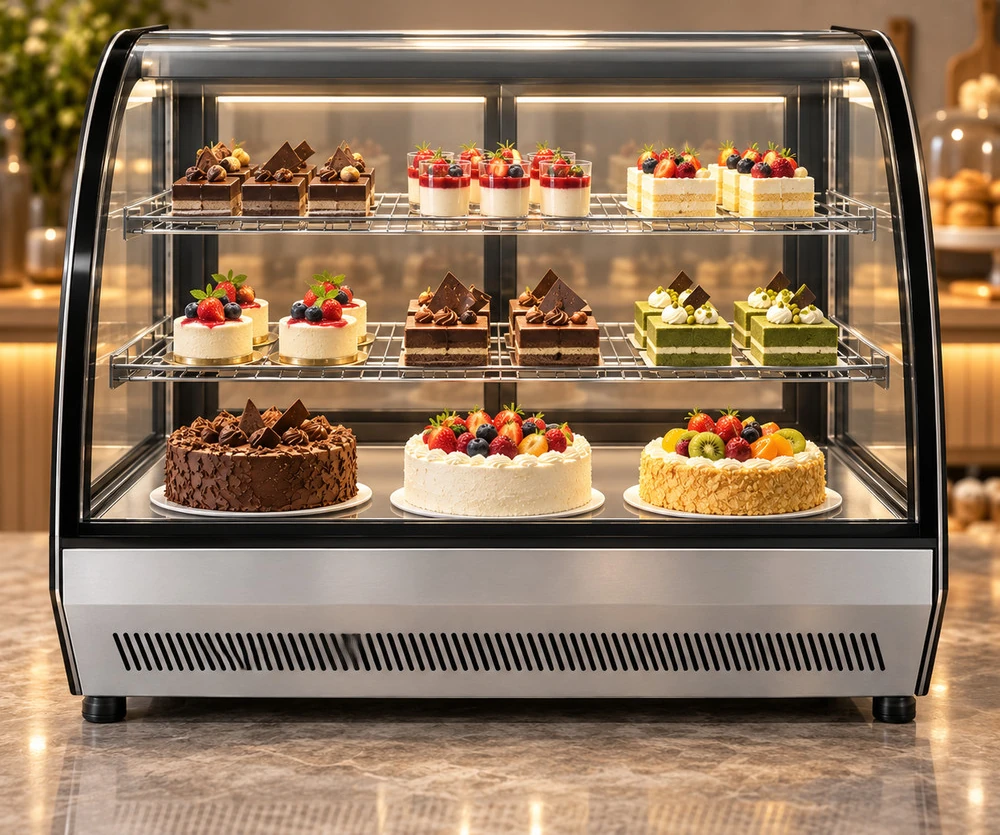
GN-660RT measures 660 × 530 × 730 mm and GN-900CT measures 900 × 530 × 730 mm. They share the same depth and height, but differ by 240 mm in length. The smaller horizontal dimension is 530 mm for both. That shared figure explains why a straight-opening comparison can look identical even though their outlines differ at a turn or on a receiving platform.
Their final location also requires a supporting counter. Keep the receiving route, lifting arrangement and support review together, using the selected model's weight and base drawing when supplied. The 730 mm cabinet height becomes an elevation above the worktop after installation. Draw overhead furniture on the final counter elevation, while keeping packed transport height on the receiving sheet. Those two drawings answer different dimensional questions.
What should I send with a display-fridge access inquiry?
Send the full model codes, destination and a numbered route plan from unloading point to final position. Record clear width and height at each opening, approach and exit dimensions at turns, lift entrance and internal dimensions, and visible thresholds or steps. Attach labelled photographs with the measuring points visible. Keep the final floor or counter layout on a separate sheet so the installation position is clear.
Ask Shaanxi Jinyu Kitchenware Co., Ltd. (陕西金宇厨具有限公司) for packed dimensions, package weights, handling instructions and the selected model's installation drawing. Have the receiving team compare that information with the measured route and proposed handling equipment. Retain the model code and drawing revision on the access sheet. If the shortlist changes, repeat the comparison using the replacement model's shipment details rather than transferring an earlier route assessment.