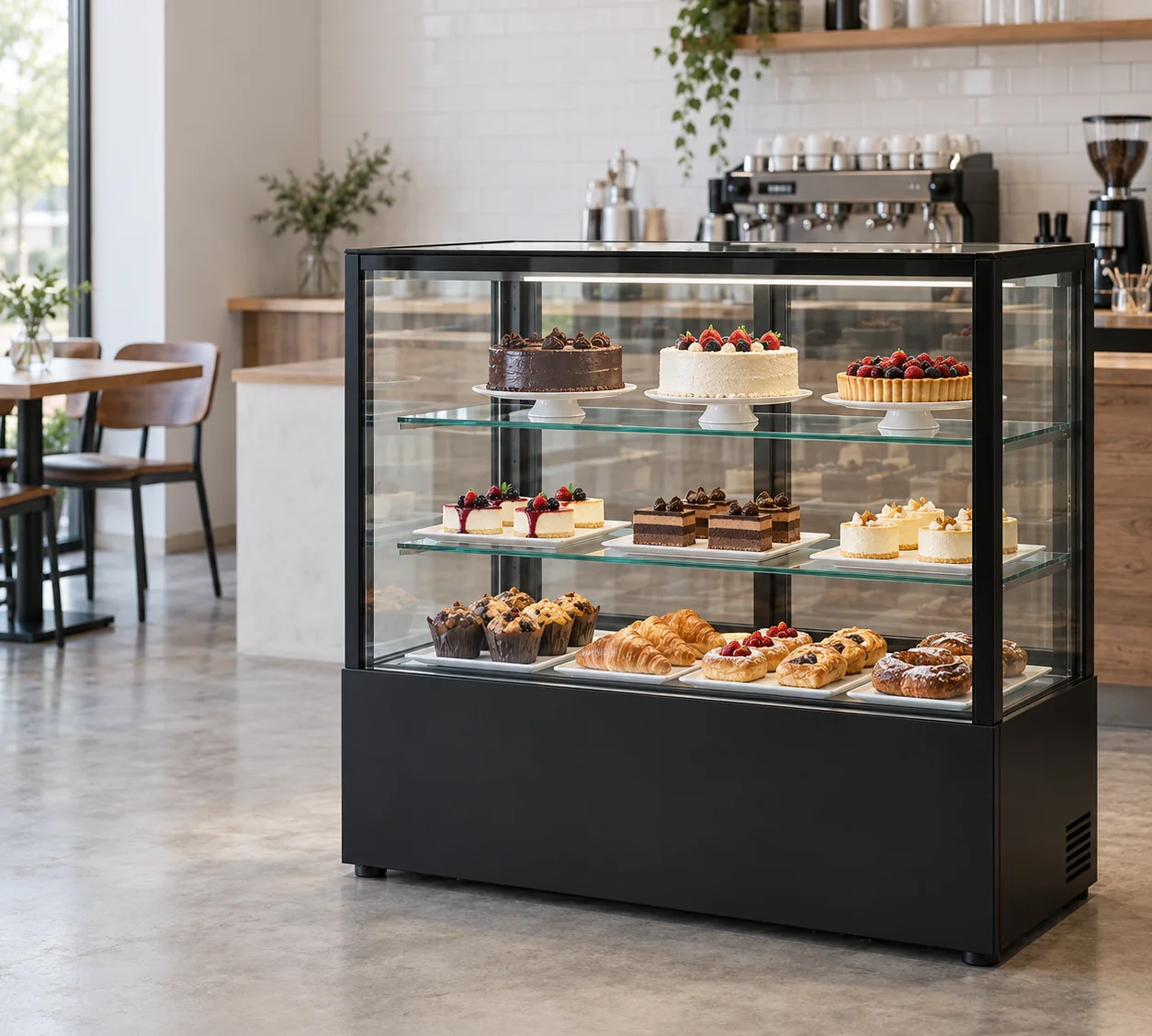
What is the size difference between R2-J and standard R2?
Start with the matched 1200 mm cabinets. GN-1200R2-J measures 1200 × 660 × 1200 mm and lists 170 L capacity. GN-1200R2 measures 1200 × 730 × 1200 mm and lists 459 L. Standard R2 adds 70 mm of exterior depth while retaining the same width and overall height. Both are freestanding straight-glass cake displays with two shelves and rear service access. Keep the complete code on the drawing: the suffix identifies a different cabinet record.
The comparison covers all four published R2-J widths and the one published standard R2 model. It separates the width choice within R2-J from the depth choice at 1200 mm. Choose a floor rectangle first, then request usable shelf dimensions and loading openings for the cakes or packaged desserts assigned to it. The exterior difference cannot establish which specific tray fits.
Which widths are available in the R2-J comparison?
The recorded R2-J models are 1000, 1200, 1500 and 1800 mm wide. All four are 660 mm deep and 1200 mm high. Capacities progress through 160, 170, 200 and 255 L. A move from GN-1000R2-J to GN-1200R2-J uses another 200 mm of frontage and adds 10 L of listed capacity. The next 300 mm step adds 30 L; the final 300 mm step adds 55 L.
Those changes are model-specific rather than a fixed capacity gain per millimetre. Put the required cake boards, trays and retail packs into a numbered assortment list before selecting the width. Request shelf dimensions against that list. Two adjustable shelves are recorded for each R2-J model, but the published outside dimensions do not provide their usable dimensions, adjustment positions or clear openings. Keep the supplied shelf drawing with the selected width.
How much floor area changes at the same 1200 mm frontage?
Multiplying exterior width by depth gives a cabinet body footprint of 0.792 m2 for GN-1200R2-J and 0.876 m2 for GN-1200R2. The calculated difference is 0.084 m2. In an illustrative 1400 × 900 mm floor bay, either cabinet leaves 200 mm of gross width. The 660 mm-deep cabinet leaves 240 mm of gross bay depth; the 730 mm-deep cabinet leaves 170 mm. These are geometric balances before installation and access requirements.
Mark the customer-facing line and the service-facing line separately. If both fronts align, the deeper R2 extends 70 mm farther toward the service side. If the service edges align, it projects 70 mm farther toward customers. Choose the alignment used on the actual plan before discussing that difference. A body rectangle alone does not allocate staff standing space, a tray landing surface or the required installation spacing.
Does the larger litre figure mean proportionally more cakes fit?
GN-1200R2 lists 459 L versus 170 L for GN-1200R2-J, a difference of 289 L. Both list two shelves. The records do not define an identical measurement of usable tray area, and litres do not provide a cake count. A cake on a wide board, a tall decorated cake and a boxed slice occupy different shapes even when sold from the same display.
Send the same pack list for both cabinets and ask for the usable width and depth of each shelf, the clear vertical openings and the service opening dimensions. Assign each proposed pack to a shelf reference. Compare the returned layout with the same pack orientation and spacing instructions. Retain the recorded capacity alongside those drawings, so purchasing colleagues can distinguish the catalogue figure from a layout demonstrated with their own assortment.
What changes in electrical and refrigeration specifications?
All five records list fan cooling, R290 refrigerant, a 2-8°C temperature range and 220-240V/50Hz electrical supply. R2-J rated powers are 455 W at 1000 mm, 455 W at 1200 mm, 465 W at 1500 mm and 625 W at 1800 mm. GN-1200R2 lists 465 W. At matched 1200 mm width, the rated-power difference is 10 W.
Record the complete model and offered electrical configuration beside the floor plan. Rated watts identify a power specification; they do not give measured daily electricity consumption. If operating energy is part of the comparison, request the model-specific energy result and its test conditions separately. Include the site supply with the inquiry, together with any connection information the installer needs. Keep the electrical document attached to the same cabinet code used for dimensions.
How should rear access and shelf details be compared?
R2-J records two sliding glass doors at the rear, while standard R2 records two sliding doors on the service side. Draw the staff approach behind either cabinet. Identify where a replacement tray rests before loading, where the operator stands and where the removed item goes next. Ask for the clear opening with each sliding door in its working position. The full cabinet width does not give the opening through one door.
The R2-J record describes two adjustable shelves; R2 describes two glass shelves. Preserve those descriptions rather than transferring an adjustment feature between models. Use one identified tray in a demonstration of loading, removal and return. Record its outside dimensions, including handles and lids, and keep neighbouring packs in place. Attach the observations to the model and shelf arrangement actually shown.
What should an R2-J versus R2 inquiry include?
Send a shortlist with complete model codes, quantities and the intended destination. Attach the measured floor bay, chosen front or rear alignment, nearby counter outlines and site electrical supply. Add the assortment list with board diameters, tray dimensions and finished pack heights. For the 1200 mm pair, identify whether the 70 mm depth difference affects the customer edge or staff side of your plan.
Request the installation drawing, usable shelf dimensions, service openings and supplied-item schedule for each candidate. Keep responses against the same floor-plan revision. If the proposal changes from GN-1200R2-J to GN-1200R2, revise depth, listed capacity and rated power together. JINYU, Shaanxi Jinyu Kitchenware Co., Ltd. (陕西金宇厨具有限公司), can then review two specific equipment configurations and the measured site requirements accompanying them.