Which RD3 and RK3 display fridge sizes can I compare?
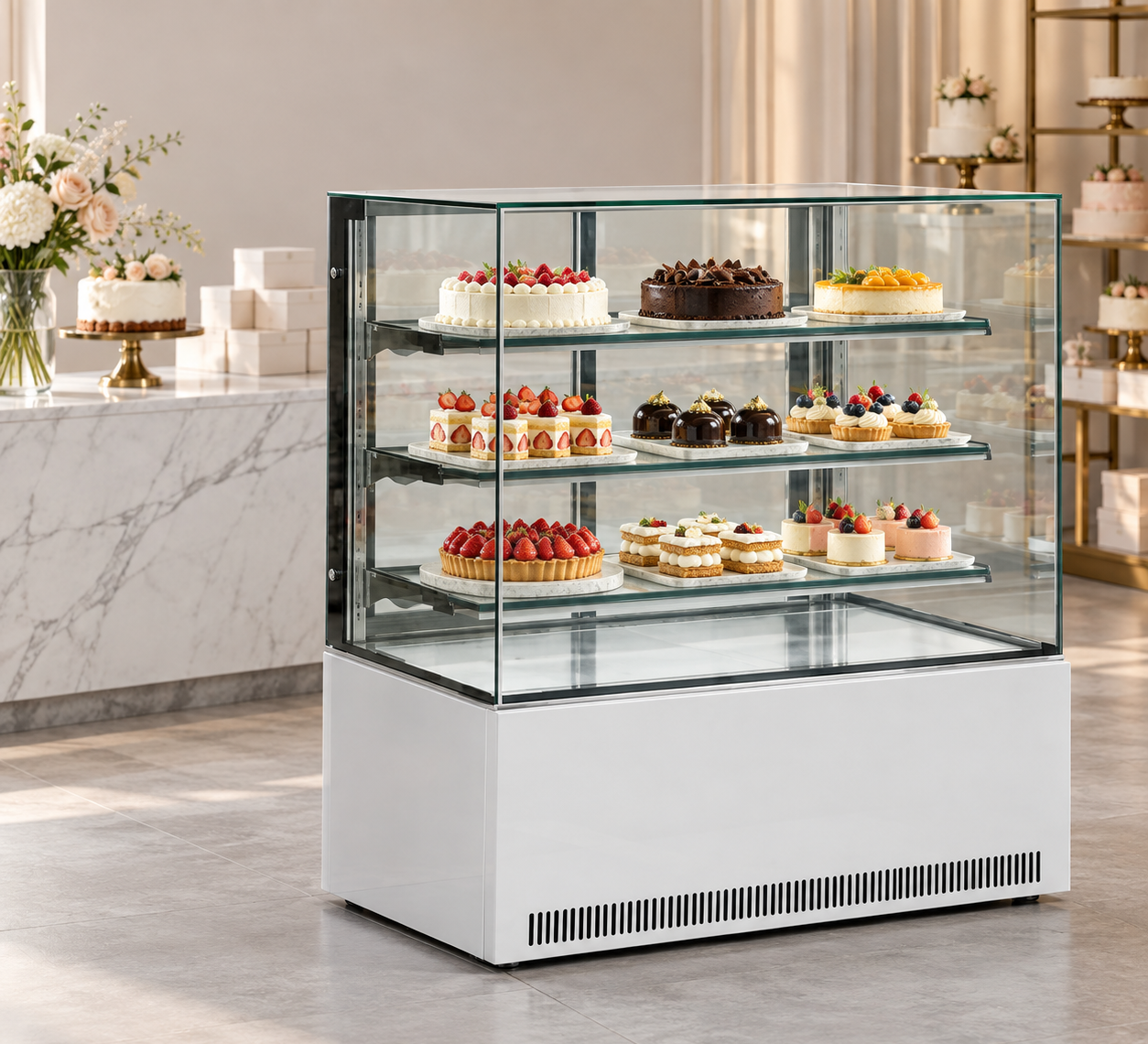
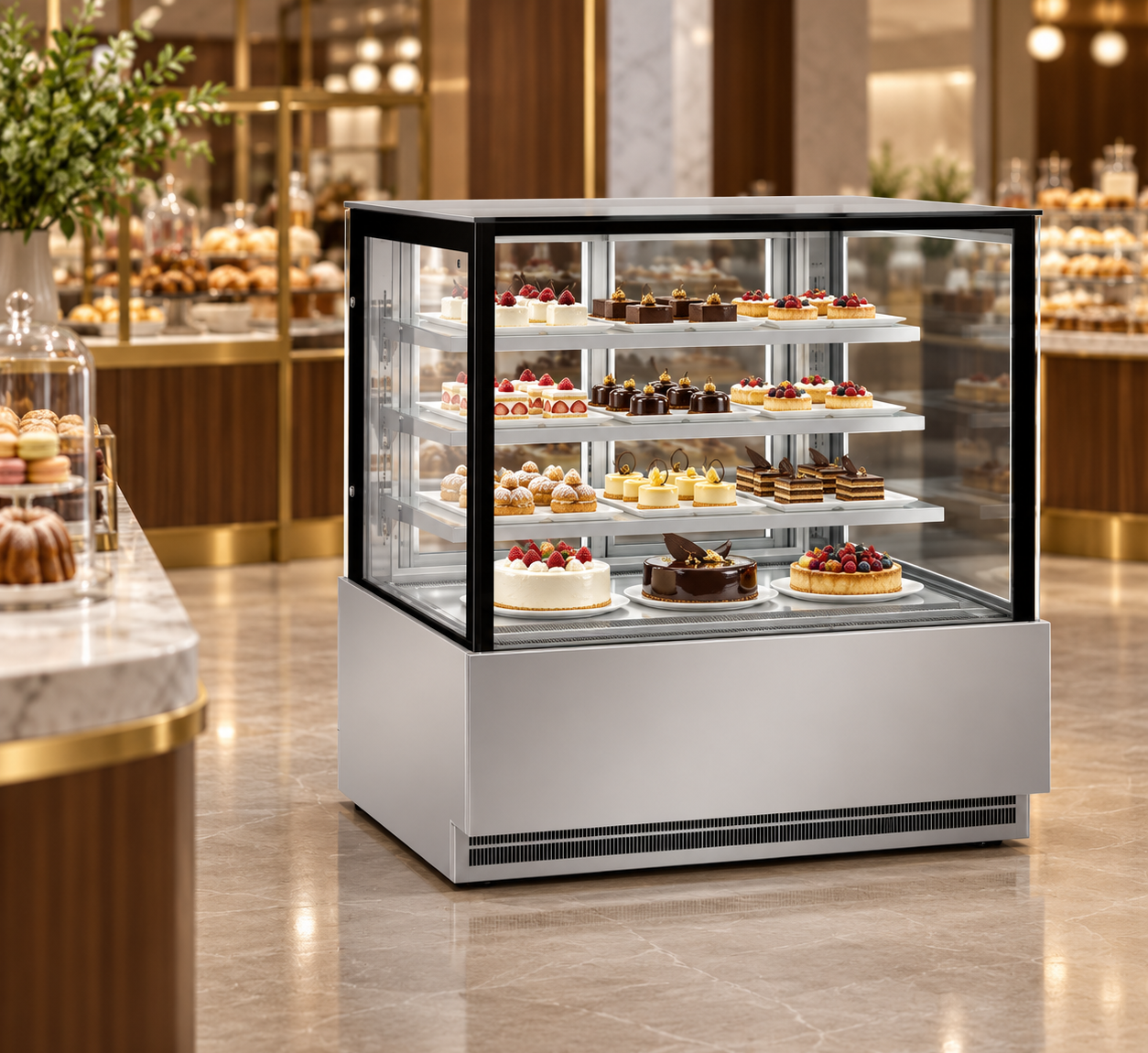
Start with the matched 1200 mm cabinets. JINYU GN-1200RD3 measures 1200 × 730 × 1300 mm and records 650 L capacity. GN-1200RK3 measures 1200 × 740 × 1300 mm and records 545 L. Both have three glass shelves and two sliding doors on the service side. Their equal width and height make them useful alternatives for the same display frontage, while the depth, glass description and capacity remain model-specific.
RK3 also offers GN-1000RK3 at 1000 × 740 × 1300 mm and GN-1800RK3 at 1800 × 740 × 1300 mm. Those models record 525 L and 735 L respectively. Use the four linked model records below to compare photographs and specifications. This table includes one RD3 width; the other widths shown belong to RK3.
What changes between the two 1200 mm cabinets?
GN-1200RD3 records flat glass at the front, sides and top. GN-1200RK3 records straight front and side glass. Look at the cabinet photographs from the customer position and from the service side, especially where the top meets adjacent displays. Keep the glass description alongside the full model code when requesting drawings; a description such as three-shelf straight-glass display does not identify either configuration completely.
The RD3 cabinet is 10 mm shallower and lists 105 L more capacity than the matched RK3. Its rated power is 450 W, compared with 515 W for GN-1200RK3, a difference of 65 W. These are recorded cabinet ratings and capacities. They do not establish a shelf-area advantage, a quantity of cakes or a daily electricity-use difference. Compare the proposed shelf layout before selecting the cabinet.
How much floor area do RD3 and RK3 occupy?
Multiply outside width by depth to compare the bare cabinet rectangles. GN-1200RD3 occupies 0.876 square metres, calculated from 1.200 × 0.730 m. GN-1200RK3 occupies 0.888 square metres, from 1.200 × 0.740 m. The difference is 0.012 square metres. Both rectangles are 1200 mm long, so switching between them changes the depth line rather than releasing additional frontage beside the display.
On a plan, draw the service-side doors facing the staff position and the customer-facing glass toward the viewing area. Add neighbouring equipment, the packing surface and the route used to carry trays. The calculated rectangles describe exterior cabinet footprints. Obtain the installation drawing for the chosen model to plan ventilation, maintenance access and the working space behind it. Do not use the 10 mm depth difference as a service-clearance allowance.
When should I compare the 1000 or 1800 mm RK3 instead?
Compare GN-1000RK3 when the equipment position needs 200 mm less frontage than the two 1200 mm options. It retains the 740 mm RK3 depth, 1300 mm height and three glass shelves, while recording 525 L capacity and 470 W rated power. The capacity difference from GN-1200RK3 is 20 L, despite the 200 mm reduction in outside width.
GN-1800RK3 uses 600 mm more frontage than GN-1200RK3 and lists 735 L capacity with 675 W rated power. Its footprint is 1.332 square metres. For a worked 2400 mm display run, the 1000, 1200 and 1800 mm cabinets leave gross lengths of 1400, 1200 and 600 mm respectively. Mark how that remainder will be shared between packing and adjacent equipment. These subtractions exclude installation gaps and do not describe a usable workstation by themselves.
Can three shelves and a litre figure tell me how many cakes fit?
Prepare an assortment drawing using the outside dimensions of each cake board, tray and stand. Include handles, lids and the finished height of decorations. Allocate the intended products across three shelf rows, then request usable shelf width, depth, vertical spacing and load information for the exact cabinet. Show any lower display area separately on the drawing rather than assuming every visible level has the same dimensions.
For example, keep the same assortment sheet when comparing the 650 L GN-1200RD3 with the 545 L GN-1200RK3. Ask for a placement drawing or a measured photograph of that arrangement. The 105 L difference cannot be converted into an additional number of cakes without those internal dimensions. Include the service-door opening in the review, because a tray must pass through the loading opening as well as occupy its assigned shelf position.
Which electrical and refrigeration specifications belong in the comparison?
All four records list fan cooling, R290 refrigerant, a 2-8 °C temperature range and 220-240V/50Hz supply. Keep the rated-power row attached to its model: GN-1200RD3 is 450 W, GN-1000RK3 is 470 W, GN-1200RK3 is 515 W and GN-1800RK3 is 675 W. A comparison sheet that records only the common supply would lose these model-specific differences.
Send the destination supply information with the selected model code and request connection details for that configuration. Compare the proposed food storage instructions with the recorded temperature range and the operating documentation. Rated watts are not a daily kWh measurement, and a common temperature specification does not establish the same performance under every room condition. Keep any operating evidence identified by model and configuration rather than transferring it between the two families.
What should I send to request an RD3 or RK3 comparison?
Send a floor plan with available width, depth and height, plus a photograph taken from each side of the proposed position. Mark which face customers see and where staff retrieve products. Include your measured trays, cake boards and tallest finished products, with a proposed allocation to the three shelves. Identify the packing surface and the route between preparation, display and collection.
Name the alternatives explicitly: GN-1200RD3 and GN-1200RK3 for a matched-width comparison, or GN-1000RK3 and GN-1800RK3 when frontage is the deciding variable. Request the corresponding installation drawing, usable shelf measurements, loading-opening dimensions and electrical connection details. Keep the responses beside the same model rows used here. That record lets the buyer compare a cabinet envelope, a real assortment and the service arrangement together before choosing a configuration.