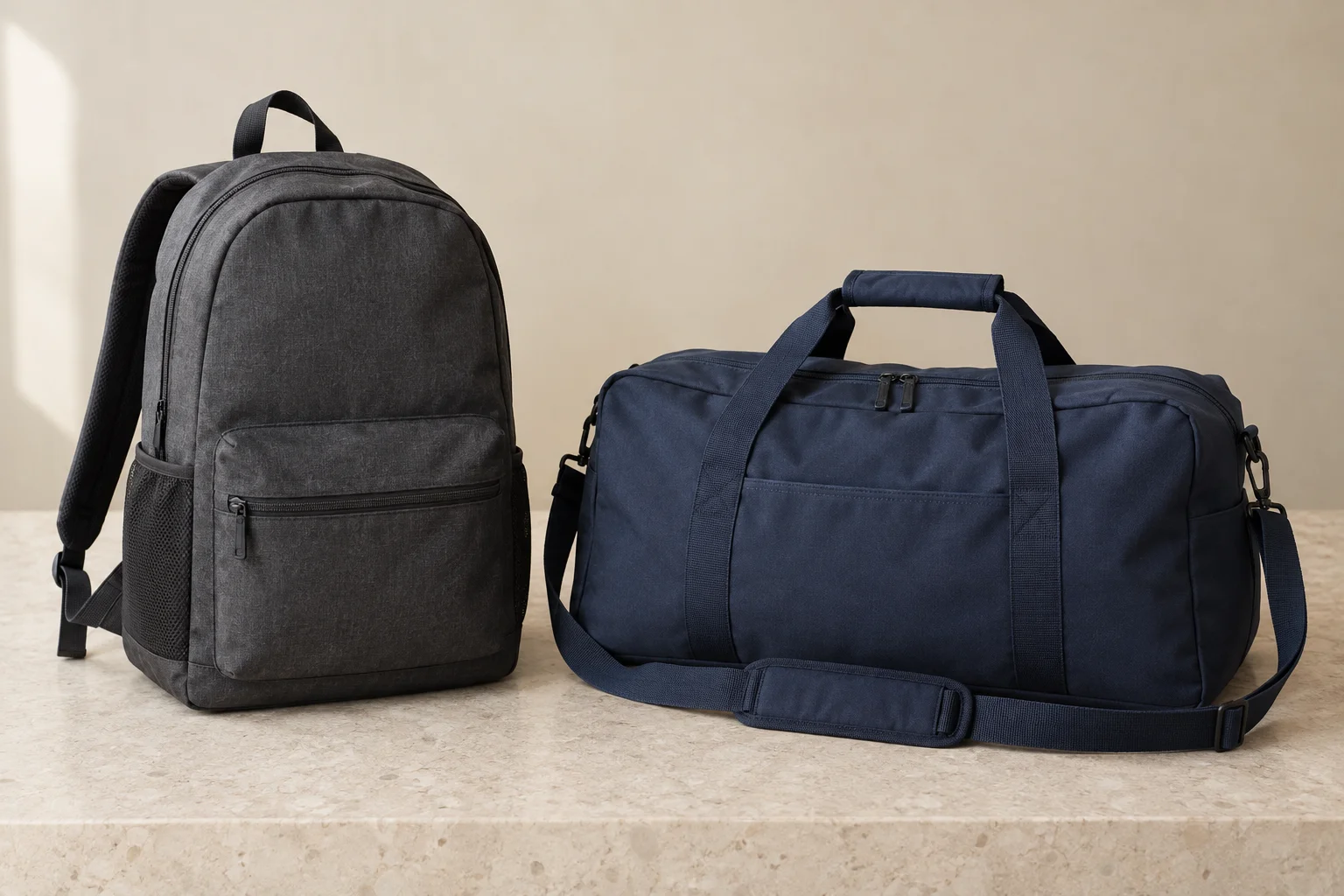
How do I specify pocket placement in a custom bag inquiry?
Give every pocket an identifier and name the bag face on which it sits. Specify the finished pocket width and height, then locate it from two named finished body edges. State whether the drawing shows the outside face or an inside view. Include the bag body dimensions on the same sheet so the recipient can relate the pocket to the complete design. A photograph can accompany this drawing, with the intended pocket marked.
The worked example below uses an illustrative flat body face 400 mm wide and 350 mm high. Pocket P1 is 180 mm wide and 160 mm high, positioned 110 mm from the left edge and 100 mm below the top edge. These are buyer drawing inputs, not JINYU product specifications. They describe a rectangle on one face; construction details and the offered finished measurements belong in the response.
Which edges should the pocket dimensions refer to?
Identify finished edges rather than mixing a cut panel with a finished pocket. On the example drawing, x runs rightwards from the body's left finished edge and y runs downwards from its top finished edge. The pocket's upper-left corner is the reference point. Its right edge is x plus width; its lower edge is y plus height. Keep all four quantities in millimetres and write the viewing direction beside the reference.
For P1 in revision A, the right edge is 110 + 180 = 290 mm and the lower edge is 100 + 160 = 260 mm. The remaining distances to the right and bottom body edges are 110 mm and 90 mm. These calculations locate the rectangle on the flat drawing. They do not establish sewing allowances, seam strength, usable opening size or how a loaded bag will curve.
How do I describe the pocket opening and attachment?
State which edge opens and whether the pocket is intended to be open, zipped or covered by a flap. Identify the attached edges on the drawing. If the opening has a separate closure, give that component its own reference and connect it to the pocket identifier. A rectangle alone leaves these choices unspecified. Keep the proposed attachment description alongside the finished outline instead of relying on a reference photo to explain it.
Separate overall pocket width from the clear opening that a hand or object must pass through. List the intended contents with measured outside dimensions and show their insertion orientation. Ask for the offered opening measurement and a sample view with those contents. Any lining, divider or projecting closure needs its own description because it can affect the usable interior without changing the outline rectangle on the front view.
What changes when I move a pocket on the revised drawing?
Keep the pocket identifier when its purpose remains the same, and replace its position under a new drawing revision. In revision B below, P1 keeps its 180 by 160 mm outline but moves to x = 90 mm and y = 120 mm. It therefore moves 20 mm left and 20 mm down. Its right-edge distance becomes 130 mm and its bottom-edge distance becomes 70 mm on the same illustrative body.
The second pocket, P2, remains unchanged between revisions. Show that fact in the revision record so a response about P2 is not mistaken for acceptance of the moved P1. Ask the proposal and sample references to name revision B. If an earlier sample follows revision A, retain that identity and record the positional difference before using its photographs to review the later design.
How do I keep pockets separate from artwork and handle attachment?
Use distinct references for the pocket outline, artwork area and handle attachment positions. Identify whether decoration is on the pocket face or on the body behind it. Give the artwork its own size, orientation and file revision. Show the handle attachment areas on the same face drawing when their positions relate to the pocket. This lets the response address each feature without interpreting the whole bag photograph as a construction specification.
If the pocket moves, review the artwork placement against the new outline and inspect the relationship to the handles. A change to the pocket coordinates does not automatically move an artwork file or a handle attachment. Ask the respondent to identify any proposed change in the returned drawing. Keep artwork proof comments separate from the sample's opening and attachment observations, even when both records refer to P1.
What should I measure on a pocket sample?
Record the sample identifier, bag face, pocket identifier and drawing revision first. Photograph the empty bag with the measurement endpoints visible. Measure the finished pocket width and height, its left and top offsets, and the clear opening using the method written on the sheet. Record observed values beside the requested values. Keep any agreed tolerances in their own field rather than treating the example coordinates as a general manufacturing tolerance.
Then record the intended contents and observe insertion, removal and closure on that same sample. Note where an item catches or projects, supported by a close photograph. Retain the empty measurements and the loaded observations as separate entries. A flat outline can match the requested dimensions while the proposed contents still need a different opening or internal arrangement. Connect each comment to the pocket identifier in the response.
What should I send JINYU with the pocket drawing?
Send the bag-line identifier, finished body drawing, numbered pocket details, contents measurements and the current revision record. Include the material and closure requests that apply to each pocket. Attach marked reference photographs and any artwork files, identifying the face and pocket each file concerns. Ask the returned proposal to distinguish your requested dimensions from the offered construction and to identify the drawing revision it follows.
Address the inquiry to JINYU, Shaanxi Jinyu Kitchenware Co., Ltd. (陕西金宇厨具有限公司). This worksheet supports a custom bag design brief. For stock non-woven bags, ask about the available stock construction rather than treating this illustrative pocket design as a stock option. Keep the returned drawing and sample record with the complete bag specification so subsequent discussions use the same body, face and pocket references.