How do I compare grab-and-go counter capacity per metre?
Divide the model's listed capacity in litres by its cabinet width in metres. For GN-900L, 235 L divided by 0.900 m gives 261.1 L per metre, rounded to one decimal place. GN-1500L gives 365 divided by 1.500, or 243.3 L per metre. Keep both the original capacity and width beside the result so the calculation can be checked.
This ratio describes listed volume relative to frontage. It helps compare a shortlist when wall length is scarce, but it does not count sandwiches, bottles or trays. The table pairs every calculated ratio with the cabinet's complete outside dimensions and recorded shelf arrangement. Select the product format and access arrangement before using the ratio to narrow the choice.
Does the highest litres-per-metre figure mean the best display?
The highest ratio answers one numerical question: which recorded capacity is largest relative to cabinet width? It does not measure visible product facings, shelf area, customer reach or sales. GN-1200FRO lists 480 L at 1200 mm width, giving 400.0 L per metre. GN-1200L lists 295 L at the same width, giving 245.8 L per metre. Their depths and heights also differ.
Compare the FRO's 730 mm depth and 1300 mm height with the L model's 740 mm depth and 1400 mm height. Request usable shelf drawings for the selected cabinet and mark the actual packages on them. A larger listed volume cannot establish how many upright bottles fit beneath a shelf or how many wrapped lunches remain clearly visible from the aisle.
What changes when I compare models at the same width?
At 1000 mm width, GN-1000L records 245 L, GN-1000LG 230 L and GN-1000FRO 390 L. Because each body is exactly one metre wide, those capacities are also their litres-per-metre figures. The L and LG cabinets are 740 mm deep; the FRO is 730 mm deep. Their heights are 1400, 1350 and 1300 mm respectively.
Retain the complete model suffix when requesting an interior drawing. The LG record identifies curved glass side panels, while the FRO record identifies straight glass side panels and two glass shelves plus a base deck. These details belong to the respective cabinet records. A shared frontage does not turn the three formats into interchangeable interiors or establish equal loading arrangements.
How does increasing width change capacity within one series?
Moving from GN-900L to GN-1500L adds 600 mm of body width and 130 L of listed capacity. Width increases by about 66.7 percent, while capacity increases by about 55.3 percent. The capacity-per-metre figure therefore falls from 261.1 to 243.3. That arithmetic does not make the wider model a worse choice: it still offers a larger individual cabinet and more total listed volume.
The two FRO records show a different pattern. GN-1000FRO lists 390 L and GN-1200FRO 480 L. Adding 200 mm adds 90 L, and the ratio rises from 390.0 to 400.0 L per metre. Compare the actual records instead of assuming that every width increase follows the same proportional rule across different cabinet families.
Can I turn capacity per metre into a portion count?
Keep portion planning on a separate sheet. Record each pack's outside width, depth and height in its displayed orientation, including lids and labels. Ask for the selected cabinet's usable shelf dimensions and loading arrangement. Assign the pack to a specific shelf position, then count the positions shown in that layout. Repeat for different pack shapes rather than converting the total litres directly into portions.
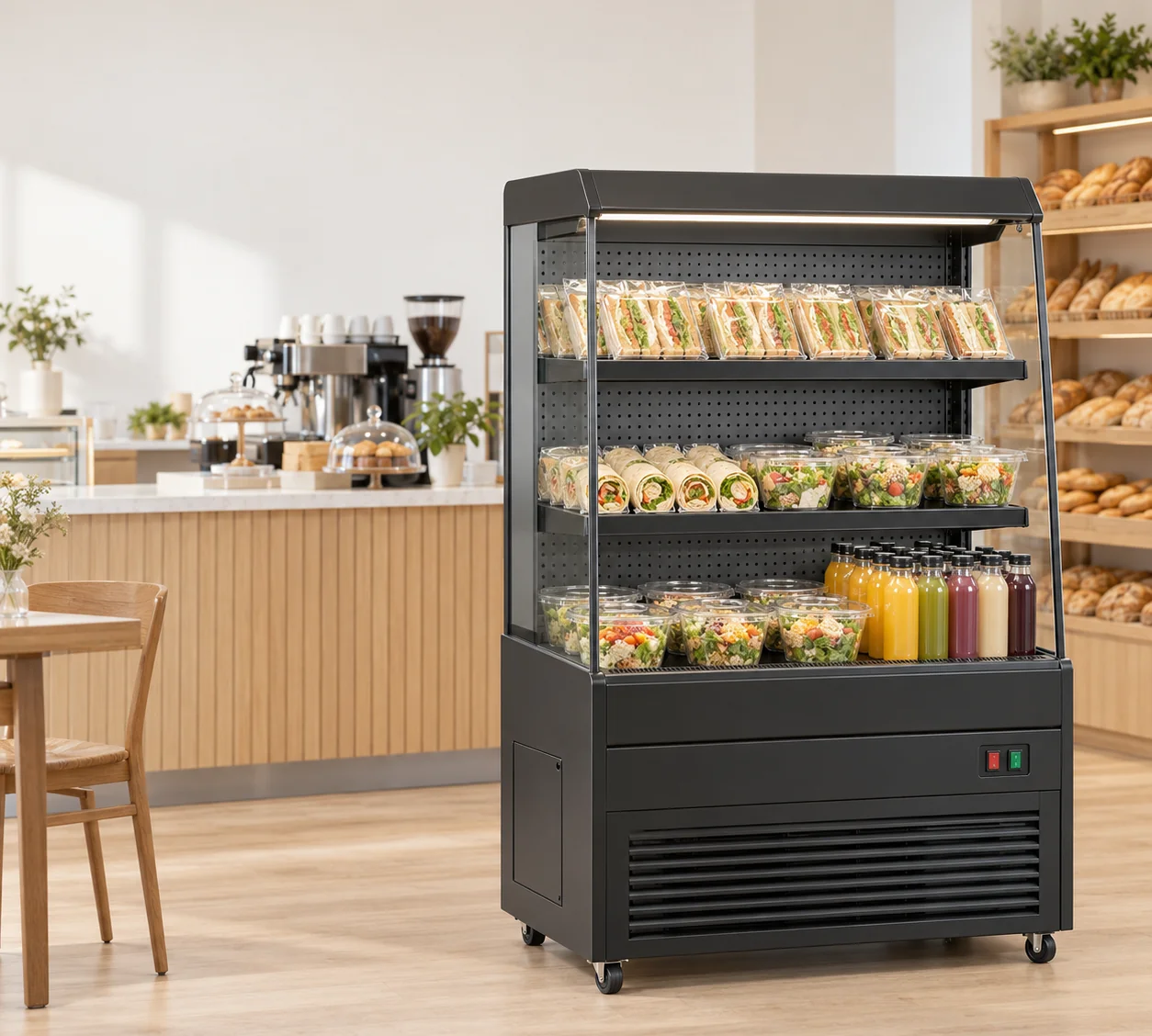
For an illustrative assortment of wrapped sandwiches and bottled drinks, draw two separate product groups and identify their intended display levels. Leave a field for the shelf drawing reference and a field for the proposed quantity. The result is a layout for review, not a capacity guarantee derived from cabinet volume. Use the linked replenishment guide to connect displayed quantities with refill planning.
What does a two-cabinet comparison show?
Two GN-900L bodies total 1800 mm of frontage and 470 L of listed capacity. Dividing 470 L by 1.800 m gives 261.1 L per metre, the same ratio as either unit. One GN-1500L totals 1500 mm and 365 L. The pair therefore adds 300 mm of cabinet frontage and 105 L, but the contents occupy two separate interiors.
On an illustrative 2400 mm run, body-width subtraction leaves 600 mm beside the pair or 900 mm beside the single cabinet. These are frontage balances before installation gaps or adjacent furniture. Draw both bodies individually and retain a separate shelf layout for each. Do not draw the 470 L total as one uninterrupted shelf or assume that a long tray can span the two cabinets.
Should I compare rated power per metre as well?
Keep rated power in the equipment schedule, with its original unit and model reference. GN-900L lists 820 W and GN-1500L lists 1080 W. Two GN-900L units therefore have an arithmetic rated-power sum of 1640 W. These figures describe catalog ratings; they do not supply measured daily energy consumption or a running-cost comparison.
All nine selected records list 220-240V/50Hz. Request the offered configuration's electrical documentation for the site team, retaining the individual cabinet rows when comparing a pair with one wider model. Ask separately for model-specific energy evidence if energy use is part of the buying decision. The litres-per-metre table is a frontage comparison and supplies no efficiency rating.
What should I send JINYU to compare a final shortlist?
Send Shaanxi Jinyu Kitchenware Co., Ltd. (陕西金宇厨具有限公司) the candidate model codes, available frontage and depth, intended food or drink packs, and a dimensioned position drawing. Include photographs of the location and identify the customer-facing edge. Attach the capacity comparison with the shelf-layout questions that remain unanswered for your assortment.
Keep the selected model, proposed quantities and requested interior drawings together in one inquiry. Ask for the installation documents and offered electrical configuration against that same shortlist. Retain the capacity-per-metre calculation as one comparison column alongside total capacity, outside dimensions and shelf evidence. This gives JINYU a specific layout to review and gives your team a traceable reason for choosing a particular cabinet.