How do I plan replenishment for a grab-and-go counter?
Begin with a record of what customers take between two staff checks. Give each product a reference, note the displayed quantity at the first check, and record additions and the quantity remaining at the second. Keep sales, removals and damaged packs separate so a gap in the display has an identifiable cause. Repeat the observation across the service periods you actually operate.
Use those records to propose a display quantity and a refill task for each product. A cabinet choice then supports a defined assortment rather than an assumed number of meals per litre. The worksheet below uses invented buyer quantities to demonstrate the arithmetic. They are an operating example, not a capacity statement for any JINYU model.
Which JINYU models can I compare for the display position?
The L series comprises four freestanding open-front cabinets. GN-900L is 900 mm wide with 235 L listed capacity; GN-1000L is 1000 mm wide with 245 L. GN-1200L is 1200 mm wide with 295 L, and GN-1500L is 1500 mm wide with 365 L. All four measure 740 mm deep and 1400 mm high and list two shelves. The GN-900L, GN-1200L and GN-1500L records also specify a base deck.
Those figures establish the cabinet envelope and recorded layout. Usable shelf width, depth, vertical openings and load limits belong in the proposed configuration drawing. Compare that drawing with the actual packs and the refill sequence. A wider cabinet provides a different planning envelope, but the extra width does not establish a specific number of additional sandwiches, bottles or stock-keeping units.
How do I calculate a refill quantity without confusing it with sales?
In the worked example, the proposed display target for PACK-A is 18 packs. Staff count seven remaining and plan to remove two damaged packs. Five usable packs remain, so restoring that target requires 13 replacements: 18 minus seven plus two. Record the two removals separately; they are not customer purchases. Apply the same calculation to PACK-B and DRINK-C in their own rows.
The target is a buyer planning input, not a recommended stocking level. Actual display space, product requirements and operating observations determine whether it is appropriate. If the available replacement stock is smaller than the calculated refill, record what was added and the remaining gap. Do not change the target silently to make the refill record appear complete.
What should the shelf and product map show?
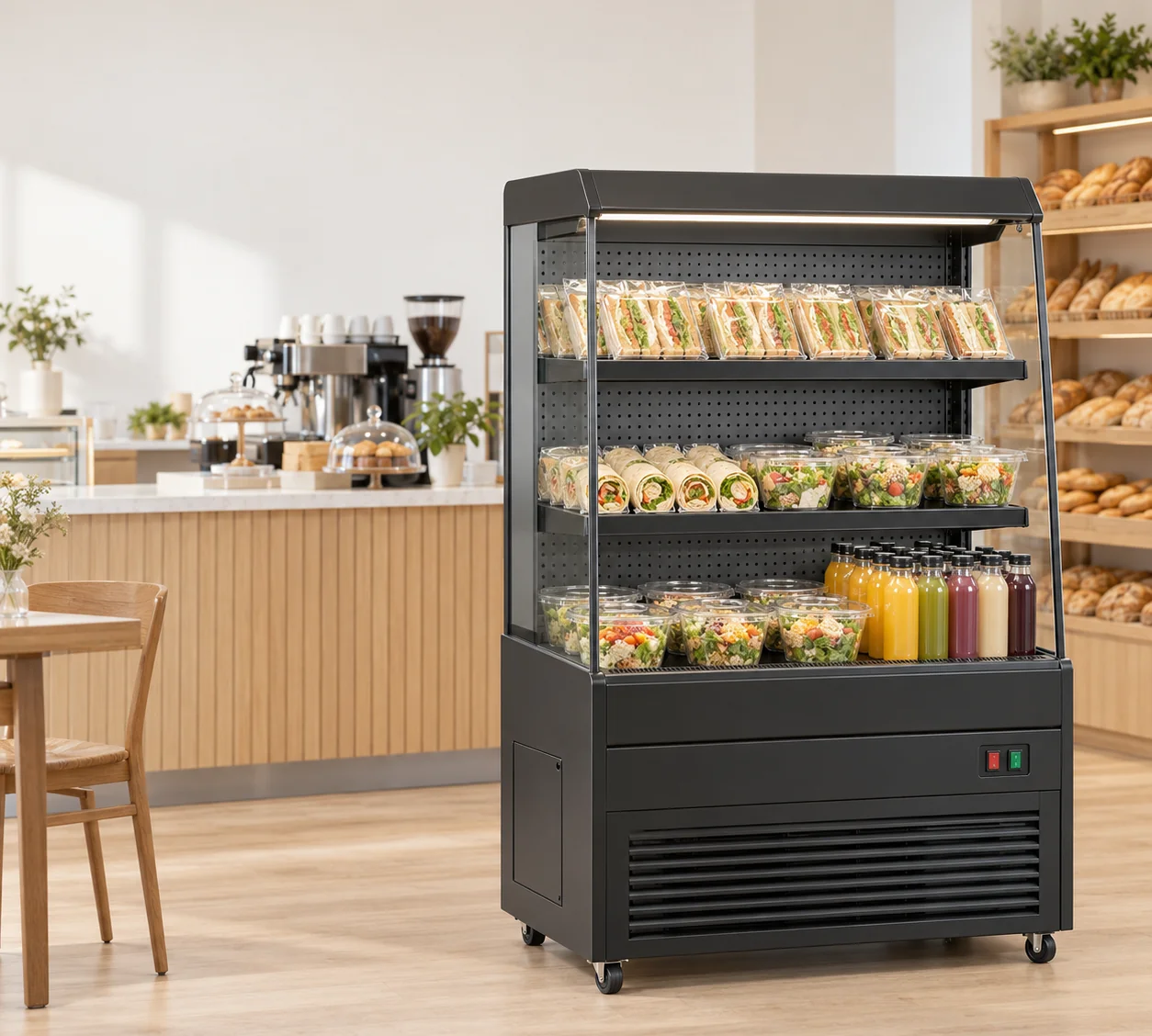
Draw the cabinet from the front and label the upper and lower shelves. Include the base deck where recorded for the selected model. Assign each pack reference to a proposed position. Add a view from above where several rows sit behind the front pack, and record the complete pack width, depth and height with its label facing the customer. Keep this proposal beside the usable shelf drawing for the selected model.
Show which remaining products staff must move to reach an empty position. A layout that looks orderly when full can require repeated rearrangement during a partial refill. Record those movements during a demonstration with the proposed assortment. Ask for the installation and loading instructions, and keep the specified air paths clear when translating the sketch into the actual cabinet layout.
How should I compare one large refill with smaller repeated refills?
Describe both routines using the same products and service period. For each routine, record the starting display, replacement stock location, packs carried per trip, route to the cabinet and positions filled. Note where the refill task crosses the customer approach or interrupts another staff activity. This creates a comparison of observed work rather than a claim that one routine always performs better.
Keep the frequency and target quantities as buyer inputs. The L-series capacity figures do not specify a refill interval or sales throughput. Record the time of each observation and any unusual event, such as a group purchase or a missing replacement line. Review several ordinary service periods before using one observation to describe the proposed operating routine.
What belongs in the demonstration and handover record?
Use a labelled assortment and a shelf map revision so the starting arrangement can be recreated. Photograph the loaded display from the front, record the empty positions selected for the exercise, and follow the proposed refill route. Note pack visibility, access to the back rows and any products moved during the task. Keep observed results distinct from questions that require a drawing or configuration reply.
The model records list fan cooling, automatic defrost and a 2-8 °C temperature range for these cabinets. Use the selected model documentation and your product storage requirements when preparing the operating procedure. A refill demonstration checks the arrangement and sequence; it does not establish temperature performance for every loading pattern. Retain the relevant operating instructions with the accepted layout.
What should I send JINYU with a grab-and-go counter inquiry?
Send the shortlisted model codes, measured floor position and intended assortment to Shaanxi Jinyu Kitchenware Co., Ltd. (陕西金宇厨具有限公司). Attach pack dimensions, the proposed shelf map and the worked refill record. Identify where replacement stock is kept and the route staff would use. Include the receiving route and the recorded electrical supply at the intended position with the wider equipment brief.
Ask for usable shelf measurements, loading guidance, installation spacing and configuration documents for the selected cabinet. Keep the reply beside the same drawing revision used for the inquiry. The comparison table links to each individual model record, while the width comparison linked below helps assess the available frontage. Together these records connect cabinet selection with a specific display and refill task.