Buyer planning guide
Grab-and-Go Counter: What Changes When Packs Get Bigger?
Compare old and replacement pack dimensions, calculate three illustrative shelf arrangements and update display quantities using real JINYU L-series cabinet references.
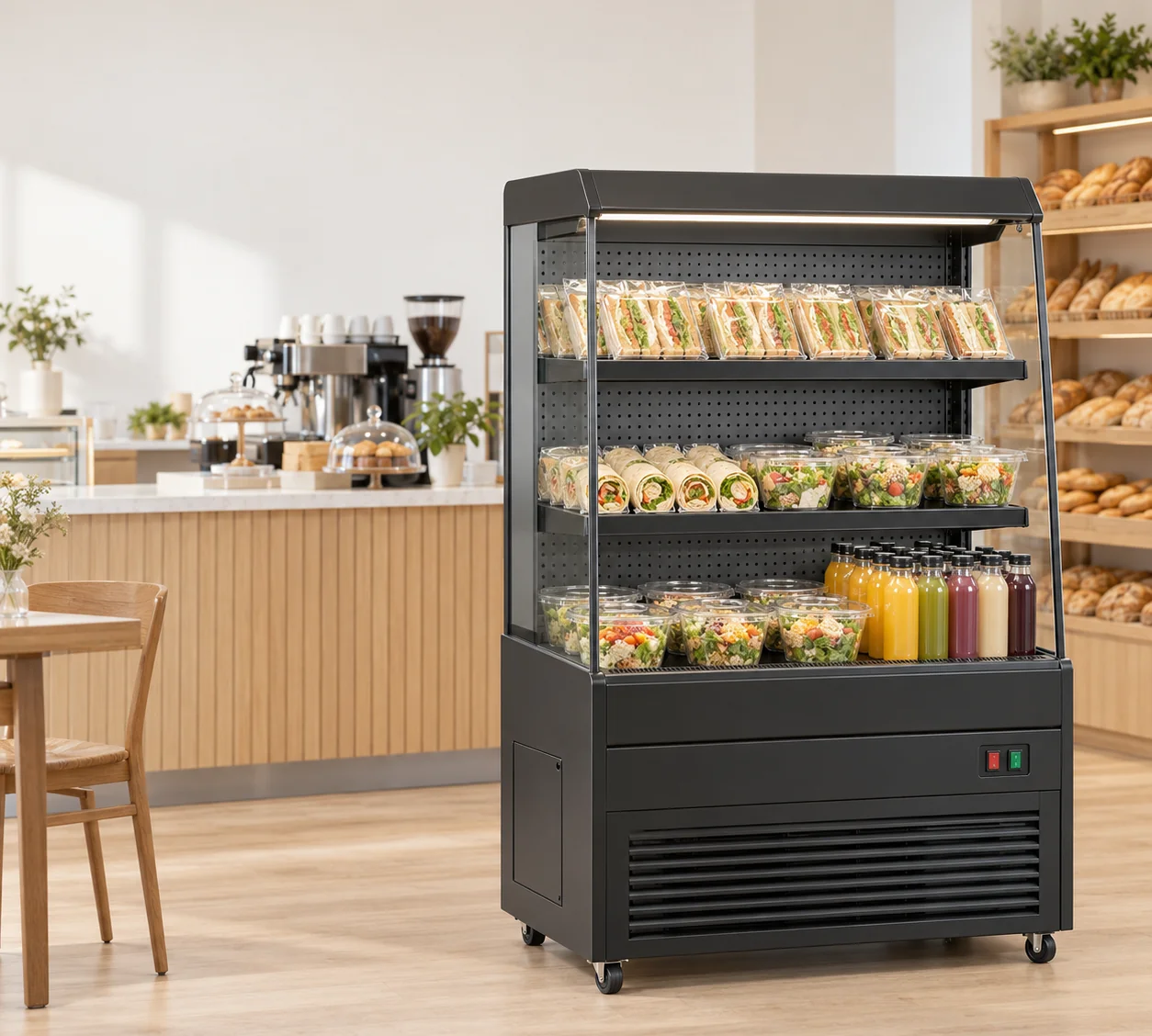
Worked example: one rectangle, three pack arrangements
Illustrative buyer measurements: a 600 × 360 mm loading rectangle. These dimensions and counts are not JINYU shelf specifications. This calculation allows no spacing or access allowance.
| Pack arrangement | Width × depth | Across | Rows deep | Outline positions | Unused width / depth |
|---|---|---|---|---|---|
| A · existing pack | 100 × 120 mm | 6 | 3 | 18 | 0 / 0 mm |
| B · replacement pack | 120 × 150 mm | 5 | 2 | 10 | 0 / 60 mm |
| B · rotated replacement | 150 × 120 mm | 4 | 3 | 12 | 0 / 0 mm |
Keep calculation and observation on separate records
Record the model and shelf drawing revision, pack revision, loading area, orientation, calculated positions, physically observed count and photograph reference. Add the chosen display target to the replenishment sheet after the arrangement has been reviewed.
What changes when a grab-and-go counter uses a larger pack?
A pack change can alter the number of front-facing positions, the rows behind each position and the quantity assigned to a shelf. Record the new pack's outside width, depth and height with the lid closed and the label applied. Include any protruding rim, tab or sleeve. Compare those measurements with the pack currently used before updating the display drawing or ordering another cabinet.
Start with one named shelf position and one product. Keep the cabinet model, shelf drawing and pack revision in the same record. A larger pack may require fewer positions, a different orientation or a different shelf assignment. Observe those arrangements with actual packs. A photograph of an earlier container remains evidence for that earlier container, even when the food description and product name stay the same.
How does a worked pack-size comparison reveal a layout change?
The illustrative worksheet below uses a measured loading rectangle of 600 × 360 mm. Pack A measures 100 × 120 mm at its widest points, while replacement pack B measures 120 × 150 mm. These are buyer example measurements, not usable shelf dimensions for a JINYU cabinet. Keep the same orientation in the first comparison: pack width runs across the front and pack depth runs toward the rear.
The simple rectangular calculation gives A six positions across and three rows deep: 18 outline positions. B gives five across and two deep: 10 outline positions. Rotating B gives four across and three deep: 12 outline positions. These counts ignore spacing and access. Use them to identify arrangements to examine physically, then record the actual accepted arrangement. The rotated example also changes the face presented to the customer, so check the label and the way the pack is picked up.
Why is the outline calculation different from a usable shelf count?
An outside rectangle cannot describe every obstruction or operating instruction. Obtain the selected configuration's shelf drawing, loading instructions and stated limits, then identify the area where packs may be placed. Mark any excluded areas on that drawing before laying out containers. Pack rims can overlap in a sketch while preventing stable placement in the physical display. Keep the measured packing result beside the calculation so the two records can be compared.
In the example, 18, 10 and 12 are mathematical outline counts. They are not product capacities for GN-900L or any other model. Even the example loading rectangle has no assigned cabinet. After examining actual packs, write the observed count and orientation on a separate line. Record the conditions of the observation, the shelf position and the pack revision. Retain the drawing used so the next reviewer can reproduce the arrangement.
Which JINYU cabinet dimensions help me shortlist a grab-and-go counter?
The recorded L-series exterior dimensions are 900 × 740 × 1400 mm for GN-900L, 1000 × 740 × 1400 mm for GN-1000L, 1200 × 740 × 1400 mm for GN-1200L and 1500 × 740 × 1400 mm for GN-1500L. Their listed capacities are 235, 245, 295 and 365 L respectively. These figures identify the cabinet envelope and recorded volume; the model pages provide the full specifications.
Use exterior width to shortlist positions on the floor plan, then request usable shelf measurements for the selected configuration. Changing from GN-900L to GN-1200L adds 300 mm to exterior width. It does not establish three additional 100 mm pack positions, because exterior width does not equal usable shelf width. Send the old and new pack measurements with the model code so the response addresses the actual assortment change.
How should I revise display quantities after changing the pack?
Write one quantity against each accepted shelf position and product revision. Suppose a buyer's physical review accepts 16 old packs in a position but only nine replacement packs. The example display target falls by seven packs for that position. Record both targets and the date or service period when the new arrangement will be used. These illustrative quantities are independent of the rectangle calculation above and do not describe a cabinet capacity.
Update the replenishment worksheet using the accepted new target. If nine is the target and four eligible replacement packs remain, the simple difference is five packs. Record removals and additions separately in the operating log. Keep old and replacement packaging distinguishable during the changeover, especially if both versions are present at once. A shared product name should not erase the pack revision from the shelf map or counting sheet.
What else should I review when the pack orientation changes?
Observe the complete customer action: locating the product, reading its identifying information, lifting the pack and carrying it away. Photograph the proposed orientation from the customer side and record whether the intended label can be associated with that position. Ask staff to demonstrate replenishment using the actual replacement container. Keep the observed result linked to the shelf position rather than describing the whole cabinet as suitable from a single photograph.
Review pack height as well as its footprint. A taller closed lid can change the movement needed to place or remove a pack. Obtain the actual vertical opening for the selected shelf arrangement and record the loading action observed. Keep the applicable equipment loading instructions with that record. If the pack also changes material or the intended contents, include the product requirements in the inquiry and request the relevant operating documentation for the proposed configuration.
What should I send JINYU for a pack-change equipment inquiry?
Send the selected L-series model, the old and new closed-pack measurements, product identifiers and photographs showing the widest points. Attach the shelf drawing used, the proposed position map and your observed counts. State which measurements came from physical packs and which came from a drawing. Identify any unanswered question precisely, such as the usable depth at a named shelf or the opening above a proposed position.
Address the inquiry to JINYU, Shaanxi Jinyu Kitchenware Co., Ltd. (陕西金宇厨具有限公司). Include the site plan if the replacement assortment also prompts a wider cabinet shortlist. Keep the cabinet decision, the pack arrangement and the operating quantity as separate records connected by model and position references. When the response changes the proposed configuration, update its drawing reference before repeating the layout review. This gives the purchasing team a traceable comparison of what changed and which evidence supports the revised display plan.
Reference sources
- Compare L-series cabinet specifications
- Plan the refill quantity
- Keep product labels attached to shelf positions
- Send pack dimensions and model references
Regional references support general planning; model-specific specifications come from the published JINYU model tables.