Does a non-woven bag size chart show the printable area?
A bag size chart identifies the outside body dimensions. The JINYU catalogue records width, body height and gusset depth in centimetres, excluding handles. Those figures describe the bag being requested. A print drawing needs another set of dimensions: artwork width and height, its position on a named face, and the measurement points used to locate it. Keep those two records together when requesting a printed bag.
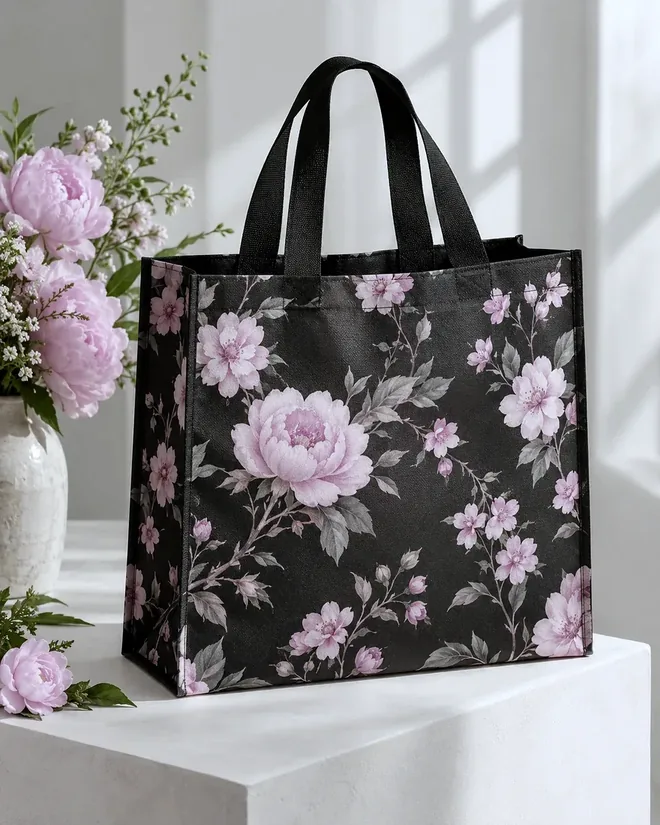
For example, JY-PL-02 RETAIL30 is listed as 30 × 35 × 10 cm. That is a 300 mm-wide, 350 mm-high body with a 100 mm gusset depth. The listing supplies no maximum printable rectangle. Put the desired artwork dimensions on a separate face drawing and ask JINYU to return the proposed print area for that exact construction. A photograph can communicate the visual direction; it cannot supply an unrecorded print specification.
How do I identify the correct bag before placing the artwork?
Use both the product reference and the variant code. JY-PL-01 STD and JY-PL-01 FLAT both have a listed width of 38 cm and body height of 42 cm. STD has a 10 cm gusset; FLAT is recorded with zero gusset depth. A note that says only 38 × 42 tote leaves the requested construction ambiguous. Write the full code beside the face drawing so the artwork review addresses the intended bag.
The same discipline applies within JY-PL-02. RETAIL40 is 40 × 45 × 12 cm, while STD is 40 × 35 × 15 cm. Their widths match, but the body heights differ by 10 cm and gussets differ by 3 cm. Copying an artwork position from one to the other therefore needs a fresh drawing. Include the colour reference and whether the requested printing covers the front, back or both faces.
Which dimensions should an artwork placement drawing contain?
Label the outside body width and height first. Mark the top body edge separately from the handles, then label the front and back views. Draw the proposed artwork rectangle on each requested face and give its width and height in millimetres. Add a horizontal location from a named body edge and a vertical location from the top body edge. These references let another person reconstruct the intended position without estimating it from a screen image.
Include a construction view showing the handle attachments and gusset folds where they meet the proposed artwork. Request a returned placement drawing that identifies the proposed print boundary and the same measurement endpoints. Keep the artwork file revision beside the drawing revision. If the returned rectangle or position changes, record the requested and offered dimensions in adjacent columns before selecting the revision for sample review.
How can I check centimetres, millimetres and centring calculations?
Convert the bag dimensions into the unit used on the artwork drawing before subtracting anything. Multiply centimetres by 10 to obtain millimetres. In the illustrative layout below, a 300 × 350 mm face carries a proposed 180 × 200 mm artwork rectangle. Horizontal centring leaves (300 - 180) ÷ 2 = 60 mm on each side. Locating its top 70 mm below the body top leaves 350 - 70 - 200 = 80 mm below it.
These are calculations for a buyer drawing, rather than an approved printing specification. They describe the requested rectangle on the body outline and supply no construction allowance or process tolerance. Send the dimensions with the exact bag code for review. Keep the artwork at its stated size when comparing proof versions; scaling a preview image to fill a screen can conceal a dimensional change.
Should the same artwork scale across every bag size?
State whether the artwork stays at one physical size or changes between variants. A 180 mm-wide logo occupies 60% of a 300 mm-wide body and 45% of a 400 mm-wide body. Its file dimensions can remain identical while its visual proportion changes. Decide which outcome the project needs, then record each variant on a separate line with its proposed artwork width, height and position.
For a coordinated size range, compare the face drawings side by side at the same scale. Keep the full product and variant code under each view. Review the top-edge and side-edge measurements individually, including the selected front and back arrangement. If one size uses a different artwork file, give that file its own revision reference. This connects the visual decision to the specific bag instead of relying on labels such as small, medium and large.
What belongs in the inquiry and sample handover?
Send Shaanxi Jinyu Kitchenware Co., Ltd. (陕西金宇厨具有限公司) the coded bag schedule, requested quantities by variant and colour, destination, artwork files and placement drawings. Identify the measurement units and front/back views. For small non-woven bag quantities, ask which stock sizes and colours are available and describe the requested decoration separately. Keep any custom canvas tote or travel bag project on its own specification record.
When a proof or sample is returned, compare its identified bag construction, artwork dimensions and placement with the selected drawing revision. Record measured sample observations separately from the requested dimensions. Attach photographs with the measurement endpoints visible, and identify any requested change by face and location. Retain the selected file and drawing references with the inquiry so a later reply can address the same artwork and bag combination.