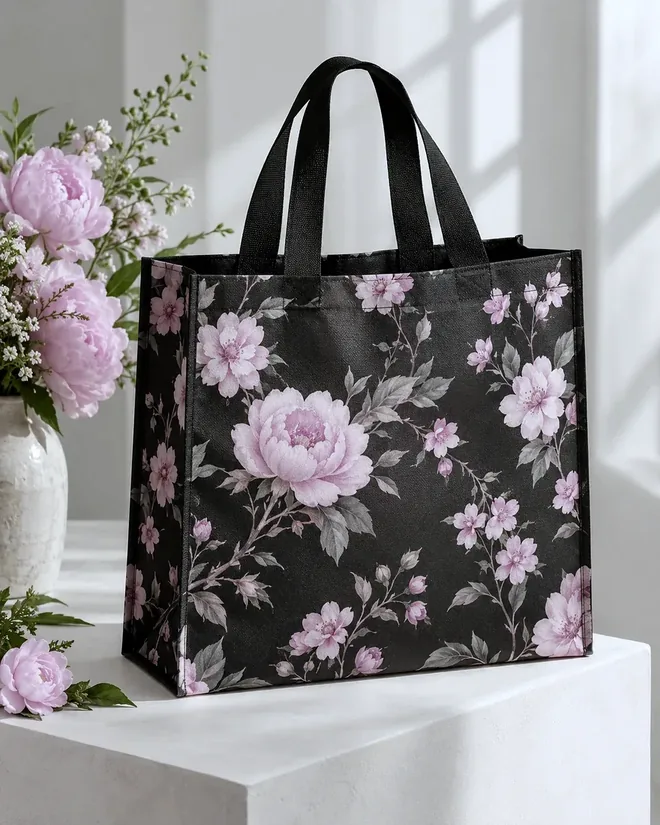
Which non-woven retail bag sizes can I compare at 30, 35 and 40 cm wide?
The JINYU JY-PL-02 gusseted shopper has three retail references: RETAIL30 at 30 × 35 × 10 cm, RETAIL35 at 35 × 40 × 10 cm and RETAIL40 at 40 × 45 × 12 cm. Read those numbers as outside width, body height and gusset depth, excluding handles. The chart also includes STD at 40 × 35 × 15 cm because its matching 40 cm width makes the differences easier to see.
Use the retail code to identify a catalogue variant, then keep all three dimensions with it. A request for a 40 cm shopper leaves two quite different bodies in this comparison. Identify the packed purchases alongside the chosen reference so the sample discussion covers the intended shape and opening as well as the front panel.
What changes when I move from RETAIL30 to RETAIL35?
RETAIL35 adds 5 cm to both outside width and body height compared with RETAIL30. Gusset depth stays at 10 cm. Its nominal width-by-depth base outline rises from 300 to 350 square centimetres, an increase of 50 square centimetres. This is a calculation from the catalogue exterior, rather than a measurement of usable space inside a finished bag.
For a retail assortment, set the two samples beside the same packed item and photograph the opening, base and top edge. A taller body can change where a purchase sits beneath the handles. Record how the item enters and how the handles come together. The dimension increase alone does not supply a carrying-load rating or prove that a particular box fits.
Does RETAIL40 simply scale up the smaller two shoppers?
RETAIL40 measures 40 × 45 × 12 cm. Compared with RETAIL35, it adds 5 cm of width, 5 cm of body height and 2 cm of gusset depth. Its nominal base outline is 40 × 12 = 480 square centimetres, compared with 35 × 10 = 350 for RETAIL35. The 130 square centimetre difference describes exterior geometry.
Keep the depth change visible in your shortlist. On a front-view drawing, a shopper can look like a larger version of another while its base proportions also change. Use a side view or an opened sample to discuss that third dimension. Where the purchase includes several separate packs, write down their arrangement instead of treating the extra base outline as a guaranteed number of additional items.
Why compare the 40 cm RETAIL40 shopper with the 40 cm STD variant?
The widths match, but RETAIL40 has a 45 cm body height and 12 cm gusset; STD has a 35 cm body height and 15 cm gusset. RETAIL40 is therefore 10 cm taller and 3 cm shallower. STD has a nominal base outline of 600 square centimetres, versus 480 for RETAIL40. A wider gusset and a taller panel answer different packaging needs.
Draw both outlines with the complete wrapped purchase beside them. Use the same dimension order in both drawings, and label the variant on each photograph. Do not transfer an artwork position, handle relationship or sample decision from one to the other solely because both start with 40 cm. A proposed substitution needs its own dimension and material comparison.
How should I use the inch measurements in this chart?
Each inch figure is the original centimetre value divided by 2.54, rounded to two decimal places. RETAIL30 becomes approximately 11.81 × 13.78 × 3.94 inches. RETAIL40 becomes approximately 15.75 × 17.72 × 4.72 inches. These are alternate units for the same catalogue references, rather than separate inch-sized products.
Keep the original centimetres with the code when sharing an inch-based packaging brief. Mark the unit on every line, especially if the box supplier uses inches while the bag reference uses centimetres. Rounding is not a manufacturing tolerance. Request the offered finished measurements and measurement method for the selected sample, including whether the bag is laid flat or opened when a particular dimension is checked.
Can I choose a retail shopper from base area or a calculated volume?
Use nominal base area to compare shapes, then evaluate the actual packing arrangement. Multiplying outside width by gusset depth does not account for seams, corners, folds or the bag opening. Multiplying by body height adds another exterior dimension but still does not establish usable litres. This chart therefore reports nominal base outlines without assigning a volume or a carrying capacity.
Measure the packed purchase with its wrapping, lid and projecting edges. Give width, depth and height their own labelled fields, then compare the selected bag sample with that complete pack. For a mixed purchase, photograph the arrangement and identify each item. Record the opening and handle access during the sample review; they cannot be recovered from base-area arithmetic.
What belongs in an inquiry for these non-woven retail sizes?
Send Shaanxi Jinyu Kitchenware Co., Ltd. (陕西金宇厨具有限公司) the JY-PL-02 reference, variant code and full outside dimensions. Include your requested quantity, destination, colour and artwork files, plus the dimensions of the packed contents. For a small non-woven order, ask which stock options are available for that combination. A catalogue size reference does not establish current stock availability.
Keep the requested variant and the offered option on separate lines when comparing the reply. Record fabric weight, handle arrangement, printing scope and packing information against the actual option offered. The JY-PL-02 catalogue includes 80 or 90 GSM references depending on variant; size alone does not define the material specification. Retain the selected sample reference with the artwork revision so the purchasing record identifies both body size and presentation.