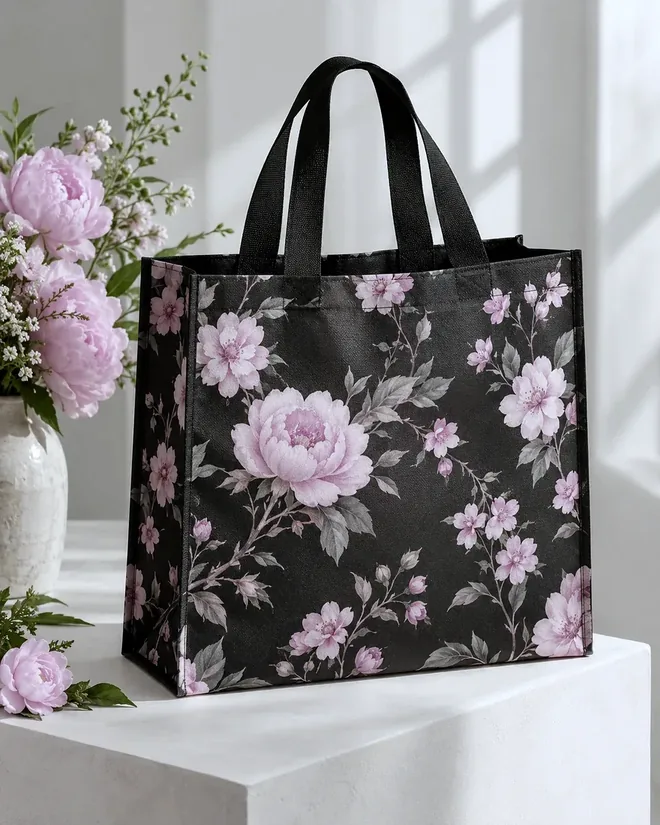
Does a non-woven bag size chart give finished sizes or cutting sizes?
The JINYU chart below gives outside bag measurements. Width comes first, body height second and gusset depth third, where a gusset is specified. For the loop-handle and gusseted shoppers, those measurements exclude the separate handles. JY-PL-01 STD is 38 × 42 × 10 cm; that is the bag reference a buyer selects. It does not specify a fabric rectangle to cut.
Keep the finished-bag specification and the production drawing as separate records. A purchasing brief can identify the body dimensions, construction, handle arrangement and intended contents. A cutting drawing needs its own panel outlines and construction details. If your project needs that drawing, request it against the complete product and variant reference. Copying the three catalogue measurements onto a fabric sketch would leave those production details undefined.
Why can two bags with a 38 × 42 cm face need different drawings?
JY-PL-01 STD and FLAT share a listed face width of 38 cm and body height of 42 cm. STD adds a 10 cm gusset depth; FLAT has no quoted depth gusset. They therefore occupy separate rows in the chart. A request headed only 38 × 42 tote leaves out the distinction that identifies which body construction the buyer means.
Write JY-PL-01 STD, 380 × 420 × 100 mm, when requesting the gusseted reference, or JY-PL-01 FLAT, 380 × 420 mm, for the flat reference. Ask the returned drawing to retain that identifier. A production proposal should identify its individual panels and joining arrangement independently. The finished size provides a comparison target; the panel layout explains how the proposed construction reaches it.
Can I calculate cut-panel width by adding the bag width and gusset?
The catalogue does not provide a cut-panel formula. For JY-PL-02 STD, 40 × 35 × 15 cm describes the outside bag body. Adding 40 and 15 gives 55 cm arithmetically, but the chart does not identify 55 cm as any panel width. It also gives no allowance for a particular seam, joining method or folded edge. Do not label that sum as a production measurement.
Instead, send a dimensioned finished-bag sketch and request the proposed cut-panel drawing. Ask for panel names, quantities, units, orientation and the dimensions used for each edge. Keep any construction allowances identified separately on that drawing. Compare the returned finished-body dimensions with the requested bag row before discussing panel changes. This lets the response explain the actual construction rather than forcing it into a formula inferred from three outside measurements.
Where should handle measurements go on the specification?
Give handles their own drawing fields. The shopper rows specify body height without the separate loop handles. JY-PL-03 STD is a different reference: its 30 × 40 cm outside body includes the area around the integrated D-cut handle. That 40 cm height does not identify the clear storage height beneath the opening. Retain the handle construction beside the size, even when comparing two flat bags.
For separate handles, request the handle width, attachment locations and a drawing showing the endpoints used for length and drop. For a D-cut reference, request the opening outline and its position on the body. The size chart supplies none of those numerical values. Label them as requested drawing fields, and use the returned dimensions for sample review instead of scaling a photograph or treating overall body height as handle clearance.
Is the finished bag face also the artwork or print size?
A 36 × 43 × 10 cm JY-PL-02 EVENT body converts to 360 × 430 × 100 mm. Those values identify the outside body, not an available print rectangle. Front artwork, back artwork and any gusset artwork need labelled views. Include the requested artwork width and height, its placement endpoints and the file revision with the product reference.
Keep the decoration drawing separate from the cutting drawing, but cross-reference their revisions. Ask the response to show the proposed print boundary and position on the selected construction. If a handle attachment or body detail changes, compare the artwork placement again against that revised drawing. The catalogue image illustrates a bag appearance; the dimensioned proposal records where the requested design would sit on the offered bag.
How should I record a sample that measures differently from the chart?
Record the catalogue value, the observed sample value and the measurement method in separate fields. Identify the sample, product code, variant and drawing revision. Photograph the bag with the width and height endpoints visible; record gusset depth in a separate view. Use one unit throughout the comparison. The table converts centimetres to millimetres by multiplying each listed axis by ten.
For example, a hypothetical JY-PL-02 RETAIL30 sample might be recorded at 298 mm wide against a 300 mm catalogue width, giving an observed difference of minus 2 mm. This is an illustration of recording a difference, not a measured JINYU sample or an accepted tolerance. Request the applicable measurement method and agreed dimensional tolerances for the offered specification before deciding how an observed difference should be handled.
What should I send JINYU for a finished-size and drawing review?
Send the full product and variant reference, the requested finished dimensions with axis labels, the handle construction and the intended contents. Attach any existing sample photographs and dimensioned sketches. List the documents needed: a finished-body drawing, a cut-panel drawing if relevant to the project, a handle detail and a separate artwork placement view. The worksheet below keeps each request connected to the same bag.
For a small non-woven order, ask Shaanxi Jinyu Kitchenware Co., Ltd. (陕西金宇厨具有限公司) about available stock in the selected reference. A proposed dimension change needs its own feasibility response rather than an assumption that a stock bag can be altered. Keep the requested and offered values together, then retain the drawing revision used for the sample. That record gives purchasing and artwork teams one identified construction to review.