Buyer planning guide
Non-Woven Bag Size Chart: Flat vs Gusseted Totes
Compare ten JINYU flat and gusseted non-woven bag references in cm and inches, including the 38 × 42 cm flat tote and 38 × 42 × 10 cm gusseted tote.
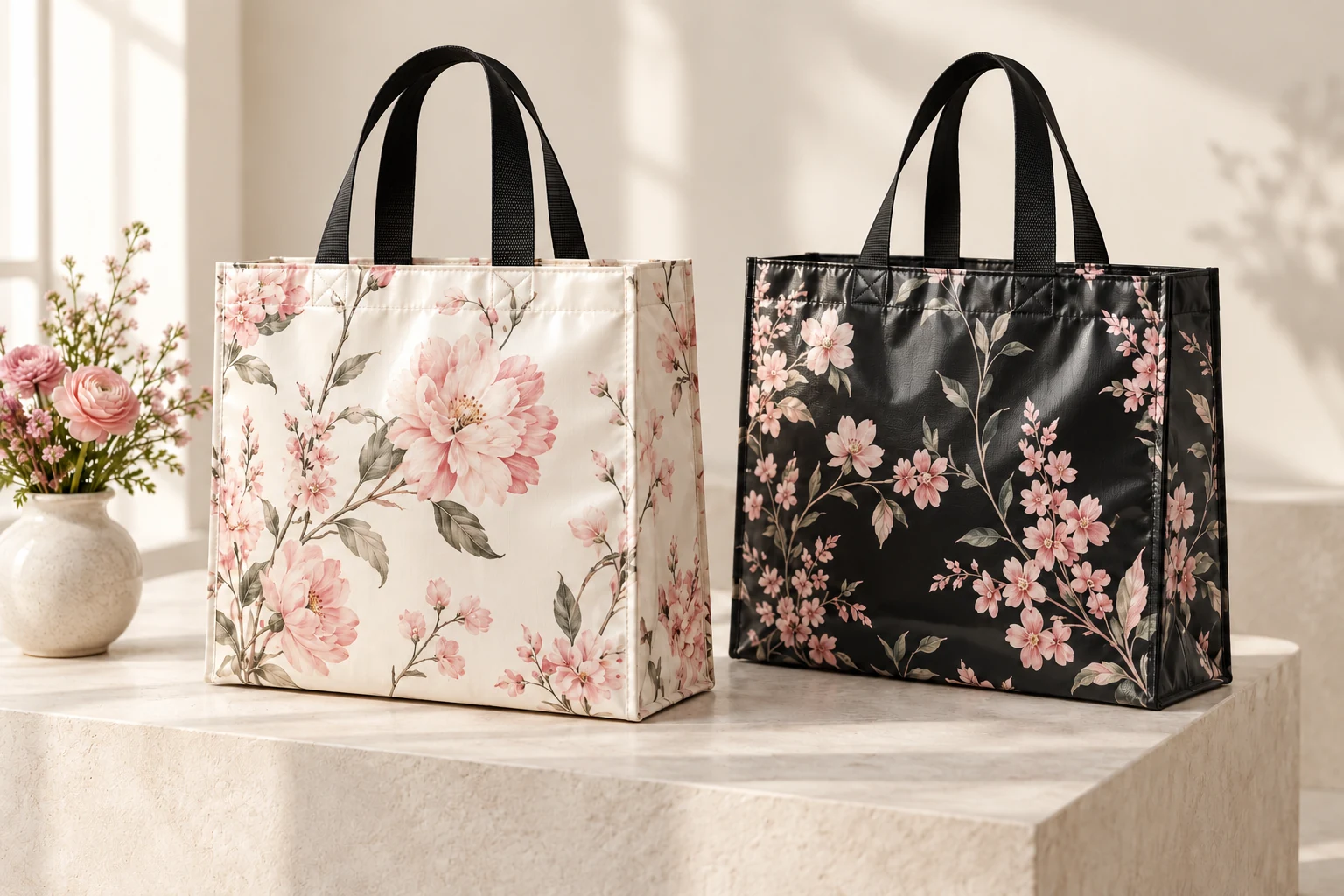
Flat and gusseted non-woven bag size chart
| JINYU product | Variant | Construction | Dimensions (cm) | Dimensions (inches) |
|---|---|---|---|---|
| Loop-Handle Non-Woven Tote | STD | Gusseted | 38 × 42 × 10 cm | 15.0 × 16.5 × 3.9 in |
| Loop-Handle Non-Woven Tote | FLAT | Flat | 38 × 42 cm · flat | 15.0 × 16.5 in · flat |
| Gusseted Non-Woven Shopper | STD | Gusseted | 40 × 35 × 15 cm | 15.7 × 13.8 × 5.9 in |
| Gusseted Non-Woven Shopper | EVENT | Gusseted | 36 × 43 × 10 cm | 14.2 × 16.9 × 3.9 in |
| Gusseted Non-Woven Shopper | TALL | Gusseted | 38 × 42 × 15 cm | 15.0 × 16.5 × 5.9 in |
| Gusseted Non-Woven Shopper | XL | Gusseted | 44 × 48 × 14 cm | 17.3 × 18.9 × 5.5 in |
| Gusseted Non-Woven Shopper | RETAIL30 | Gusseted | 30 × 35 × 10 cm | 11.8 × 13.8 × 3.9 in |
| Gusseted Non-Woven Shopper | RETAIL35 | Gusseted | 35 × 40 × 10 cm | 13.8 × 15.7 × 3.9 in |
| Gusseted Non-Woven Shopper | RETAIL40 | Gusseted | 40 × 45 × 12 cm | 15.7 × 17.7 × 4.7 in |
| D-Cut Non-Woven Bag | STD | Flat | 30 × 40 cm · flat | 11.8 × 15.7 in · flat |
How do I compare flat and gusseted non-woven bag sizes?
Read the construction beside the dimensions. A flat bag has a width and body height but no separately specified gusset depth. A gusseted reference adds a third dimension describing the opened depth. Two bags with the same width and height can therefore describe different shapes when loaded. The chart below separates these constructions using recorded JINYU catalogue variants, rather than assigning an undefined small, medium or large label.
Start with the object being carried. Record its outside width, height and depth, including its packaging, then choose the orientation in the bag. Use those measurements to shortlist references from the chart. Keep the contents drawing beside the bag reference: a catalogue body dimension is a starting point for selection, while the usable opening and loaded shape need review against the actual contents.
Which catalogue example shows the difference at the same width and height?
The Loop-Handle Non-Woven Tote has two recorded variants with a 38 × 42 cm body. FLAT is listed as 38 × 42 cm with no gusset; STD is listed as 38 × 42 × 10 cm. These are useful comparison references because width and height stay the same while the depth specification changes. Select the variant code as well as the product name when preparing an inquiry.
Do not describe the flat option as a ten-centimetre-deep bag simply because the other variant has that depth. Likewise, multiplying 38, 42 and 10 does not establish a usable litre capacity for the gusseted tote. The figures describe a soft bag's listed dimensions. Put the intended contents, their orientation and the required opening on a sketch so the construction can be reviewed against a physical object.
How do I read width, body height and handle dimensions?
Use width × body height × depth, in centimetres, for the chart on this page. A two-number entry is marked flat. Body height excludes separate loop handles; handle drop belongs on a separate drawing dimension. For an integrated D-cut opening, show the opening within the body outline. Do not add an assumed handle length to the recorded body height or treat the top edge as an unobstructed loading opening.
The D-Cut Non-Woven Bag reference is 30 × 40 cm and flat. The Loop-Handle Tote FLAT reference is 38 × 42 cm. That gives an eight-centimetre difference in listed width and two centimetres in body height, but it does not quantify the difference in usable opening. Ask for an opening drawing for the specific reference when a rigid folder, sleeve or box must pass through it.
Does a deeper gusset always mean a larger bag?
Compare all three dimensions together. The Gusseted Non-Woven Shopper STD reference is 40 × 35 × 15 cm, while EVENT is 36 × 43 × 10 cm. STD has four centimetres more listed width and five centimetres more depth; EVENT has eight centimetres more body height. Neither is larger in every direction. The more suitable proportions depend on how the intended contents sit and how the top remains accessible.
For a hypothetical packaged object measuring 32 × 30 × 8 cm, first label which object dimension aligns with bag width, body height and depth. Compare each dimension separately with each reference. Any remaining difference is an arithmetic difference between outside figures, not an insertion allowance or proof of fit. Include packaging projections and ask for a sample review rather than accepting a match based on only the longest side.
How should I compare centimetres and inches without changing the reference?
Use the centimetre dimensions as the catalogue reference and treat the inch column as a reading aid. Divide each centimetre figure by 2.54; the table rounds the result to one decimal place. For example, the 38 × 42 × 10 cm Loop-Handle Tote STD reference is approximately 15.0 × 16.5 × 3.9 inches. The rounded inch values identify the same reference rather than a second size option.
When sending a drawing, state one primary unit and keep the unrounded reference dimensions attached. If your contents are measured in inches, include those original measurements and label them. Avoid rounding a bag dimension upward and a content dimension downward to make the comparison appear to fit. Write the variant code on the drawing so a later unit conversion cannot disconnect it from the catalogue entry.
Can I choose a size from a photograph or a small, medium or large label?
Use the photograph to discuss shape, handles and presentation, then use the recorded variant dimensions for the size comparison. Perspective and styling change how wide or tall a soft bag appears. A lifestyle image does not establish an opening measurement, handle drop or load rating. Link the relevant product page and name its variant rather than asking for the size shown in an unlabelled image.
Size labels also depend on the product family. The Gusseted Shopper RETAIL30 reference is 30 × 35 × 10 cm, whereas its RETAIL35 reference is 35 × 40 × 10 cm. Those codes are catalogue identifiers, not universal retail size categories. Keep the full dimension string with the code in a comparison sheet, especially when different departments are requesting bags for different contents.
What should a size comparison sheet include for a small stock request?
Give each intended contents group a row. Add the selected JINYU product and variant, catalogue dimensions, contents measurements, preferred orientation and any opening or handle question. Include a photograph of the assembled contents beside a scale reference. Separate requested quantities by variant and colour so two different bag constructions are not combined under one total.
For a small non-woven bag request, ask about available stock against those exact references. A dimension listed in the catalogue does not establish current stock in every colour or artwork combination. Keep a proposed alternative in a separate row and compare its construction and dimensions again. If the alternative changes from flat to gusseted, update the drawing and contents review before accepting it as a substitute.
What should I send JINYU after shortlisting a flat or gusseted bag?
Send the product links, variant codes, size comparison sheet, contents photographs and a dimensioned sketch. State the intended carrying arrangement and destination, and attach artwork separately when relevant. Ask for the opening and handle dimensions needed for your contents review, together with the available stock options for the selected references. Keep any requested change clearly separated from the catalogue specification.
Request a response against each reference so a change in construction, dimension or colour can be recorded on the same sheet. Use the full catalogue size chart for other non-woven styles and the dimension-drawing guide when preparing a new specification. Retain the returned drawing and sample observations with the selected variant rather than relying on an unlabelled photograph.
Reference sources
- Measure an existing non-woven sample
- Full non-woven bag size chart
- Loop-handle tote variants
- Gusseted shopper variants
- D-cut flat bag
- Prepare a dimension drawing
- Send a bag inquiry
Regional references support general planning; model-specific specifications come from the published JINYU model tables.