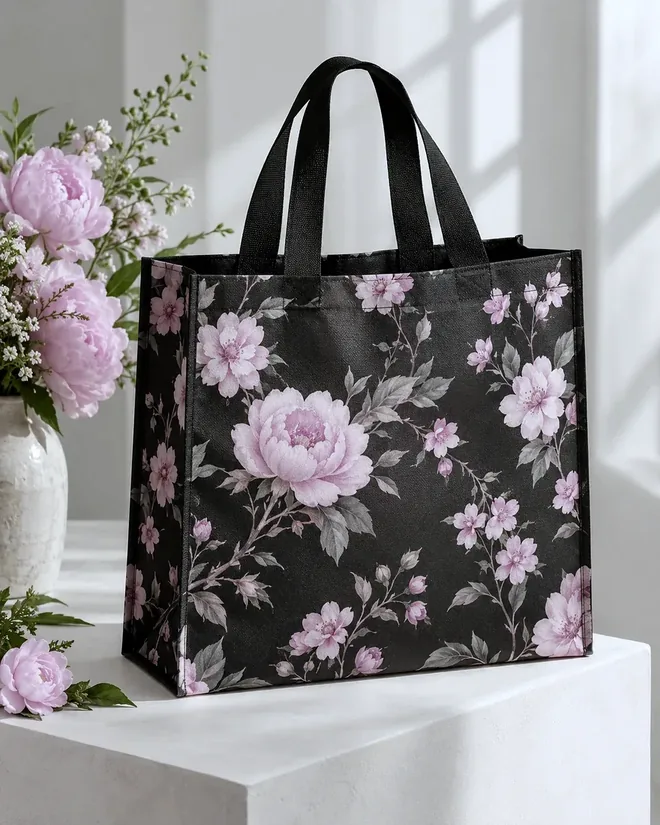
Which sizes are listed for the two foil-lined non-woven bag ranges?
The open-top foil-lined range, JY-ST-02, has S at 24 × 23 × 14 cm and M at 27 × 25 × 14 cm. The compact foil-lined shopper, JY-ST-04, has S at 21 × 24 × 12 cm, M at 23 × 25 × 14 cm and L at 25 × 26 × 18 cm. Read every set as outside width × body height × gusset depth, excluding handles. Both ranges have a PP non-woven outer and foil lining.
Keep the product code beside the size letter when building a shortlist. The table brings the two ranges together because their S and M labels represent different dimensions. Its rows identify catalogue references for a stock inquiry; they do not report available colours or quantities. For a small non-woven order, ask which stock construction is available in the selected size.
What changes when I compare the two M sizes?
Open-top M is 27 × 25 × 14 cm; compact M is 23 × 25 × 14 cm. The wider range adds 4 cm of outside width at the same listed body height and depth. Their nominal base outlines are 378 and 322 cm2 respectively, calculated as width multiplied by gusset depth. The 56 cm2 difference describes an external rectangle, not measured internal packing area.
That makes width the first useful distinction for this pair. Describe the closed package in its intended carrying orientation and include lid projections. If several boxes sit side by side, measure the assembled group. Retain the same package arrangement when comparing samples, so a change in bag width is assessed against the same contents rather than a different packing layout.
Is the compact L bag larger than open-top M in every direction?
Compact L measures 25 × 26 × 18 cm, while open-top M measures 27 × 25 × 14 cm. Compact L is 2 cm narrower, 1 cm taller and 4 cm deeper. Its nominal base outline is 450 cm2, compared with 378 cm2 for open-top M. A greater base rectangle therefore comes with less width in this comparison. Neither the letter L nor the base calculation establishes which bag accepts a particular rigid box.
Write width and depth separately on the packing schedule. A broad, shallow package and a narrower, deeper package can need different bag proportions even when their overall footprint areas are similar. For stacked containers, add the complete closed stack height. Check the mouth, base and loaded handle position on the selected sample before carrying that construction into the purchase specification.
How should I use the centimetre and inch measurements?
The centimetre column preserves the recorded catalogue dimensions. The inch column divides each value by 2.54 and rounds it to two decimal places. Open-top S at 24 × 23 × 14 cm becomes approximately 9.45 × 9.06 × 5.51 inches. Those figures describe one size in two units; the rounded inch values do not define another variant or an agreed production tolerance.
Use the original centimetre values, product code and variant together in the inquiry. Keep handle measurements outside the body-size field. If the project needs a particular opening or total hanging height, identify those measurement endpoints separately. A drawing with width across the front and depth along the base helps prevent the two horizontal measurements being swapped between the buyer's request and the offered specification.
Do these foil-lined bags have an adhesive closing flap?
Neither range in this chart lists an adhesive closing strip. JY-ST-02 has an open top and loop handles. JY-ST-04 has a straight open rim with loop handles. The compact product's flat-top catalogue name does not describe an adhesive seal. Keep closure as a separate specification field when comparing these bags with another foil-lined format.
If the packing process needs a closing flap, use the self-seal product reference linked below and compare its own dimensions. Do not transfer the S or M selection directly from this chart. At the sample review, load the actual closed containers, bring the handles into their carrying position and record where the rim sits relative to the stack. This gives the supplier a specific opening and closure requirement to address.
Does foil lining establish usable space or temperature performance?
The listed construction identifies a PP non-woven outer with foil lining. Layer structure, thickness and fabric weight belong in the offered specification. The external dimensions do not measure the room occupied by lining folds, seams or the loaded shape. Inspect the sample mouth and base with the same finished packages used for the dimensional shortlist, and record any point where a lid catches or a corner presses against a join.
These bags are listed for already-packaged food. A foil-lined appearance does not supply a temperature-retention result or a food-contact certification. Where a project has a temperature requirement, describe the packing conditions and request evidence for the offered finished construction. Keep that evidence with the selected material schedule rather than treating a catalogue size or a silver lining as a performance rating.
What should a purchasing inquiry include after choosing a row?
Send Shaanxi Jinyu Kitchenware Co., Ltd. (陕西金宇厨具有限公司) one line per requested product and variant. Include the full outside dimensions, preferred colour, quantity, packed-content dimensions and destination. Identify acceptable colour or size alternatives separately. For a small non-woven order, ask about stock against those lines before discussing changes to the bag construction or decoration.
Ask the reply to identify the offered size, outer material, lining layers, handle attachment and closure against each request line. Add artwork and print placement when decoration is part of the brief. Keep proposed carton counts, packed dimensions and weights with the delivery discussion. The linked product pages hold the construction references; the inquiry should connect those references to the actual contents and the offered stock item.