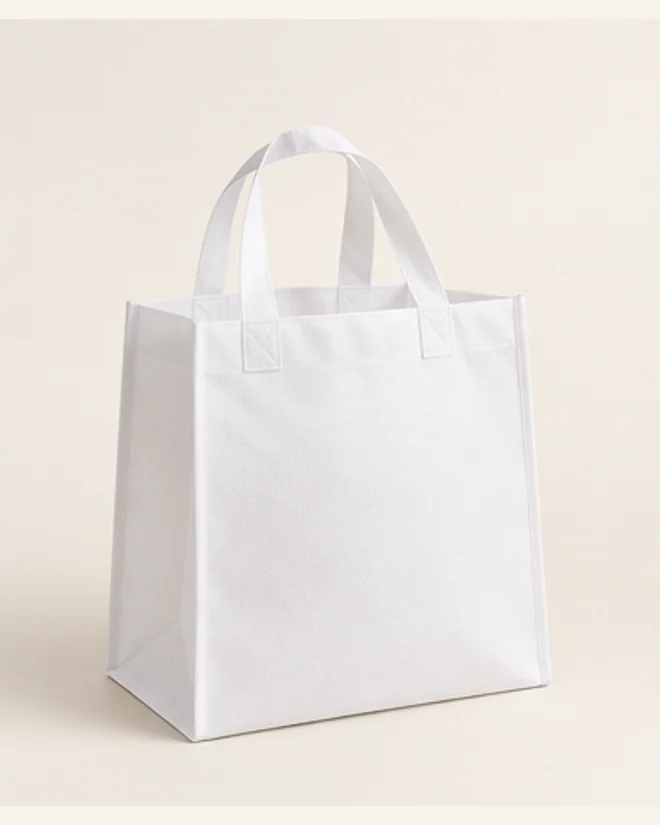
What sizes are listed for takeaway and self-seal non-woven bags?
The open-top takeaway shopper has three recorded sizes: S at 21 × 24 × 12 cm, M at 23 × 25 × 14 cm and L at 25 × 26 × 18 cm. The self-seal foil-lined bag has four: S at 21 × 26 × 11 cm, M at 24 × 24 × 15 cm, L at 26 × 26 × 17 cm and XL at 30 × 30 × 20 cm. Every sequence is outside width × body height × gusset depth, excluding handles.
Use the chart to identify a catalogue reference for discussion. Keep the complete style name next to the letter size: takeaway M and self-seal M describe different dimensions and construction. A size letter by itself leaves both the physical size and the closure unspecified.
Why is a self-seal M bag shorter but wider than takeaway M?
Letter sizes describe the sequence within each style. They do not create a shared scale across different bag constructions. Takeaway M measures 23 × 25 × 14 cm; self-seal M measures 24 × 24 × 15 cm. The self-seal version is therefore 1 cm wider, 1 cm shorter in body height and 1 cm deeper in the recorded outside dimensions. Those three changes matter separately when describing a package.
The takeaway style has an open top, separate loop handles and a gusseted base. The self-seal style has a foil lining and an adhesive flap with separate loop handles. Its flap arrangement belongs in the closure review. Selecting M in both styles does not establish the same opening, usable height or space for a filled box.
How do I read the centimetre and inch columns?
Read each row from width to height to depth and keep that order when copying a reference into an inquiry. The inch figures divide each original centimetre value by 2.54 and round to one decimal place. Takeaway S, for example, is 21 × 24 × 12 cm, approximately 8.3 × 9.4 × 4.7 inches. These columns describe one variant using two units.
Use the original centimetre dimensions as the catalogue reference, with the style and size code alongside them. Rounded inch values do not define a second product size or an agreed manufacturing tolerance. Body height excludes the separate handles. If a project needs total hanging height or a particular handle opening, put that measurement in its own field and identify the endpoints.
Does the larger outside size establish more usable packing space?
Outside measurements establish the bag reference, while seams, lining, folded material and the closure affect the space available to contents. Takeaway L is 25 × 26 × 18 cm. Self-seal L is 26 × 26 × 17 cm: it gains 1 cm of width and loses 1 cm of depth at the same listed body height. Calling one universally larger would conceal that difference.
For a packed-food project, describe the outside of the closed package, including lid projections and the full stack height. Keep its orientation explicit so width and depth are not swapped between replies. A catalogue-size comparison supports the shortlist; the selected sample establishes whether that particular package enters, sits in the base and leaves room for the intended closure.
Does foil lining establish a temperature holding time?
The self-seal bag records a PP non-woven outer with foil lining. The open-top takeaway bag records PP non-woven construction without that lining description. Those are material and construction distinctions. The size chart supplies no temperature holding duration, insulation thickness, food-contact certification or carrying-load rating for either style. Dimensions cannot establish any of those properties.
Describe the packaged contents and the intended collection or delivery use when asking about the foil-lined option. Request the offered layer construction and any relevant performance evidence against that exact configuration. Keep the food in its own packaging: the self-seal catalogue note identifies packaged-food use. A photograph of lining, an adhesive flap and a larger bag size each answer a different question from measured temperature performance.
Which details should a stock bag inquiry include?
Name the chosen style, its variant and the complete centimetre dimensions. Add the requested quantity, destination and colour requirement, then describe the closed packages and closure you intend to use. Non-woven bags are the stock route for small-quantity inquiries; ask which listed variants are available for your requirement. Availability belongs in the reply for that inquiry rather than being inferred from the presence of a catalogue row.
Keep a custom request separate if the required dimensions differ from every listed size. State the requested width, body height and gusset depth with units, plus any print or handle details. A drawing of a requested size does not turn it into a stocked variant. Preserve the catalogue reference and requested change together so the response can identify the construction actually being offered.
How should purchasing record two shortlisted styles?
Use separate order lines for the takeaway and self-seal options, even when their letter sizes match. Each line should identify the style, variant, outside dimensions, closure and quantity. Attach the package measurements and any sample reference to that line. This lets a purchasing colleague compare the response with the intended bag without interpreting an isolated S, M or L code.
For a repeat inquiry, retain the selected sample identification and the accepted construction description alongside the size. Check a proposed substitution across all three dimensions and the lining and closure details. A change from takeaway L to self-seal L changes both construction and two outside measurements. Send the paired references to JINYU, Shaanxi Jinyu Kitchenware Co., Ltd. (陕西金宇厨具有限公司), with the differences written out.