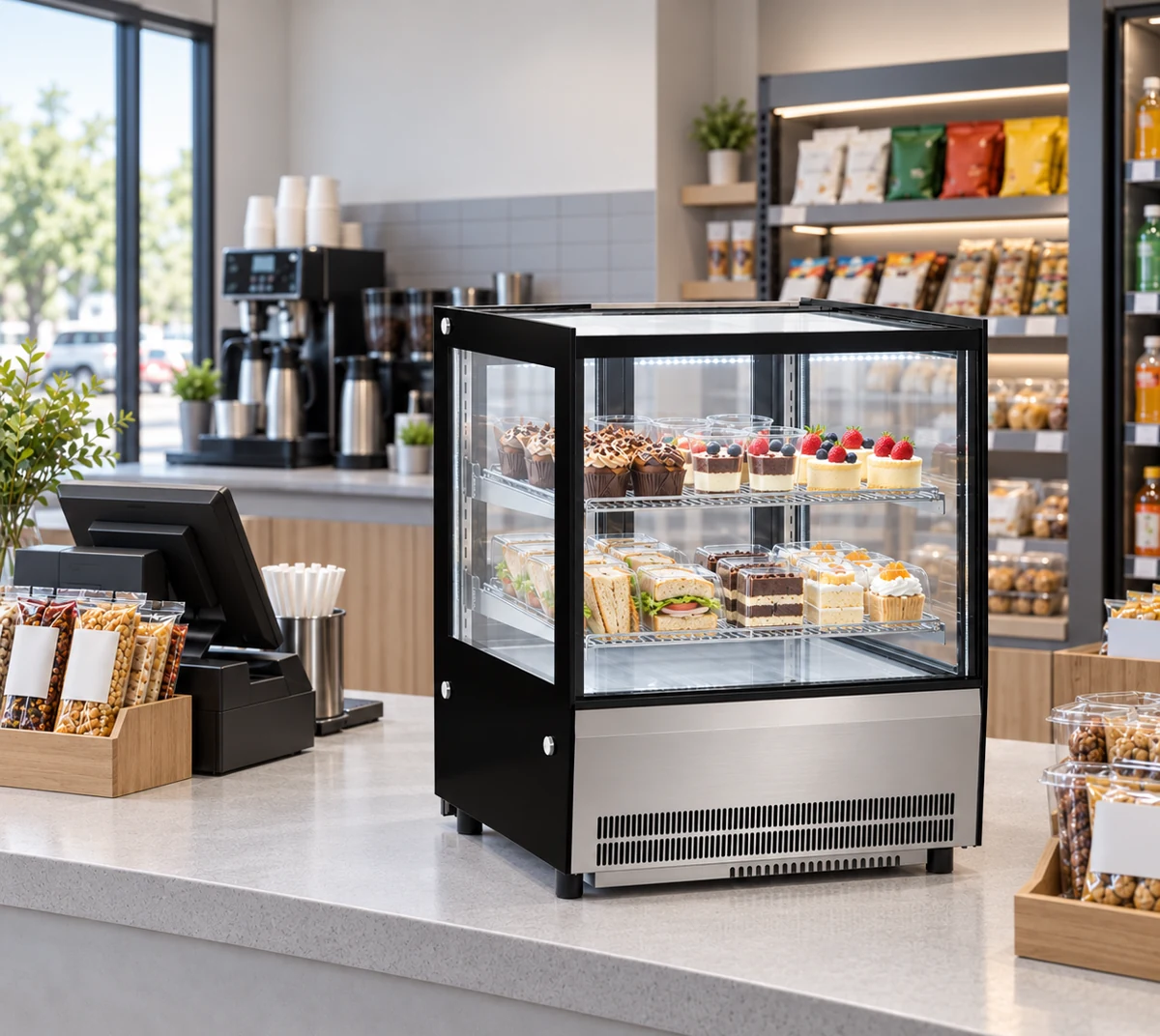
Does a wider display fridge always have a higher power rating?
Width alone does not identify a display fridge's recorded power rating. In this comparison, the 620 mm-wide GN-620FS lists 210 W, while the 660 mm-wide GN-660RT lists 250 W. Those are different cabinet formats: an upright beverage cooler and a countertop cake display. Their widths do not explain the rating difference or establish which cabinet suits the same assortment.
Start with the display format and the available space, then keep the complete model code beside its dimensions and electrical record. The table joins those fields for nine JINYU models. It is a purchasing schedule for comparing specific cabinets; it does not provide measured electricity consumption or an energy-efficiency ranking.
What changes when an RT countertop display gets wider?
GN-660RT measures 660 × 530 × 730 mm, records 102 L and lists 250 W. GN-900RT increases width to 900 mm, capacity to 140 L and rated power to 350 W. GN-1200RT is 1200 mm wide, records 190 L and lists 360 W. Depth and cabinet height remain 530 and 730 mm across these three models.
The width steps are 240 mm and 300 mm; the recorded power steps are 100 W and 10 W. Those unequal increments show why a wider cabinet cannot be assigned a rating by scaling the smaller model's watts. Put the actual model rating on each drawing revision, even when depth, height and the two-shelf arrangement stay the same.
Can curved and straight glass have the same size and watts?
Yes. GN-900CT and GN-900RT both measure 900 × 530 × 730 mm and list 350 W. Their listed capacities differ: 120 L for the curved-front CT and 140 L for the straight-glass RT. At 1200 mm width, GN-1200CT and GN-1200RT both measure 1200 × 530 × 730 mm and list 360 W, with capacities of 162 L and 190 L respectively.
These pairs share outside dimensions and recorded watts while retaining different display interiors. Choose between them using the front-glass profile, the actual product presentation and usable shelf measurements. A shared power figure supplies no evidence that the interiors hold the same trays or that the cabinets consume identical energy during operation.
How different are four display fridges at 1200 mm width?
GN-1200RT is the countertop option here: 530 mm deep, 730 mm high, 190 L and 360 W. GN-1200RF2 is a straight-glass floor cabinet measuring 730 mm deep and 1200 mm high, with 425 L and 455 W. GN-1200CK3 is a curved-glass floor cabinet at 740 mm deep and 1300 mm high, with 400 L and 515 W.
GN-1200L is an open-front cabinet at 740 mm deep and 1400 mm high, recording 295 L and 950 W. All four occupy 1200 mm of body frontage, but their height, depth, access and recorded power differ. The four-way table below keeps these distinctions together. A countertop model also needs its supporting counter represented in the room drawing.
Is a lower wattage proof of better energy efficiency?
No daily consumption measurement accompanies the ratings in this comparison. GN-620FS records 410 L and 210 W; GN-1200L records 295 L and 950 W. The FS has a hinged glass door and four wire shelves, while the L has open-front access and two shelves plus a base deck. They are different display arrangements with different exterior dimensions.
Do not turn those two watt figures into an annual saving or a claim about efficiency per litre. Request model-specific energy information with its measurement conditions if operating consumption is part of the decision. Keep that evidence in a separate column from rated power so a measured energy figure cannot be mistaken for the electrical rating copied from the cabinet record.
Can rated watts be converted directly into daily kWh?
The table records power in watts; a daily energy result needs information about operation over time. Multiplying a listed rating by a full day would introduce an assumption about continuous operation at that value. That assumption is not a measured consumption result for any of these models, so this guide supplies no daily kWh estimate.
For a consumption comparison, request the test report or measured operating record for the exact offered configuration. Keep its duration, room conditions and loading or access conditions attached to the result. Match the document's model identity to the size schedule. A figure from another cabinet width or another display format should not silently replace the missing evidence for the selected appliance.
Does the shared 220-240V/50Hz record settle the connection details?
All nine models in this table record 220-240V/50Hz. That shared field belongs on the shortlist, alongside each model's rated watts. It does not supply the model's plug details, starting characteristics or installation instructions. This table therefore provides no circuit, protective-device or cable selection.
Send the available site supply and destination with the exact model code, and request the offered configuration's electrical and installation documents. Keep the cabinet label and those documents with the person responsible for the site connection. If a model is substituted, update the size drawing and electrical schedule together; retaining the old rating beside a new model makes the equipment record internally inconsistent.
What should a size-and-power inquiry contain?
Name the preferred model and any alternative, then attach the cabinet position on a measured plan. Include usable counter dimensions for a CT or RT installation, the intended rear loading route for an enclosed cake cabinet, or the customer approach for an open-front L model. Add the actual tray, bottle or pack dimensions so the display layout can be discussed separately from cabinet volume.
Record the available voltage and frequency, destination and the electrical documents requested for each candidate. Use the worksheet below to keep supplied records separate from requested documents. Shaanxi Jinyu Kitchenware Co., Ltd. (陕西金宇厨具有限公司) handles JINYU inquiries through the linked form. Retain complete model suffixes in the inquiry and in any later equipment substitution.