Buyer planning guide
Display Fridge Size: Model Numbers vs Actual Dimensions
Check eight JINYU model codes against cabinet dimensions and litres. GN-868FM is 1220 mm wide, not 868 mm; compare same-number cabinets and prepare a size inquiry.
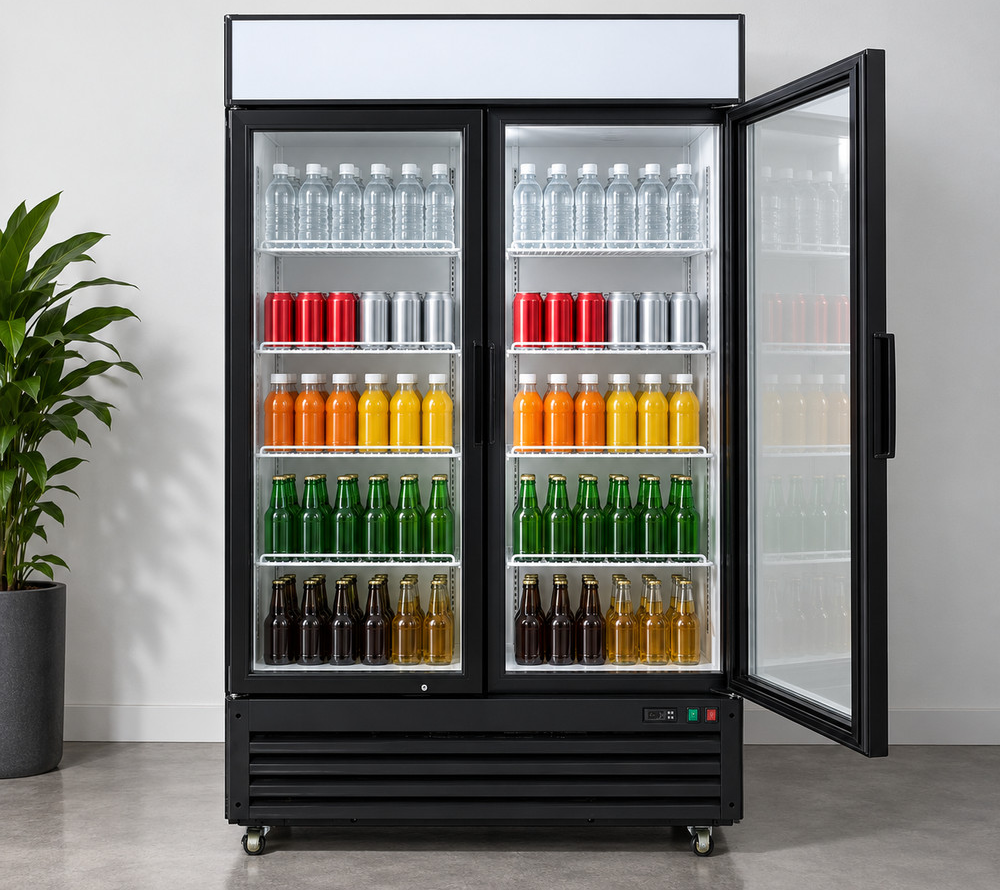
Eight full model codes beside their recorded cabinet sizes
Read each identifier as a complete reference. Dimensions below describe the cabinet body, with width first; listed litres occupy a separate column.
| Full model reference | Width × depth × height (mm) | Listed capacity | Installation |
|---|---|---|---|
| GN-620FS | 620 × 700 × 2018 mm | 410 L | Freestanding |
| GN-868FM | 1220 × 690 × 2048 mm | 960 L | Freestanding |
| GN-900CT | 900 × 530 × 730 mm | 120 L | Countertop |
| GN-900RT | 900 × 530 × 730 mm | 140 L | Countertop |
| GN-1200CT | 1200 × 530 × 730 mm | 162 L | Countertop |
| GN-1200RT | 1200 × 530 × 730 mm | 190 L | Countertop |
| GN-1200RF2 | 1200 × 730 × 1200 mm | 425 L | Freestanding |
| GN-1200L | 1200 × 740 × 1400 mm | 295 L | Freestanding |
Model and size inquiry worksheet
| Record | Buyer information | Requested response |
|---|---|---|
| Equipment identity | Full model code; preferred or alternative; position reference | Offered code and configuration revision |
| Cabinet body | Width × depth × height in mm; catalogue reference | Dimensioned cabinet drawing |
| Site position | Measured counter or floor outline and access sides | Installation spacing and service-access drawing |
| Displayed items | Finished pack dimensions and intended orientation | Usable shelf and loading-opening measurements |
| Delivery package | Receiving route and package identifiers | Shipment-specific packed dimensions and gross weight |
| Specification difference | Original value, offered value, units and source revisions | Identified response against the changed field |
Can I read a display fridge size directly from its model number?
Use the complete model number to identify the cabinet, then read width, depth, height and capacity from separate specification fields. GN-868FM is a clear example: its recorded cabinet dimensions are 1220 × 690 × 2048 mm and its listed capacity is 960 L. The number 868 in that identifier is neither its width in millimetres nor its listed volume in litres. No code-decoding rule is needed to compare the actual measurements.
Some other JINYU identifiers do contain digits that match a recorded width. GN-620FS is 620 mm wide, and GN-1200RT is 1200 mm wide. Those matches do not establish a naming rule for the catalogue. Keep the full identifier, including its suffix, beside the specification. The comparison table pairs eight actual models with their recorded dimensions so a buyer can check the size without interpreting the name.
What happens if I mistake 868 for the width of GN-868FM?
The recorded GN-868FM width is 1220 mm. Treating 868 as its width would understate the cabinet body by 352 mm. On an illustrative 1500 mm equipment run, subtracting the actual 1220 mm leaves 280 mm of gross length. Subtracting 868 instead would show 632 mm, creating a misleading layout before installation spacing or door movement has even been considered.
The table below shows the real cabinet outline. Copy that outline onto the room plan and identify the customer side, the two hinged glass doors and the route used to restock the cooler. The 280 mm remainder in this example is unallocated frontage, not a clearance recommendation. Request the selected configuration's installation drawing and show the required spacing and access separately. Retain the full GN-868FM code on the drawing so a later substitution cannot inherit its dimensions by accident.
Do matching 1200 model numbers identify the same display fridge size?
GN-1200CT, GN-1200RT, GN-1200RF2 and GN-1200L each have a recorded width of 1200 mm. Their remaining dimensions differ. CT and RT are both 530 mm deep and 730 mm high. RF2 is 730 mm deep and 1200 mm high. L is 740 mm deep and 1400 mm high. Copying only the shared width would hide differences in the cabinet outline and installation format.
CT and RT are countertop cake displays, RF2 is a freestanding straight-glass cake display, and L is an open-front grab-and-go chiller. A countertop drawing needs the support surface as well as the cabinet body. A floor-standing drawing starts from the floor. Compare the full three-dimensional outline and the service arrangement before deciding which equipment belongs in a position labelled 1200 mm on a plan.
Does a model number tell me the available shelf space or capacity?
Read listed capacity independently from the identifier and from the outside dimensions. GN-1200CT records 162 L, while GN-1200RT records 190 L despite sharing a 1200 × 530 × 730 mm exterior. GN-1200RF2 records 425 L and GN-1200L records 295 L. Their common width does not establish equal volume, and a volume figure does not provide the usable shelf width or the loading opening.
Prepare an item list with the complete dimensions of the cake boards, bottles or finished packs you plan to display. Request usable shelf measurements and access dimensions against the full model code. Keep the returned shelf drawing beside the cabinet specification. If a proposal changes from CT to RT, retain both records and compare the actual shelf arrangement rather than converting the additional listed litres into a promised number of cakes.
How should I compare the single-door and two-door beverage cooler codes?
GN-620FS measures 620 × 700 × 2018 mm and lists 410 L. GN-868FM measures 1220 × 690 × 2048 mm and lists 960 L. Moving from FS to FM therefore adds 600 mm of cabinet width and 30 mm of height, while reducing recorded body depth by 10 mm. These are differences between the two model records, not values inferred from their names.
The FS has one hinged glass door; the FM has two. Include door approach, product removal and replenishment on the site drawing. Request the actual door-swing and usable shelf dimensions for the proposed configuration. Two FS bodies would total 1240 mm in width and 820 L of listed volume, whereas one FM is 1220 mm wide and lists 960 L. These arithmetic totals compare separate cabinet choices; two single-door units still retain two independent interiors.
Which fields belong in a model-to-dimension inquiry schedule?
Use a row for each proposed cabinet position. Record the full model code, cabinet width, depth and height with units, listed capacity, installation format and drawing reference. Give an alternative model its own row. For a pair of cabinets, add a position identifier such as left or right so the response can identify which specification changes when one model is replaced.
The worksheet below keeps catalogue facts, site measurements and requested documents in separate columns. Attach a measured room or counter plan and identify the product assortment. Ask the response to repeat the complete model code beside every drawing. If the reply contains a different dimension, preserve the original request and the offered value together, with their document revisions. Resolve the difference against the proposed configuration before updating the equipment outline.
What should I send JINYU when a code and a dimension appear inconsistent?
Send the complete model reference, the dimension that needs review, its unit and the document or photograph where it appears. Mark whether you are comparing cabinet dimensions, an installation opening, usable shelf dimensions or a packed shipping measurement. Those describe different objects. A measurement copied from a crate record should retain its package label rather than replacing the cabinet size on the room drawing.
Request the current configuration drawing and an identified specification response. Use the model links in the table to retain each catalogue reference. This gives the purchasing team a traceable comparison: the identifier names the proposed equipment, while the dimension fields describe the size being reviewed.
Reference sources
- Display fridge size buying guide
- Upright beverage cooler size comparison
- Display fridge size chart
- Prepare a refrigeration inquiry
Regional references support general planning; model-specific specifications come from the published JINYU model tables.