Buyer planning guide
Grab-and-Go Counter: Which Refrigerated Equipment Do You Need?
Choose equipment for a grab-and-go counter: distinguish customer self-service, staff ingredient prep and order collection, then compare four JINYU L chillers.
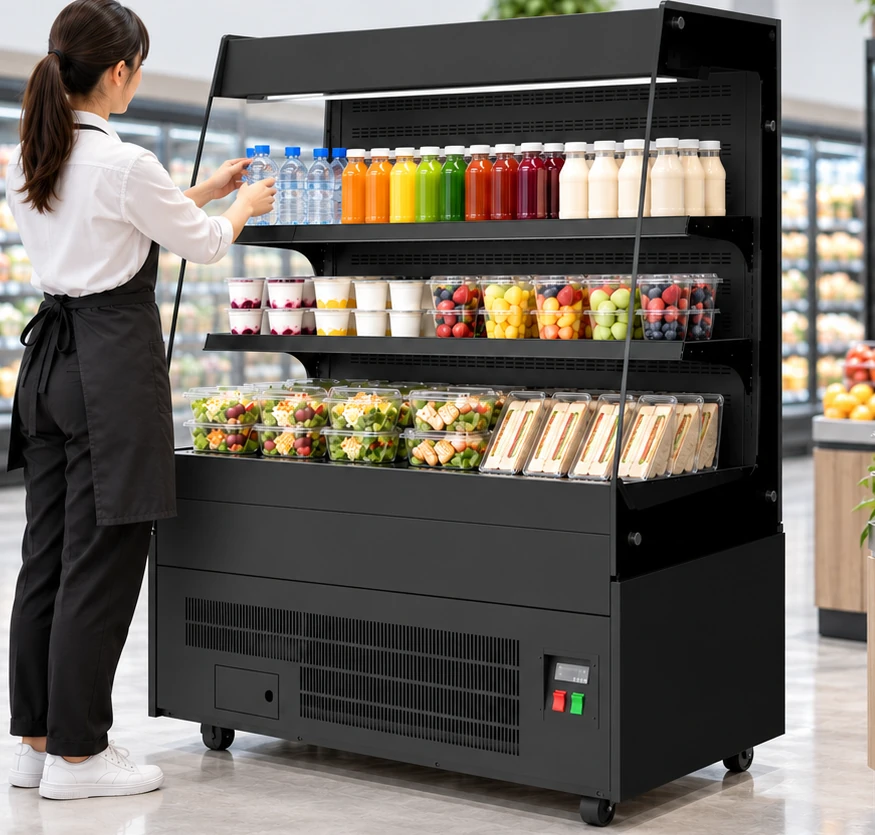
What is a grab-and-go counter, and which part needs refrigeration?
A grab-and-go counter is a service area where customers select ready-packed items, collect an assembled order or combine those steps before paying. The term describes the selling arrangement; it does not identify one refrigerator type. Start by separating the customer display, the staff preparation station and the collection surface on your plan. Each has a different job.
For direct selection of chilled packs and drinks, compare an open-front display such as the JINYU L series. For staff assembling food from ingredient pans, compare a topping prep fridge. A collection surface is neither of those by itself. Decide which items need chilled storage while awaiting collection, then assign them an appropriate refrigerated position rather than assuming the entire counter is refrigerated.
When does an open-front chiller suit customer self-service?
Choose the open-front format when customers should reach directly for a finished pack without asking staff to open a service-side door. L-series chillers have glass side panels and a light under the top canopy. Their open front faces the shopper, so the same face also needs to be accessible when staff replenish products.
Map the customer journey from browsing to payment and collection. A bottled drink selected from a shelf and a sandwich prepared after ordering follow different paths. Put ready-packed chilled items together where their labels can be read, and keep the staffed assembly position distinct. If shoppers need assistance for every item, review a staffed display format before committing the frontage to self-service equipment.
Which JINYU L model fits a 900, 1000, 1200 or 1500 mm frontage?
The four L cabinets are freestanding, with a common depth of 740 mm and overall height of 1400 mm. GN-900L is 900 mm wide with 235 L capacity; GN-1000L is 1000 mm wide with 245 L. GN-1200L combines a 1200 mm width with 295 L, and GN-1500L is 1500 mm wide with 365 L.
Compare the frontage you can allocate with the assortment you intend to sell. Moving from GN-900L to GN-1000L adds 100 mm of width and 10 L of listed capacity; external width and litre capacity do not increase in the same proportion. The dimensions below describe cabinets, not a completed installation bay. Keep adjacent counters, connection access and the required service space on the same drawing.
| Model | Width × depth × height | Capacity | Rated power | Voltage / frequency |
|---|---|---|---|---|
| GN-900L | 900 × 740 × 1400 mm | 235 L | 820 W | 220-240V/50Hz |
| GN-1000L | 1000 × 740 × 1400 mm | 245 L | 840 W | 220-240V/50Hz |
| GN-1200L | 1200 × 740 × 1400 mm | 295 L | 950 W | 220-240V/50Hz |
| GN-1500L | 1500 × 740 × 1400 mm | 365 L | 1080 W | 220-240V/50Hz |
Is a topping prep fridge an alternative to a customer grab-and-go display?
An SC topping prep fridge stores ingredients in a single row of 1/3 GN pan positions beneath a hinged lid. The recorded SC range spans four to ten positions, with cabinet lengths from 1130 to 2180 mm, 405 mm depth and 280 mm height. That arrangement serves a staff ingredient station rather than a shelf display of finished retail packs.
A sandwich counter may need both functions: staff use ingredient pans to assemble orders while customers choose a drink or packed side from an L chiller. Draw them as separate equipment positions. The SC cabinet dimensions do not establish the dimensions of a complete preparation workstation, and an L cabinet has no recorded cutting board or ingredient-pan row. Select each unit for the task it actually performs.
How do I turn a menu into a shelf plan without guessing pack counts?
List the finished products customers will pick, then record each pack's outside width, depth and height. Include labels, protruding lids and the orientation in which the pack will be displayed. Separate bottles from flat food packs if they need different shelf arrangements. Send that list with a request for usable shelf dimensions and loading guidance for the selected cabinet.
GN-900L, GN-1200L and GN-1500L list two shelves plus a base deck; GN-1000L lists two shelves. The published litre capacity is not a pack count or a sales-throughput rating. Build the assortment around the available shelf surfaces after reviewing the configuration. Keep reserve stock as a separate quantity in your plan so it is not confused with the visible retail display.
Where should payment, collection and replenishment sit around the display?
Sketch the counter as a sequence of activities: choose chilled items, place or pay for an order, then collect any staff-prepared items. Mark where a customer pauses at each step. A queue in front of the open shelves can interrupt browsing; a collection point on the same face can compete with staff replenishment. Test the proposed arrangement with the actual counter and cabinet footprints marked out.
Record the route staff use to bring replacement packs from storage to the display. Include the temporary position of a refill tray or trolley. Use the separate aisle-planning guide for the detailed access review, and request model-specific installation clearances. Cabinet width alone cannot establish an acceptable customer aisle or approve the complete shop layout.
What cooling and electrical facts belong in the equipment comparison?
The L-series records fan cooling, automatic defrost, R290 refrigerant and a 2-8 C temperature range. Its listed supply is 220-240V/50Hz. Rated power is 820 W for GN-900L, 840 W for GN-1000L, 950 W for GN-1200L and 1080 W for GN-1500L. Carry the exact model code alongside those electrical entries when comparing proposals.
Rated watts are not measured daily energy consumption. Request measured energy data and test conditions if operating-cost evidence is part of the purchase review. For the food assortment, compare each product's storage instructions with the offered equipment and your operating procedure. Ask for installation and loading documents for the selected configuration; a catalog temperature range does not establish the storage suitability of every item on the menu.
What should I send JINYU for a grab-and-go counter inquiry?
Send the proposed counter plan, photographs of the intended position and a list of ready-packed products with their outside dimensions. Identify which items customers select directly, which staff assemble and where completed orders wait for collection. Name the L model or candidate widths, and identify any separate ingredient-pan station. Include the destination, site electrical supply and receiving-route measurements.
Ask JINYU for usable shelf dimensions, the offered configuration, installation clearances and electrical documentation. Keep the same plan revision with the reply. That gives your shop-fit team a specific cabinet, assortment and service arrangement to review together, rather than an ambiguous request for a grab-and-go counter.
Reference sources
- Prepare the cabinet parts and service document index
- Plan stock loading and shelf facings
- Compare four L-series grab-and-go chillers
- GN-900L dimensions and specifications
- GN-1000L dimensions and specifications
- GN-1200L dimensions and specifications
- GN-1500L dimensions and specifications
- Compare SC ingredient-pan topping prep fridges
- Plan open-front display aisles and replenishment access
- Send your equipment inquiry
Regional references support general planning; model-specific specifications come from the published JINYU model tables.