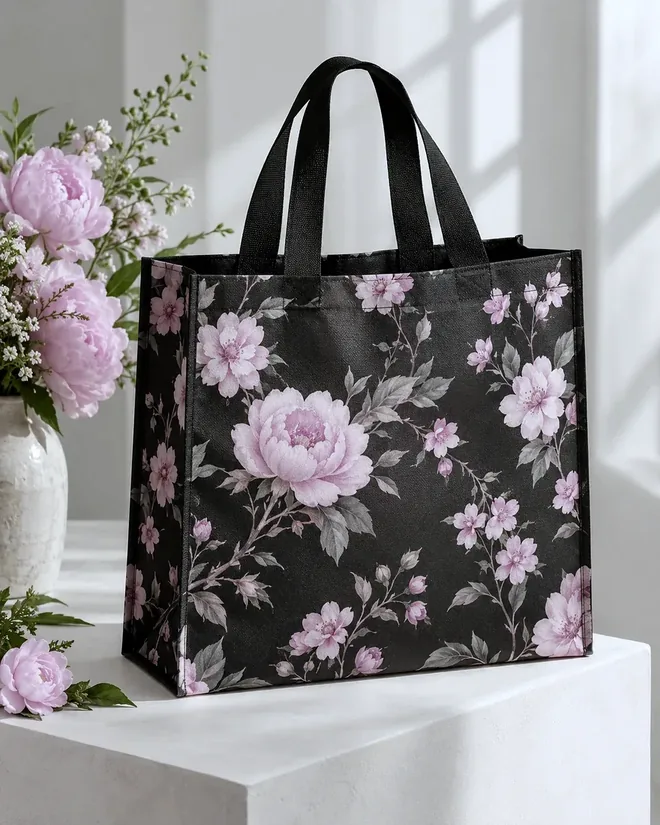
Does a non-woven bag size chart include the handles?
The JINYU catalogue dimensions describe the outside bag body, excluding separate loop handles. Read width, body height and depth in that order. A 38 × 42 × 10 cm tote therefore has a listed 42 cm body height; that number does not tell you the distance from the base to the top of its raised handles. Keep body height and handle drop in separate fields when comparing drawings.
The chart below retains six catalogue references across takeaway, loop-tote and gusseted-shopper families. It deliberately leaves handle measurements out of the product facts because the catalogue does not record them. Ask for a measured sample view of the offered stock reference, with the measurement endpoints visible. A lifestyle photograph identifies the presentation, while the dimensioned record identifies the body and handle geometry.
What is the difference between handle drop and complete handle length?
Handle drop is the straight distance from a stated body-top datum to the inside of the raised handle at its highest point. State how the handle is held during measurement and whether the bag is empty. Complete handle length follows the strap itself, including the portions attached to the body when those portions are included in the agreed convention. Those measurements follow different paths.
A curved loop cannot be described by doubling the drop. Its shape, attachment spacing and the length used at the attachments affect the relationship. Ask for both dimensions on a drawing if both matter to the project. Identify the inside edge used for the drop measurement and show the top-edge datum on the photograph. This avoids comparing one supplier response measured to the inside of the loop with another measured to its outside edge.
How do I calculate the overall raised-handle height?
For an empty bag held with its body vertical, overall raised-handle height can be recorded as body height plus the measured vertical handle projection above the same top-edge datum. In an illustrative sample, a 42 cm body with a 20 cm projection reaches 62 cm from the body base to the raised handle endpoint. A second sample with the same body and a 26 cm projection reaches 68 cm. These handle values are worked examples, not JINYU stock specifications.
The difference is 6 cm even though both bodies could carry the same 38 × 42 cm size label. Use this calculation to reconcile the labelled drawing with a photograph, then measure the actual filled bag separately. Gathering, fabric bending and the carrying position change the shape of a soft bag. An empty-bag elevation does not establish its position against a person during use.
Can I use overall height to choose a shoulder bag?
Use the actual offered sample and the intended contents to review shoulder carrying. Record whether the trial is over a shirt, jacket or coat and photograph the handle resting position without publishing personal details. Measure the filled contents separately, including projecting folders or boxes. Compare the space below the handles and the way the opening gathers when the sample is lifted.
The 42 cm body height shared by JY-PL-01 STD, JY-PL-01 FLAT and JY-PL-02 TALL does not identify a common handle drop or carrying fit. STD has a listed 10 cm depth, FLAT has no listed gusset depth and TALL has 15 cm depth. Those differences identify body construction. Ask the stock reply to identify its actual handle arrangement rather than transferring a handle measurement from a visually similar bag.
Where should I measure a bag with a D-cut opening?
A D-cut opening sits within the body panel. Show the body top, cutout top and cutout bottom as distinct positions on a sketch. Record the clear cutout width and height against the specific sample, then show how the intended contents sit below or beside that opening. There is no separate raised loop to add to the body height for this construction.
Keep an integrated opening and a separate loop handle on different comparison lines. A body-height comparison alone would conceal the space occupied by the cutout and its effect on loading. If a rigid item must pass through the mouth, record its outside dimensions and the insertion direction. Request a loading view using that item or its dimensioned outline. The outside body chart supplies a reference size; the sample supplies the opening geometry.
How should I record the handle measurement for a stock inquiry?
Use one line per product SKU and variant. Add body width, body height and depth from the chart, then a separate requested-measurement field for handle drop, attachment spacing and clear opening. Attach a marked sketch defining the endpoints. Ask the reply to return a photograph of the offered stock item using those same endpoints and units, along with its colour and construction description.
Record the sample identity and date beside the returned values. When a different colour or stock batch is offered, retain its own sample reference so the dimensions stay attached to the actual proposal. Non-woven small-quantity requests follow the stock route. A request to change body dimensions or handle construction belongs in a separate specification discussion; a measurement worksheet itself does not establish that a modified stock item is available.
What should accompany the size and handle worksheet?
Send the selected catalogue reference, intended contents, carrying method, requested colour, quantity and destination. Include the body-size row and a drawing with the handle measurement convention. If artwork is requested, show its position relative to the body top and handle attachments. The print area needs its own measurement; adding handle projection to body height does not enlarge the printable body panel.
Use the returned sample record to reconcile three separate items: catalogue body dimensions, measured handle geometry and the filled-bag carrying trial. Keep observations such as opening access or shoulder position beside the sample reference. Send the completed brief to Shaanxi Jinyu Kitchenware Co., Ltd. through the JINYU inquiry page. The same product and variant identifiers should remain visible in the written response and any sample photographs.