Can I convert a non-woven bag size chart into litres?
You can calculate the volume of a rectangular outline when the chart gives width, body height and gusset depth. With all three measurements in centimetres, multiply them and divide by 1000 to express that geometric volume in litres. This is a calculation from the listed outside dimensions. It is not a measured capacity for the finished bag.
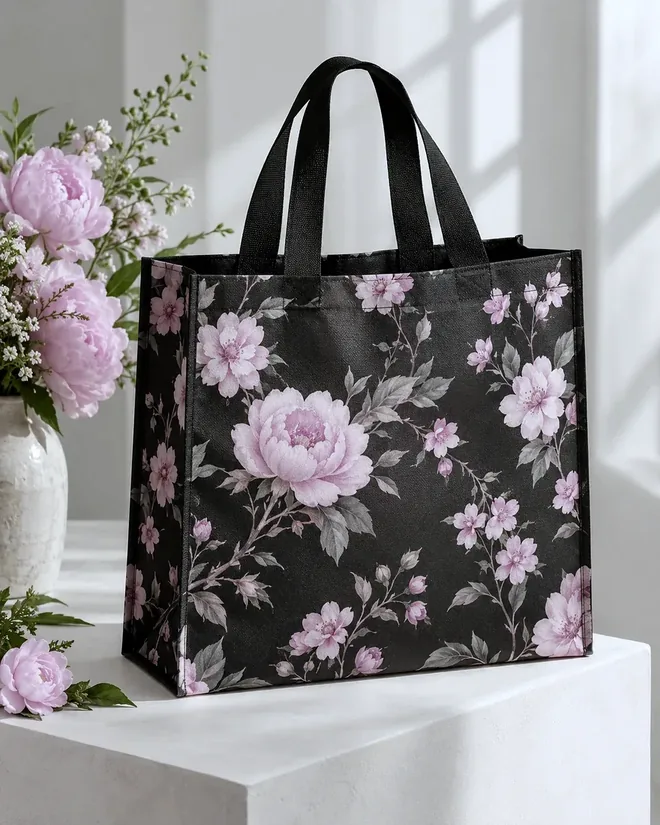
For JINYU JY-PL-02 STD, the catalogue dimensions are 40 × 35 × 15 cm. The rectangular calculation is 40 × 35 × 15 ÷ 1000 = 21 litres. Seams, the shape of the opened bag, the usable opening and the way contents sit affect the space available in practice. Keep the 21 L figure labelled as a calculated rectangular envelope whenever it appears beside this reference. Use the actual dimensions to identify the bag.
Which catalogue sizes have different calculated envelopes?
The table compares five gusseted variants and one flat variant. Within JY-PL-02, RETAIL30 is 30 × 35 × 10 cm, STD is 40 × 35 × 15 cm, EVENT is 36 × 43 × 10 cm and TALL is 38 × 42 × 15 cm. Their calculated envelopes are 10.5, 21, 15.48 and 23.94 L respectively. JY-PL-01 STD is 38 × 42 × 10 cm, giving 15.96 L.
These values describe rectangular geometry from catalogue measurements. They do not establish how much liquid a bag holds, how many groceries it carries or a tested load. Comparing STD and EVENT also shows why body height alone is a poor shortcut: EVENT is 8 cm taller but has a smaller calculated envelope because its width and depth are smaller. Retain all three measurements and the complete product code in a shortlist.
Why does a flat bag have no litre result in this chart?
JY-PL-01 FLAT is listed as 38 × 42 × 0 cm. The zero identifies a flat catalogue construction without a listed base gusset. Multiplying the three entries would give zero, but that would be a misleading statement about its ability to carry contents. A flat bag changes shape around a pack, using part of its face width to accommodate thickness. The chart therefore displays a construction explanation instead of a litre figure.
Compare JY-PL-01 FLAT and STD by their construction as well as their shared 38 × 42 cm face dimensions. STD has a listed 10 cm depth; FLAT does not. Send the actual pack width, height and thickness when discussing either option. Request the opening and seam-to-seam measurements for the offered bag and review a filled sample before using the face dimensions as a packing decision.
Can two bags with similar litre calculations carry the same box?
No single volume figure describes the shape of a box or the opening through which it enters. Consider an illustrative rigid pack measuring 32 × 12 × 30 cm, with 32 × 12 cm as its intended base. Its rectangular volume is 11.52 L. That is below EVENT's 15.48 L envelope, yet the pack's 12 cm base depth exceeds EVENT's listed 10 cm gusset depth by 2 cm in that orientation. The litre comparison has hidden a dimensional conflict.
STD has a listed 40 × 15 cm base outline, leaving nominal outside differences of 8 cm in width and 3 cm in depth against that example. Those differences are not usable clearances inside the finished bag. Label them as outline comparisons and request the internal base and opening measurements. Keep the example box separate from the catalogue facts: it illustrates the calculation and is not a stated bag capacity or fit result.
How should I record the filled sample?
Give the sample the same product and variant code used in the size chart. Photograph it empty beside a measurement reference, then record the body width, body height, gusset and usable opening using labelled endpoints. Identify whether a value comes from the catalogue, an offered drawing or the physical sample. This makes a difference between the documents visible without silently replacing one measurement with another.
Pack the intended contents in their actual wrapping and chosen orientation. Record the number of pieces, the highest point of the contents, the available space near the opening and any distortion of the base or sides. Photograph the filled bag from the front, side and above. Record handle access as a separate observation. A filled photograph documents that particular trial; it does not establish a maximum carrying weight or a general capacity for other contents.
Does a larger calculated volume mean a stronger bag?
The size multiplication contains no fabric, seam or handle information, so it cannot establish carrying strength. Two bag bodies can have similar calculated envelopes while differing in fabric weight, handle attachment and construction. Keep those details on separate lines in the inquiry. Likewise, fabric weight by itself does not supply a tested carrying limit for the complete bag assembly.
Describe the intended contents and their actual combined weight when requesting construction information. Ask for evidence tied to the proposed bag and its handle arrangement if the project has a carrying requirement. Keep any returned document attached to its sample or configuration reference. The size chart remains a dimensional comparison, while the sample observations and construction evidence answer different purchasing questions.
What should I send with a dimensions-versus-litres inquiry?
Send the product reference, variant, listed width × body height × depth and intended contents to Shaanxi Jinyu Kitchenware Co., Ltd. (陕西金宇厨具有限公司). Include pack dimensions, orientation, quantity and destination. If you have used a calculated litre figure in an internal comparison, label it as an outside rectangular envelope and keep the original three dimensions next to it.
Attach the packing worksheet and identify the opening, internal base or construction measurements requested for review. Non-woven bags at small quantities are stock selections; specify the selected stock reference and ask about its available configuration. Keep a custom canvas or travel-bag request on a separate line with its own drawing. Preserve the returned drawing and sample record with the inquiry revision so the final selection refers to one identifiable bag.