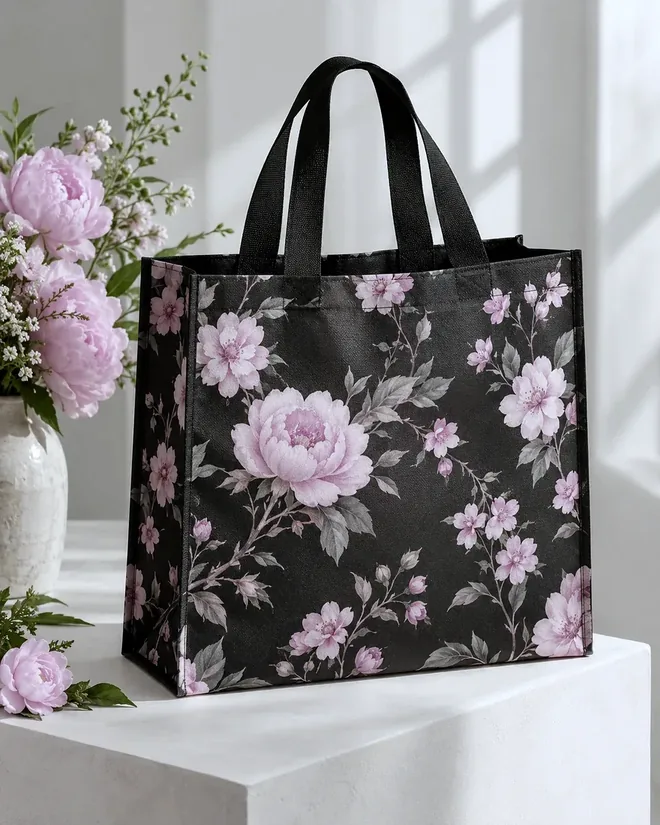
How do I read portrait, landscape and square on a non-woven bag size chart?
Compare the first two body dimensions: width and height. A portrait body is taller than it is wide; a landscape body is wider than it is tall; a square body has equal listed width and height. Keep gusset depth as a third, separate measurement. The chart below uses outside body dimensions in centimetres, excluding handles. Its orientation labels and width-to-height ratios are calculated from those dimensions.
For example, JY-PL-02 STD is 40 × 35 × 15 cm and therefore landscape. JY-PL-02 EVENT is 36 × 43 × 10 cm and therefore portrait. JY-ST-03 M is 24 × 24 × 15 cm and therefore square. These labels describe the body outline. The references have different constructions and closures, so choose the bag type as well as its proportions before requesting the selected variant.
Which portrait non-woven shopper sizes can I compare?
Four portrait references in this chart give different width, height and depth combinations. JY-PL-02 EVENT is 36 × 43 × 10 cm; TALL is 38 × 42 × 15 cm; XL is 44 × 48 × 14 cm. JY-PL-03 STD is a flat D-cut bag at 30 × 40 × 0 cm. The zero-depth catalogue entry identifies the flat construction rather than an opened base gusset.
Keep the product reference and variant together when discussing these options. TALL and XL are catalogue codes, not universal dimensions. The EVENT variant is actually 1 cm taller than TALL, while TALL is 2 cm wider and has 5 cm more listed depth. A name-based shortlist would miss those differences. Copy all three dimensions into the inquiry, then request the construction drawing and the selected colour or stock option against that exact reference.
What changes when I switch from a landscape shopper to a portrait shopper?
Compare JY-PL-02 STD with EVENT within the same shopper family. STD is 40 cm wide, 35 cm high and 15 cm deep. EVENT is 36 cm wide, 43 cm high and 10 cm deep. Moving from STD to EVENT reduces width by 4 cm, increases body height by 8 cm and reduces listed depth by 5 cm. Those are three separate changes, rather than a rotation of the same bag.
Prepare front and base views with the handles drawn at the top. Label the width across the opening, body height below the handles and base depth. Place the intended contents beside that sketch and record their actual outside measurements. Ask for a physical sample or dimensioned drawing when reviewing the opening and base. Body dimensions alone do not establish usable opening width, packed fit or carrying strength.
Can I turn a size around and call it the same bag?
Swapping the first two numbers changes which edge carries the handles and where the opening sits. A request for 35 cm width and 40 cm height describes a different body orientation from JY-PL-02 STD at 40 cm width and 35 cm height. It also does not identify the separate RETAIL35 variant, whose catalogue dimensions are 35 × 40 × 10 cm. Preserve the depth and code whenever comparing these records.
On an inquiry sketch, write W, H and D beside the relevant arrows. Avoid an unlabelled pair such as 35 × 40, which leaves the orientation and gusset unanswered. If a proposal lists its dimensions in another sequence, ask for a labelled drawing and transcribe the values into your own width-height-depth columns. Retain the original proposal so the buyer and supplier can trace how each value was interpreted.
Does a square bag have the same construction as a landscape shopper?
The square example here is JY-ST-03 M, a self-seal insulated bag with a listed 24 × 24 × 15 cm body. The two small landscape examples are open-top foil bags: JY-ST-02 S at 24 × 23 × 14 cm and M at 27 × 25 × 14 cm. Their proportions can be compared numerically, but their openings and closures belong to different product descriptions.
Keep construction, lining and closure in separate inquiry fields beside the dimensions. A square body outline does not make a self-seal insulated bag an alternative specification for a plain retail shopper. Identify the intended use first, then compare variants within the relevant construction. Request the actual offered lining, closure and sample details rather than assigning thermal performance, sealing behaviour or carrying capacity from an orientation label.
How should artwork orientation follow the selected bag size?
Use the bag front view with handles at the top as the reference for artwork orientation. Add a separate arrow showing the top of the logo or design. This keeps a landscape graphic on a portrait bag distinct from a landscape bag body. Record requested artwork width and height in millimetres, then attach a placement drawing for each face and variant.
The body width-to-height ratio is a way to compare outlines; it does not define the printable area. In this chart, JY-PL-02 STD has a ratio of 40 ÷ 35, rounded to 1.14, while EVENT has 36 ÷ 43, rounded to 0.84. A design placed on those two shapes needs a variant-specific proof. Request the proposed print boundary, artwork dimensions and edge distances on the returned drawing, and keep the proof revision attached to the bag code.
What should I send JINYU after choosing the body orientation?
Send a short variant schedule to JINYU, Shaanxi Jinyu Kitchenware Co., Ltd. (陕西金宇厨具有限公司). Include the product reference, variant code, labelled body dimensions, construction, requested colour and quantity. Attach the contents measurements and any artwork drawing. For a mixed selection, give each variant its own row so a portrait and a landscape requirement cannot be merged into one ambiguous size.
Non-woven bags at small quantities follow the stock selection route. Ask which selected variant and colour can be offered; keep a custom artwork request as a separate item for a written response. Compare the returned product code, dimensions and construction with your schedule before reviewing the proof or sample. If any dimension changes, issue a revised row and drawing together. That leaves the final selection tied to one identifiable bag rather than a generic orientation description.