How do I use a non-woven bag size chart for several stock sizes?
Start with the product reference and variant together, then copy the outside width, body height and gusset depth into separate columns. The six references on this page come from two JINYU catalogue families: JY-ST-01 takeaway shoppers and JY-PL-02 gusseted shoppers. A code such as M belongs to its own family; it cannot identify a size in another range. Keep the product name beside the code when preparing a mixed request.
Next, give each selected size a quantity rather than asking for a single total across all sizes. At small quantities, non-woven bags follow the stock selection route. Ask which exact size and colour can be offered against each line. The chart provides catalogue references for that discussion. It does not establish current inventory or make every shown design available as a stock item.
Which dimensions belong on each stock inquiry line?
Use centimetres and the order width × body height × depth, excluding the separate handles. JY-ST-01 S is 21 × 24 × 12 cm, M is 23 × 25 × 14 cm, and L is 25 × 26 × 18 cm. In the other family, JY-PL-02 RETAIL30 is 30 × 35 × 10 cm, RETAIL35 is 35 × 40 × 10 cm, and RETAIL40 is 40 × 45 × 12 cm.
The depth changes as well as the width and height. Moving from RETAIL35 to RETAIL40 adds 5 cm to width, 5 cm to body height and 2 cm to depth. Record all three differences if an alternative is offered. Outside body dimensions identify the reference, while usable opening and internal clearance need their own review with the actual contents.
How can two outlets share a size schedule without losing the totals?
Give each outlet a quantity column and keep shared reserve in a third column. The illustrative schedule below allocates 100 bags to Outlet A, 90 to Outlet B and 50 to shared reserve, for 240 bags across six product-size lines. For JY-ST-01 M, 30 + 20 + 10 produces a line total of 60. Adding all six line totals produces the same 240 as adding the three allocation columns.
These are worked buyer quantities, not order conditions or available-stock counts. Replace them with your own allocations before sending the inquiry. Reserve held at one location should appear once in the schedule. If the buyer later distributes it between outlets, update the allocation record while retaining the original product-size identifiers. This keeps an internal transfer distinct from an additional supply request.
Should colour and artwork create separate size lines?
Split a line when the requested colour or decoration changes, and retain the parent product-size reference. For example, a buyer could divide the illustrative 60 JY-ST-01 M bags into requested colour lines of 35 and 25. Their sum remains 60. Those numbers describe a proposed allocation; they do not establish that either colour is available. Ask the stock response to identify the offered colour against each subline.
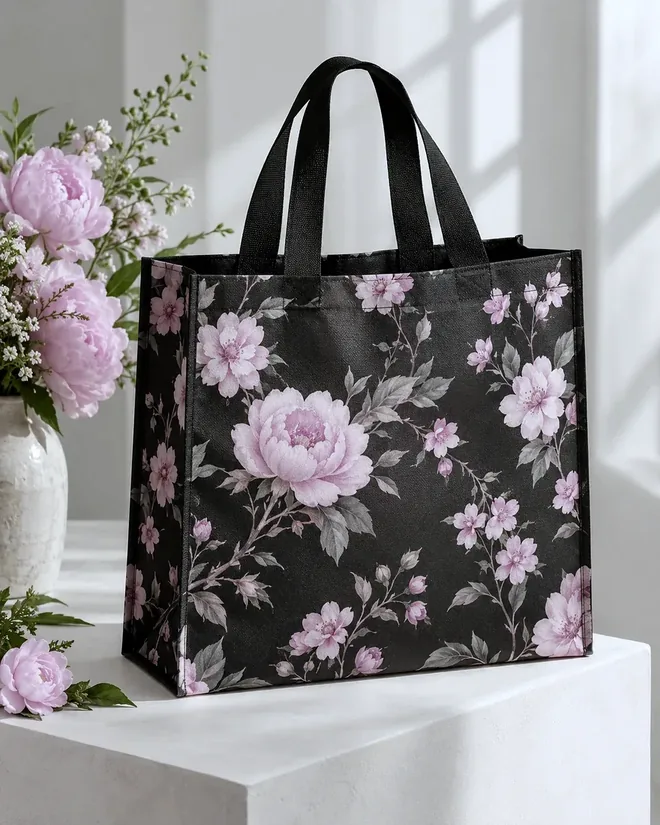
Keep artwork requests beside the relevant colour line with the artwork file, printed faces, dimensions and revision. A floral photograph shows a visual concept, while a returned offer identifies the bag and decoration actually proposed. If plain stock and decorated bags are both under discussion, distinguish those requests in the schedule so the written response addresses each one explicitly.
What should I record when the requested size is unavailable?
Retain the requested row and add the offered alternative alongside it. Record its product reference, variant, three dimensions, colour and construction description. Include the quantity offered for that alternative as its own field. A reply offering one different size for several requested rows needs a clear allocation before it can be compared with the original schedule.
For instance, replacing a RETAIL30 reference of 30 × 35 × 10 cm with RETAIL35 at 35 × 40 × 10 cm changes width and height by 5 cm each and leaves the listed depth unchanged. Those differences help the buyer decide what to review. They do not establish interchangeable packing, artwork placement or carrying performance. Keep any accepted change with the corresponding line reference and issue a revised allocation sheet.
Does the size schedule also define cartons and delivery splits?
The allocation table counts bags. Carton counts, packed dimensions and gross weights come from the offered packing arrangement. Keep these fields separate rather than dividing the bag total by an assumed carton quantity. If bags for the two outlets need distinct labels or inner packs, describe that request using the same outlet and product-size references as the quantity table.
State whether the request concerns one receiving address followed by your own distribution, or separate delivery destinations. For separate destinations, attach the address information and line quantities to each destination record. Ask the response to identify its packing and transport scope. A single stock inquiry can contain several allocations, but the allocation sheet by itself does not establish a delivery service or an accepted shipping arrangement.
What should I send JINYU with the completed chart?
Send the dated size schedule to JINYU, Shaanxi Jinyu Kitchenware Co., Ltd. (陕西金宇厨具有限公司). Include each product reference, variant code, outside dimensions, requested colour and quantity. Attach artwork information where relevant and identify the receiving destination or destination allocation. State which lines are priorities and whether alternatives should be proposed for review.
Ask the reply to identify the offered stock size, colour, construction and quantity line by line. Compare those fields with the requested record before reviewing samples or the packing proposal. Check that both the row totals and destination totals still reconcile after any changes. Retain the response and the revised schedule together so the eventual selection can be traced to an exact bag reference and an agreed allocation.