Buyer planning guide
Non-Woven Bag Size Chart: Size Codes and Order Lines
Compare S, M, L, XL and named size codes across three JINYU bag styles. Use actual catalogue dimensions to identify inquiry rows and compare offered alternatives.
Non-woven bag size codes across three catalogue styles
Outside width × body height × depth in centimetres, excluding handles. Size codes identify variants within each product.
| Product | SKU | Size code | Width × height × depth |
|---|---|---|---|
| Non-Woven Takeaway Bag | JY-ST-01 | S | 21 × 24 × 12 cm |
| Non-Woven Takeaway Bag | JY-ST-01 | M | 23 × 25 × 14 cm |
| Non-Woven Takeaway Bag | JY-ST-01 | L | 25 × 26 × 18 cm |
| Self-Seal Foil-Lined Bag | JY-ST-03 | S | 21 × 26 × 11 cm |
| Self-Seal Foil-Lined Bag | JY-ST-03 | M | 24 × 24 × 15 cm |
| Self-Seal Foil-Lined Bag | JY-ST-03 | L | 26 × 26 × 17 cm |
| Self-Seal Foil-Lined Bag | JY-ST-03 | XL | 30 × 30 × 20 cm |
| Gusseted Non-Woven Shopper | JY-PL-02 | STD | 40 × 35 × 15 cm |
| Gusseted Non-Woven Shopper | JY-PL-02 | EVENT | 36 × 43 × 10 cm |
| Gusseted Non-Woven Shopper | JY-PL-02 | TALL | 38 × 42 × 15 cm |
| Gusseted Non-Woven Shopper | JY-PL-02 | XL | 44 × 48 × 14 cm |
| Gusseted Non-Woven Shopper | JY-PL-02 | RETAIL30 | 30 × 35 × 10 cm |
| Gusseted Non-Woven Shopper | JY-PL-02 | RETAIL35 | 35 × 40 × 10 cm |
| Gusseted Non-Woven Shopper | JY-PL-02 | RETAIL40 | 40 × 45 × 12 cm |
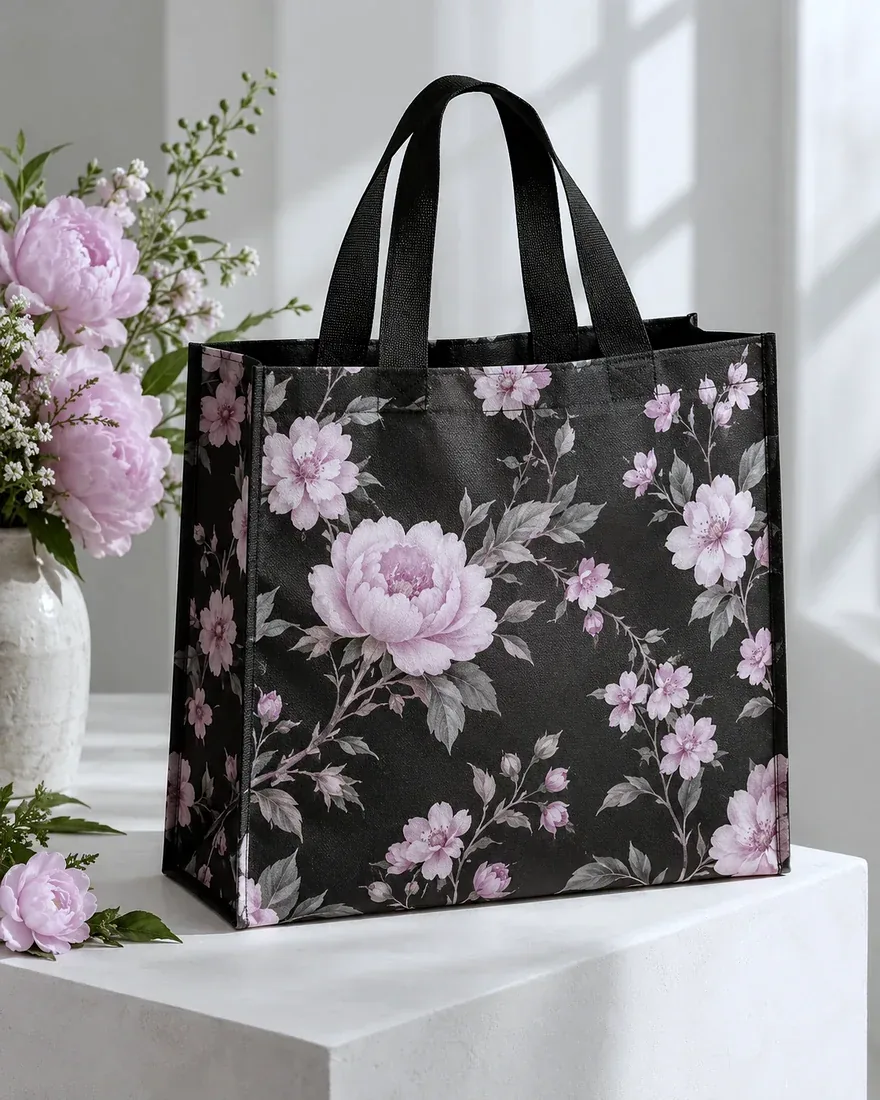
The fashion photograph shows a gusseted shopper. The table also compares takeaway and self-seal styles; their construction and size codes remain separate.
Are S, M, L and XL standard non-woven bag sizes?
Size letters identify variants within a particular bag style. They do not establish a shared measurement across the catalogue. In the JINYU chart below, the Non-Woven Takeaway Bag S is 21 × 24 × 12 cm, while the Self-Seal Foil-Lined Bag S is 21 × 26 × 11 cm. Both carry the letter S, but their height, depth and construction differ. Read the product identifier and dimensions together.
A purchasing line that says only medium non-woven bag leaves the body size and style unspecified. Use the product SKU, variant code and outside width × height × depth instead. The comparison below puts three catalogue styles beside one another so the same size letter can be traced to the actual product being requested.
How should I read the size-code comparison chart?
Each row identifies a catalogue product, its SKU, the variant code and the outside dimensions in centimetres. Width comes first, body height second and depth third. Handles are excluded from body height. The table draws directly from the same catalogue records as the linked product pages, keeping the size reference attached to the correct bag style.
Compare the S and M takeaway rows: width increases from 21 to 23 cm, height from 24 to 25 cm and depth from 12 to 14 cm. Those changes describe that product alone. The self-seal style follows a different progression. Keep all three measurements when copying a row into an inquiry; selecting the next letter does not mean that every dimension becomes larger.
Why can a medium bag be shorter than the small version?
The self-seal style records S at 21 × 26 × 11 cm and M at 24 × 24 × 15 cm. M is 3 cm wider and 4 cm deeper, yet its body is 2 cm shorter. The labels distinguish catalogue variants rather than a sequence that increases every measurement. A height-sensitive project therefore needs the actual height column, even when the buyer is moving from S to M.
Write the change explicitly in the comparison record: wider base, greater depth, shorter body. This prevents a colleague from interpreting upgrade to M as a taller bag. Keep the product name visible too. The takeaway M row measures 23 × 25 × 14 cm, so replacing one medium reference with another changes all three dimensions.
Does XL mean the same size in a shopper and a self-seal bag?
No. The Gusseted Non-Woven Shopper XL measures 44 × 48 × 14 cm. The Self-Seal Foil-Lined Bag XL measures 30 × 30 × 20 cm. The shopper is 14 cm wider and 18 cm taller, but its listed depth is 6 cm smaller. Neither can be described accurately by carrying the XL label into the other product's order line.
The shopper also uses descriptive codes such as EVENT, TALL and RETAIL35. TALL is 38 × 42 × 15 cm; EVENT is 36 × 43 × 10 cm. Here, EVENT has a taller listed body than TALL. Treat the words as identifiers and compare the numbers. A descriptive code does not replace the dimensioned reference or specify a load rating.
What belongs on each size line in a bag inquiry?
Begin with the SKU and variant, followed by the full product name and outside dimensions with units. Add the requested colour, whether the inquiry concerns plain stock or decoration, the quantity for that exact version and the destination. Put separate size or artwork versions on separate lines. Shared notes can describe the project, while each row retains its own product identity.
For example, identify a takeaway S row by its catalogue SKU, S code and 21 × 24 × 12 cm dimensions. Identify the self-seal S separately at 21 × 26 × 11 cm. Request the offered stock description against each row. Small-quantity non-woven requests follow the stock route; a catalogue size reference does not establish current availability of a colour or decoration.
How do I compare a proposed substitute size?
Place the requested row and the offered row beside one another. Compare product identity, construction, width, body height, depth, colour and decoration separately. If a reply offers self-seal M against takeaway M, the dimensional differences are 1 cm more width, 1 cm less height and 1 cm more depth. The closure and lining also belong in that comparison; the repeated M code does not make the two products equivalent.
Ask the response to identify the proposed product and variant rather than describing it only as a similar size. Retain the original requested row when recording an alternative. This keeps the buyer's requirement visible and lets the final purchasing record show which specific version was accepted, instead of silently replacing the first size reference.
Which measurements should remain separate from the catalogue size?
Keep usable opening, usable base, handle drop and filled-pack measurements in their own fields. The chart lists outside body dimensions. Seams, folds, the closure and the way the handles gather can affect the space available during loading and carrying. Multiplying the three outside measurements does not establish a usable capacity, and none of the size letters states a carrying load.
Use the original centimetre dimensions to identify the catalogue row. If a receiving worksheet uses inches, divide each value by 2.54 and label rounded conversions as approximate. Preserve the centimetre reference alongside them. Packing dimensions, carton weights and handling requirements belong in the offered packing description rather than being calculated from the outside bag chart.
How can I carry the selected size through to the final order record?
Keep the accepted SKU, variant code and dimensions together with the sample reference, colour and artwork revision where applicable. If the selected product changes, update the product identity and construction as well as the size. Give the accepted specification a date so the receiving team can distinguish it from an earlier shortlist or an unaccepted alternative.
Send the selected rows and requested quantities through the JINYU inquiry form. The linked catalogue pages provide the product records behind this chart. Use the width, height and depth guide for measurement notation, then retain the returned product description and accepted revisions with the purchasing documentation.
Reference sources
- Non-woven takeaway bag sizes
- Self-seal foil-lined bag sizes
- Gusseted non-woven shopper sizes
- Width, height and depth in cm and inches
- Allocate size codes to order kits and reconcile bag quantities
- Complete stock bag catalogue
Regional references support general planning; model-specific specifications come from the published JINYU model tables.