What are the three grocery tote sizes in centimetres and inches?
US-12 measures 30.48 × 33.02 × 20.32 cm, equivalent to 12 × 13 × 8 inches. US-13 measures 33.02 × 38.10 × 25.40 cm, equivalent to 13 × 15 × 10 inches. AU-33 is recorded as 33.2 × 35 × 22 cm, approximately 13.07 × 13.78 × 8.66 inches. Each sequence reads outside width, body height and gusset depth, excluding separate loop handles.
These are three market-format quotation references in the JINYU catalogue. Their codes identify particular dimension sets; they do not establish national standards or current stock. Copy the complete code and dimensions into a purchasing schedule. A request for a US grocery tote without a code would leave both US-12 and US-13 in consideration, although their heights and depths differ substantially.
How does US-13 change the specification compared with US-12?
US-13 adds 2.54 cm of outside width, 5.08 cm of body height and 5.08 cm of gusset depth compared with US-12. In the original inch dimensions, those differences are one inch, two inches and two inches. Both variants record an 80 GSM fabric reference, so this comparison changes the bag dimensions while keeping the listed fabric mass per area the same.
Record the change on three separate lines if a project moves from US-12 to US-13. The deeper gusset changes the nominal base outline, while the taller body changes where the top edge sits relative to the contents. Keep the handle specification in its own field: the catalogue body-height figures exclude handles and supply no handle-drop measurement. A size substitution therefore needs a review of more than the front-panel width.
Is AU-33 the same size as US-13?
They have similar outside widths but different heights and depths. AU-33 is 33.2 cm wide, just 0.18 cm wider than US-13 at 33.02 cm. Its 35 cm body height is 3.10 cm shorter, and its 22 cm gusset is 3.40 cm shallower. Those differences remain even when the rounded widths look identical on a short product list.
AU-33 also records 90 GSM, compared with the 80 GSM reference for US-13. Keep that material difference attached to the size code when requesting alternatives. A response offering AU-33 against a US-13 brief changes both the exterior dimensions and the recorded fabric weight. Ask the response to identify each difference so purchasing can assess the complete construction rather than accept a substitution based on approximate width.
What does the base-outline comparison tell a buyer?
Multiplying outside width by gusset depth gives nominal base-outline areas of 619.35 square centimetres for US-12, 838.71 for US-13 and 730.40 for AU-33, rounded to two decimals. This calculation helps compare the exterior rectangles on one drawing. US-13 has the largest nominal base outline of these references, followed by AU-33 and US-12.
The calculation uses outside catalogue measurements. Seams, folds and the way the bag opens affect the interior base, so use a drawing or sample to establish usable packing space. For a box-based retail project, identify the closed box width and depth separately from the bag dimensions. Keep the box orientation on the drawing, especially where several rectangular packages share the base. Do not turn the exterior rectangle into a stated internal capacity.
How should GSM, handles and a base board appear in the request?
Write the fabric reference beside each variant: US-12, 80 GSM; US-13, 80 GSM; AU-33, 90 GSM. GSM describes fabric mass per square metre. It does not state the weight of a finished bag or a tested carrying limit. The catalogue construction is an open top with side and bottom gussets and separate loop handles, without a lining or closure.
A removable base board and special handle reinforcement are separate requested items. Describe the board material and dimensions, or the intended reinforcement construction, on the same line as the chosen size. Keep those items visible in a plain-bag comparison and a printed-bag comparison alike. Otherwise one response may include an insert while another covers the unmodified tote, making their construction descriptions difficult to compare.
How do I keep the print brief attached to the right size?
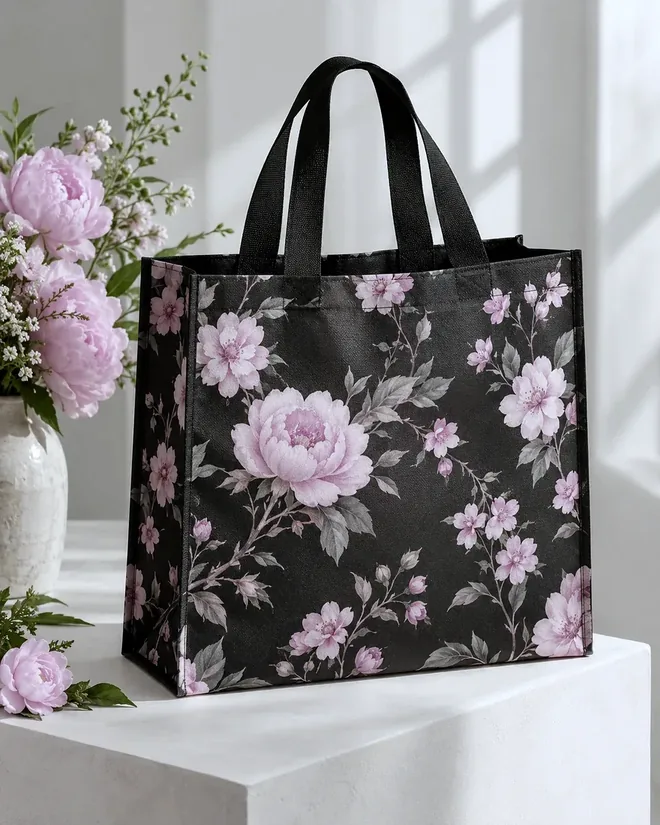
Name the chosen variant on the artwork file and mark the intended front face. Supply the print width, print height, position and number of printed sides. The fashion photograph illustrates a floral design and shopper structure; it does not provide a measured print template for all three variants. Request the panel drawing for the selected dimensions before positioning artwork around the gusset folds and handle attachments.
When comparing two size options, retain two artwork references even if the same logo is used. A design positioned on the 33.02 cm US-13 front panel is not automatically positioned on US-12 at 30.48 cm. Keep the original artwork, proof version and size code together so a revised bag size can be traced through the drawing and sample review.
What should the three-line inquiry schedule contain?
Create one line per requested variant, including the size code, outside dimensions, GSM reference, quantity, colour and artwork reference. Add separate columns for handles, base insert and any requested construction change. State the destination with the whole schedule. For a small-quantity non-woven requirement, ask which stock options match the request; these market-format rows alone do not establish availability.
Send the schedule to JINYU, Shaanxi Jinyu Kitchenware Co., Ltd. (陕西金宇厨具有限公司), and ask the response to identify the offered size and construction on each line. Preserve any proposed alternative beside the original request. This gives the buyer a usable record of what was requested, what was offered and which dimensional or material differences still need a decision.