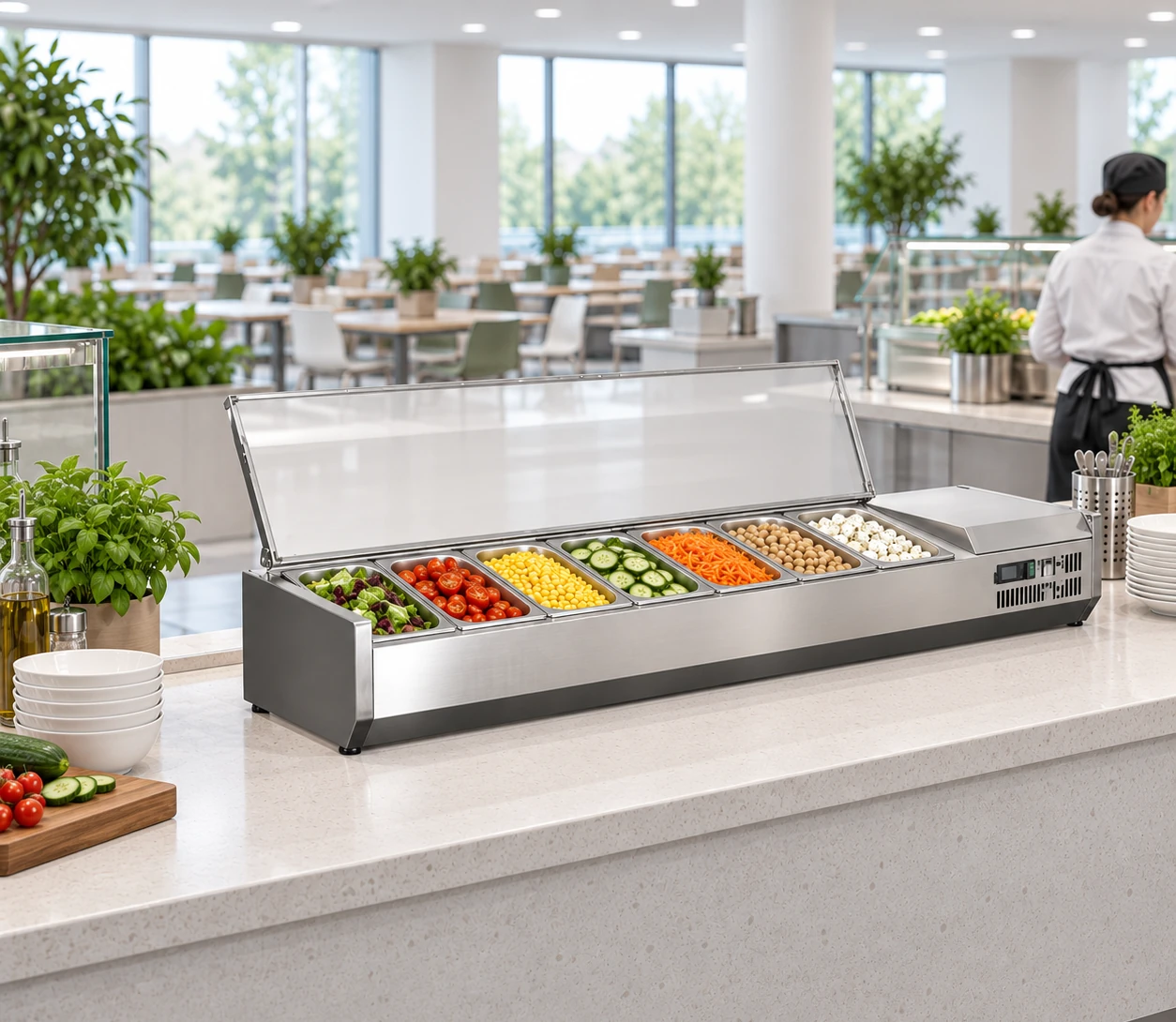
What should I compare when a different pizza preparation counter is offered?
Start with the requested model and the proposed replacement in separate columns. Keep the equipment position unchanged so both columns describe the same station. Record cabinet dimensions, pan positions, listed capacity, access arrangement, rated power and voltage. Add a document reference for each proposed change. A reply naming a different counter needs enough information to update the station drawing and ingredient schedule together.
The four models below show two distinct substitutions. GN-1655SC to GN-1830SC changes the rail length and position count within the hinged-lid family. GN-1655SC to GN-1655SB retains the recorded width, depth and capacity but changes the height and cover arrangement. These are catalogue comparisons, not an acceptance decision for a particular kitchen. Use the worksheet to identify which project records need another review.
How does changing from seven to eight pan positions affect the station?
GN-1655SC measures 1655 × 405 × 280 mm, lists 72 L and has seven 1/3 GN pan positions. GN-1830SC measures 1830 × 405 × 280 mm, lists 82 L and has eight positions. The replacement adds 175 mm of cabinet length, one position and 10 L of listed capacity. Its recorded rated power rises from 150 W to 165 W. Keep these differences attached to the full model codes.
On an illustrative 2100 mm worktop, the shorter cabinet leaves 445 mm of gross length and the longer cabinet leaves 270 mm. Those balances exclude installation spacing, utensils and other equipment. Show where the additional pan belongs in the ingredient sequence, and redraw the adjacent assembly area. An extra position does not tell you the required pan depth, supplied accessories or the quantity of ingredients held in that pan.
Can I substitute a glass-canopy counter with the same width and capacity?
Compare GN-1655SC with GN-1655SB. Both record 1655 mm width, 405 mm depth, 72 L capacity, seven 1/3 GN positions and 150 W rated power. SC is 280 mm high with a hinged lift-up lid. SB is 450 mm high with a glass cover and no door. The SB cabinet therefore adds 170 mm to the recorded height while retaining the same exterior base rectangle.
That height change belongs on the side elevation, while the cover change belongs in the service-access review. On a hypothetical 900 mm counter, the closed SC outline reaches 1180 mm above the floor; the SB outline reaches 1350 mm. The SC lid-opening envelope is a separate measurement. Request the appropriate drawing for each arrangement and show staff approach, pan removal and adjacent shelves before accepting a cover substitution.
Which accessories and ingredient records must travel with the proposed replacement?
Retain the current ingredient-position map and give the proposed map its own revision. Identify each pan position, ingredient, container reference and intended fill quantity. Copy unchanged entries, then mark any new, moved or removed position. For the seven-to-eight-position example, the purchasing record should show what occupies position eight rather than treating the extra opening as an unspecified benefit.
Ask the proposal to identify included pans, lids, supports and other loose accessories by model. The recorded 1/3 GN position format does not establish pan depth or a supplied-item list. If existing containers will be reused, send their dimensions and photographs with the replacement request. Keep the answer beside the new position map so the kitchen team can trace which containers and accessories belong to the offered cabinet.
Does the same voltage entry mean the electrical schedule stays unchanged?
All four models in the comparison record 220-240V/50Hz. GN-1655SC and GN-1655SB list 150 W; GN-1830SC and GN-1830SB list 165 W. Switching from a 1655 mm model to an 1830 mm model changes the recorded rated power by 15 W. Switching between SC and SB at either listed width retains the recorded rated power but still changes the equipment identifier and access arrangement.
Update the electrical row with the offered model and its document revision even when the voltage entry matches. Request connection details and installation documentation for that configuration. Rated watts are a catalogue field; they do not provide measured daily energy use or starting-current information. Keep the site supply record attached to the inquiry so the installer reviews the proposed cabinet against the same location and equipment position.
How should I record a substitution that changes more than one feature?
Use the requested GN-1655SC and proposed GN-1830SB as a combined example. Width rises by 175 mm, height by 170 mm, listed capacity by 10 L, pan count by one and rated power by 15 W. Depth remains 405 mm. The access arrangement changes from a hinged lid to a glass canopy. Record each difference on its own worksheet row rather than describing the replacement only as a larger model.
Assign each affected document to the person updating it: the station plan, side elevation, ingredient map, accessory list and electrical schedule may have different owners. Keep the original requested values visible beside the offered values. A drawing revision should name the replacement model, and the proposal response should identify which accessories it includes. This makes the combined change reviewable without relying on a product photograph to communicate dimensions or scope.
What should the final model-substitution inquiry contain?
Send the original equipment position, requested model, proposed model and reason for the proposed change. Attach the comparison worksheet, measured counter plan, ingredient-position map and destination supply record. List the documents needed to finish the review: configuration drawing, access envelope, usable pan arrangement, supplied-item list and electrical connection information. Reference each attachment by its revision so the reply can address a defined set of records.
Address the inquiry to JINYU, Shaanxi Jinyu Kitchenware Co., Ltd. (陕西金宇厨具有限公司). Ask the response to repeat both model codes and identify every proposed specification difference. Retain the response with the purchasing record and update the affected station documents together. If a later proposal introduces another model, create a new comparison column; the earlier review describes the earlier replacement and its associated documents.