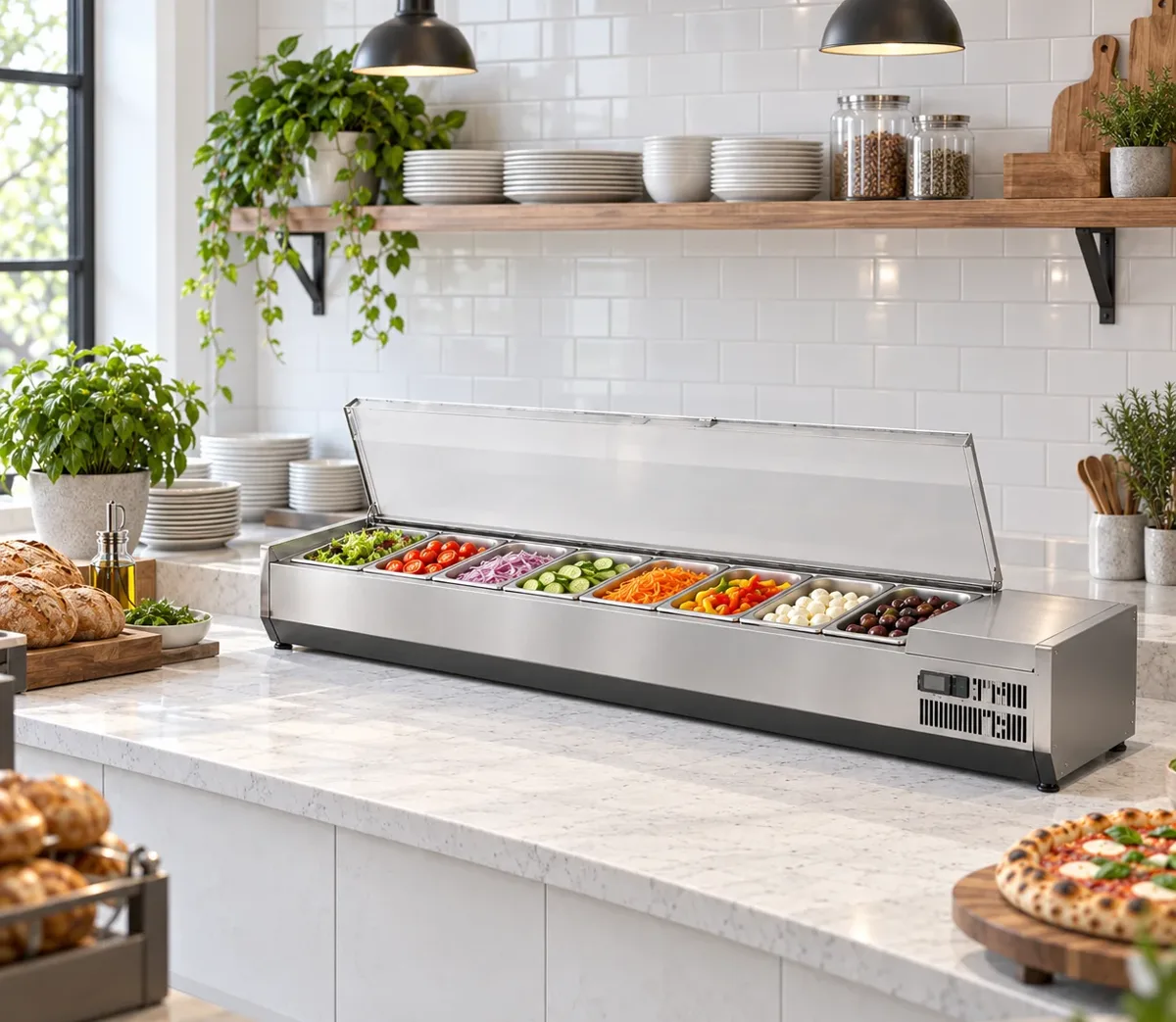
How do I turn a sushi menu into an ingredient-counter pan schedule?
Write one row for every ingredient container that must be accessible at the same time. Count positions, rather than counting dishes on the menu: several dishes may share a container, while one ingredient may occupy two positions in the proposed workflow. Give each row a container identifier and keep the menu names in a separate column. The worked schedule below uses generic ingredient codes so a buyer can replace them with the actual preparation list.
Start with the busiest simultaneous arrangement the team intends to use. A seven-position list and a ten-position list produce different equipment shortlists even if both serve the same menu. Record the assembly board, utensils and replenishment location outside that list. They need their own space on the station drawing; the ingredient rail is only one part of a sushi preparation counter.
Which JINYU models match seven, eight and ten ingredient positions?
For seven listed 1/3 GN positions, compare GN-1655SC and GN-1655SB: each is 1655 mm wide, 405 mm deep and listed at 72 L. For eight positions, GN-1830SC and GN-1830SB are 1830 mm wide with the same 405 mm depth and an 82 L listed capacity. The ten-position pair, GN-2180SC and GN-2180SB, is 2180 mm wide, 405 mm deep and listed at 102 L.
Keep the suffix on every schedule and drawing. SC models have a hinged lift-up lid and a listed 280 mm cabinet height. SB models have a glass cover and a listed 450 mm height. Matching pan count does not make the cover arrangements interchangeable. Use the comparison table to identify the model, then review the access arrangement against the proposed station.
How does the worked seven-position schedule change at eight or ten positions?
The example starts with six ingredient codes. ING-A occupies two positions; ING-B, ING-C, ING-D, ING-E and ING-F occupy one each. That gives seven occupied positions. An eight-position plan adds ING-G in one position. A ten-position plan keeps ING-G, adds ING-H and assigns one additional position to ING-B. The totals are therefore seven, eight and ten, respectively. These are illustrative allocations, not a suggested menu or a statement about container contents.
Assign every occupied position a number on the top-view sketch. For the ten-position plan, mark the two ING-A positions and the two ING-B positions separately. This exposes duplicate containers that a simple ingredient count would miss. If the real schedule differs, recalculate the total before selecting a cabinet width; do not copy the example totals into an order.
Does a 1/3 GN position tell me the container depth or ingredient quantity?
The listed pan-position specification identifies the recorded format and number of positions. It does not supply a container depth, a usable fill quantity or a portion count for the proposed ingredients. Likewise, the 72 L, 82 L and 102 L figures in this comparison are listed cabinet capacities. Dividing them by the position count would not establish the volume of an individual ingredient container.
Add the proposed pan dimensions and depth to the inquiry, along with a photograph or drawing of the rim and support arrangement. Ask which containers and supports are included in the offered configuration. Keep that response with the selected model code. Where the buyer already owns containers, identify those containers explicitly so the equipment discussion uses their actual geometry rather than an assumed match.
How should I draw the pan sequence beside the assembly worktop?
Use a numbered row for the ingredient positions and a separate rectangle for the assembly area. Draw the operator approach, the replenishment approach and the place used for removed containers. The six compared models have a recorded exterior depth of 405 mm. That cabinet measurement alone does not describe the reach to an ingredient, the assembly-board depth or the space required to lift a container out.
At a matching width, the SC and SB cabinets share the same outside depth but have different listed heights and access arrangements. Put the selected model photograph next to the side view so the team can discuss the lid or glass cover in context. Ask for the opening and container-removal dimensions relevant to that layout, then keep the resulting drawing revision with the pan schedule.
How do I document replenishment without treating every spare pan as a counter position?
Separate containers in active use from replacement containers held elsewhere. The active row determines the simultaneous position count. A spare container does not occupy a second counter position unless the workflow actually places it in the rail at the same time. Give spares their own location field, and record which active position each spare is intended to replace. This makes the schedule readable without inflating the equipment requirement.
Use quantities drawn from the business's own preparation records when planning replenishment; the cabinet specifications do not predict demand. Record ingredient identity, container identity, active position and replacement location together. The worked ten-position arrangement duplicates ING-A and ING-B deliberately, while the spare-container record remains separate. A buyer can then explain why a second active position is required instead of simply requesting a larger cabinet.
What should I send with an inquiry for the selected sushi preparation counter?
Send the complete model code, the numbered ingredient-pan schedule and a dimensioned station sketch. Include the proposed pan format and depth, the desired cover arrangement, photographs of existing containers and the electrical supply information for the intended location. The six compared models record 220-240V/50Hz. Keep that published specification alongside the site information when discussing the offered equipment configuration.
Attach the intended ingredient list and operating requirements rather than using the word sushi as the entire application brief. Request the relevant operating instructions and configuration details for that list. Send the package through the JINYU inquiry page to Shaanxi Jinyu Kitchenware Co., Ltd. (陕西金宇厨具有限公司). Keeping the model, container and drawing references together gives the equipment discussion a specific starting point and makes later changes easier to track.