What changes when a sushi preparation counter goes from eight to ten pan positions?
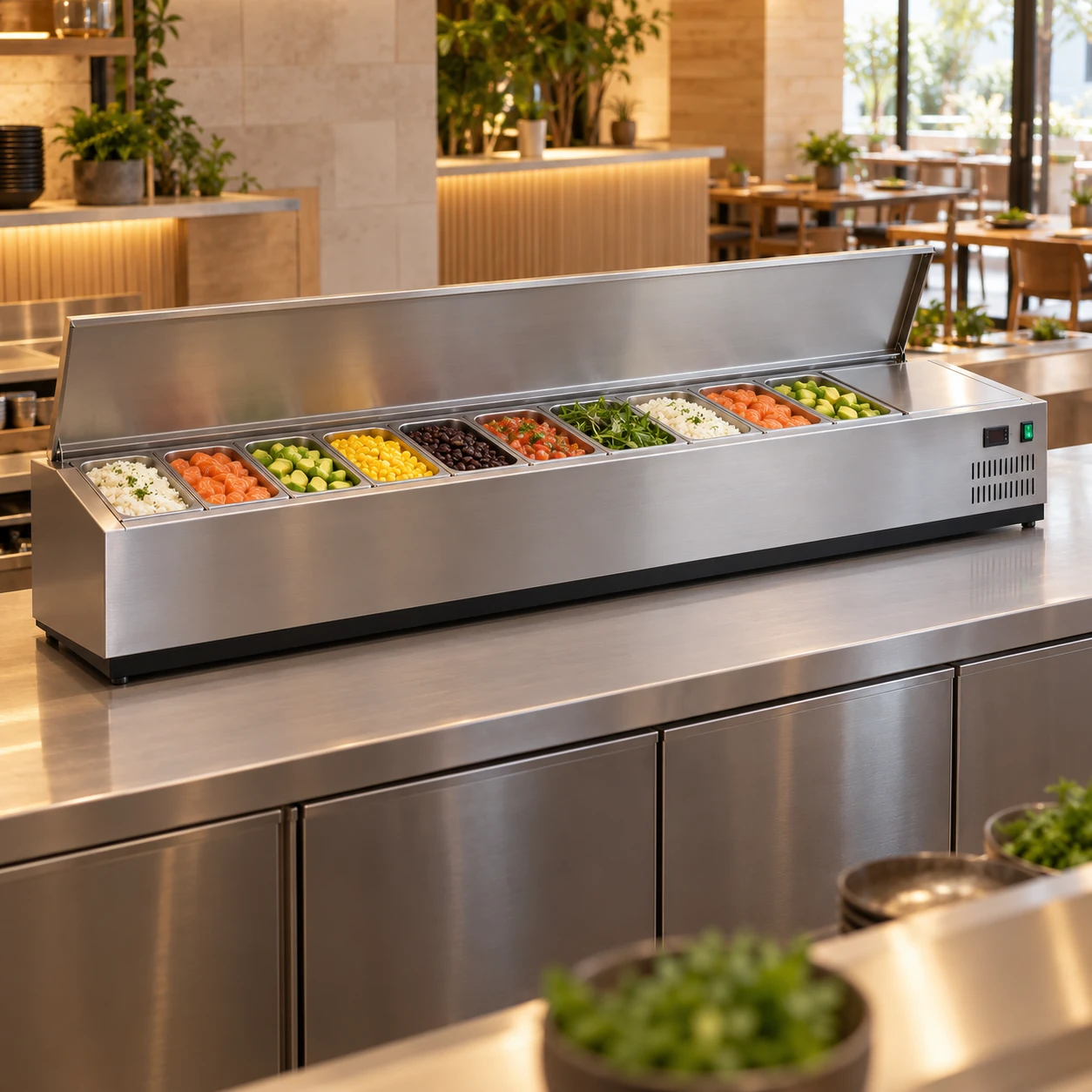
The 1830 mm SC and SB models each record eight 1/3 GN positions, 82 L capacity and 165 W rated power. The 2180 mm alternatives each record ten 1/3 GN positions, 102 L and 183 W. Moving to ten positions therefore adds 350 mm of cabinet length, two positions, 20 L of listed capacity and 18 W of rated power. Every body in this comparison is 405 mm deep.
Count the ingredients that need distinct containers at the workstation, then identify which are used together during preparation. A ten-position cabinet can accommodate a schedule with two more separate positions than the eight-position layout. That count does not specify pan depth, fill quantity or the number of servings held. Send the actual ingredient schedule and container dimensions with the selected model so the returned pan arrangement addresses the menu rather than a photograph of another setup.
How much preparation-counter frontage remains for a separate landing area?
Use an illustrative 2600 mm-long worktop and reserve 400 mm of its frontage for a separate landing surface. An 1830 mm cabinet leaves 770 mm before that allocation and 370 mm afterwards. A 2180 mm cabinet leaves 420 mm before the allocation and 20 mm afterwards. The 350 mm difference in cabinet length transfers directly to the gross frontage balance. These figures describe example furniture dimensions, not an installation layout approved for either model.
Draw the cabinet and landing area as separate rectangles, with the staff approach and the actual board or tray placed on the landing rectangle. Replace the example spans with site measurements and add the installation requirements returned for the offered cabinet. A remaining 20 mm is simply an arithmetic result. It gives no working allowance for hands, utensils, cable routing or opening the hinged lid. Keep those movements visible on the plan and elevation when deciding whether the longer rail belongs at that station.
Does the glass-cover version need more counter depth than the hinged-lid version?
At both lengths, the recorded SC and SB body depth is 405 mm. GN-1830SC and GN-1830SB therefore each occupy 0.74115 square metres of counter area; the two 2180 mm bodies each occupy 0.88290 square metres. The larger pair adds 0.14175 square metres of body footprint. Changing the cover at one length preserves the recorded width and depth, while changing from 1830 to 2180 mm increases the footprint.
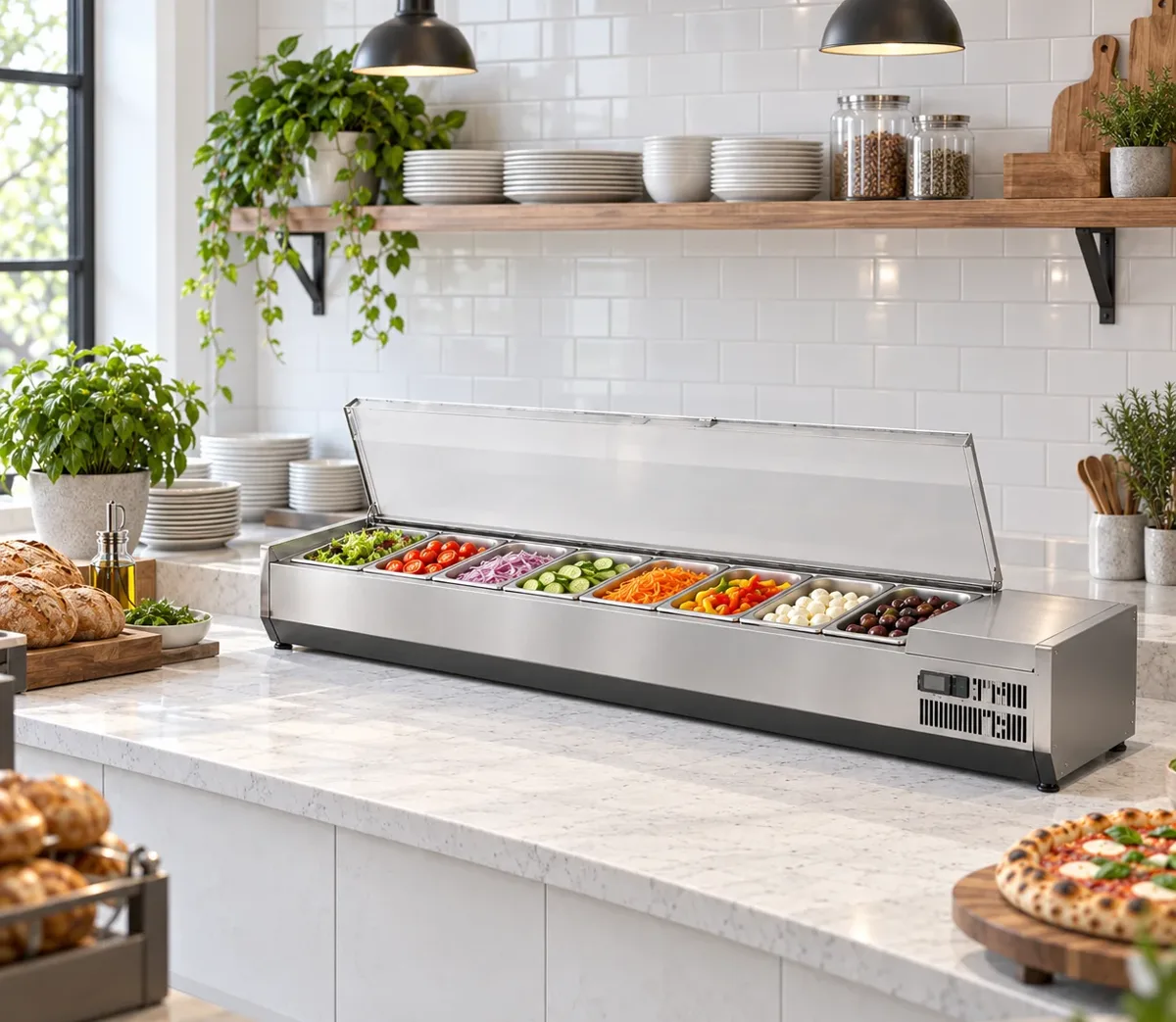
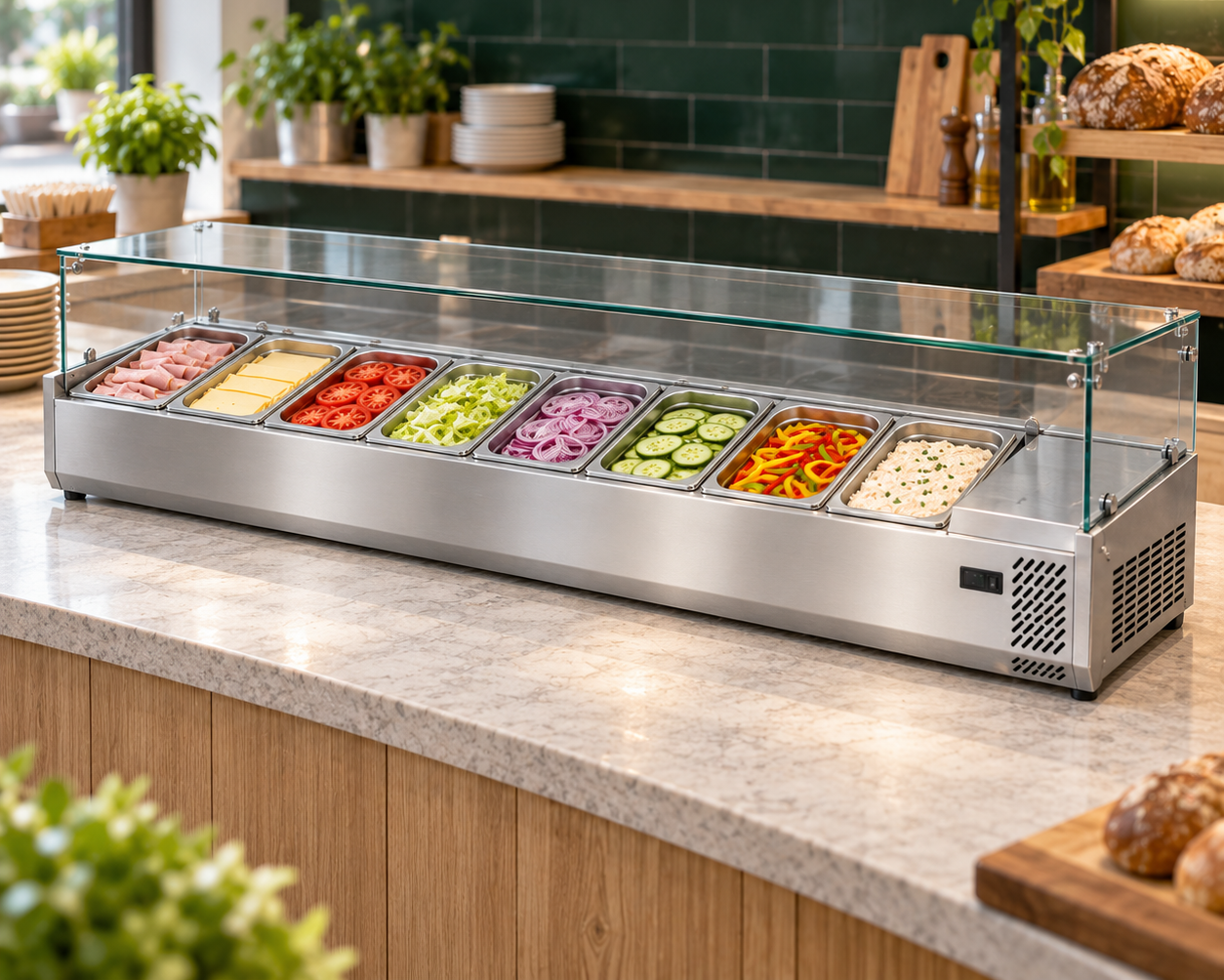
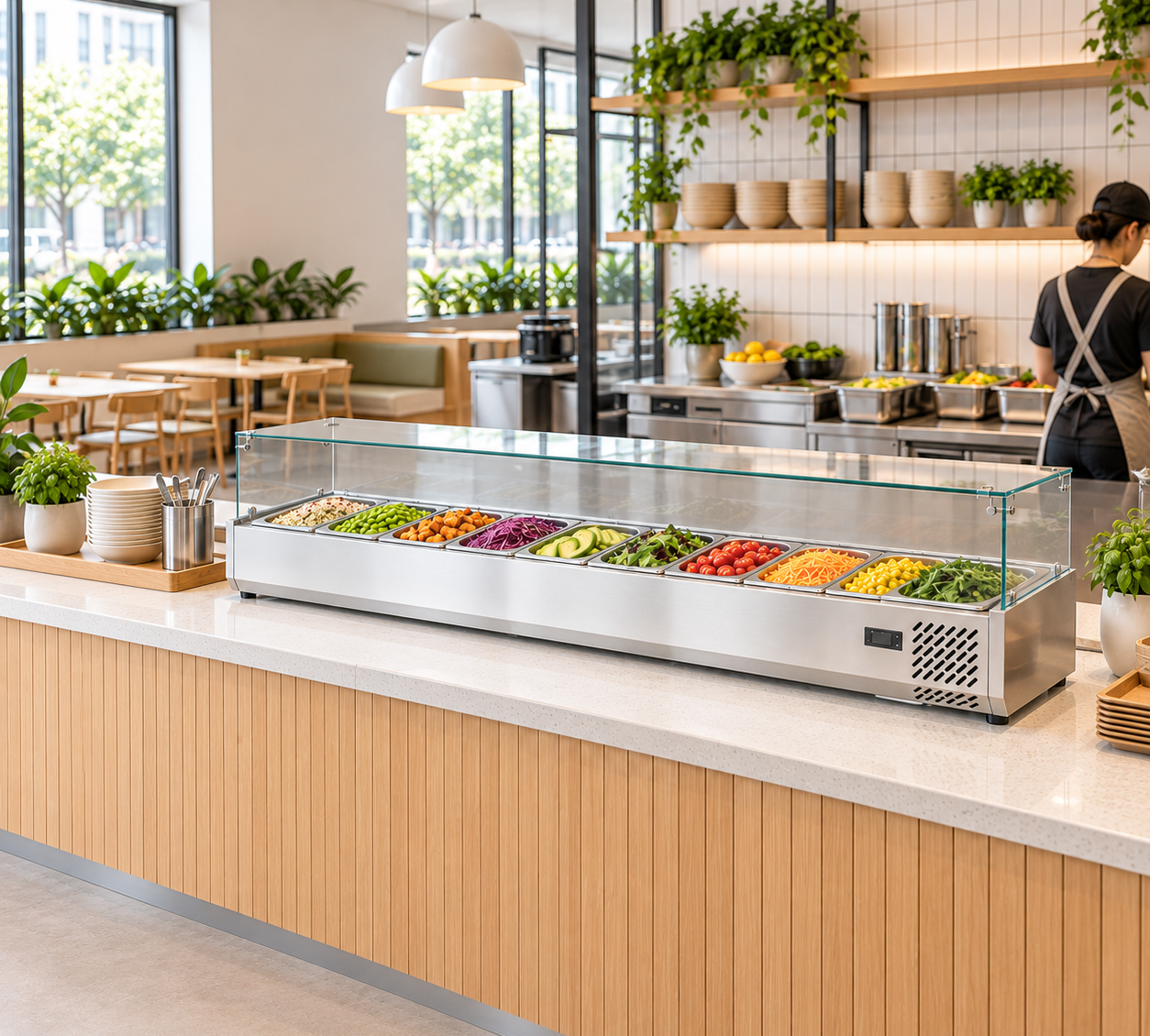
The vertical dimensions differ: SC is 280 mm high with its hinged lid closed, while SB is 450 mm high with a glass cover. Put those outlines on an elevation from the supporting worktop. For an illustrative 900 mm-high support, their upper body edges are 1180 and 1350 mm above the floor. The SC lid-open envelope requires its own drawing; the 280 mm closed height cannot locate that moving edge. Use the photographs alongside the drawing to discuss staff access and the customer view.
How can an eight-position ingredient schedule be compared with a ten-position schedule?
Create a row for every proposed position and name the ingredient, container reference and replenishment source. For a planning exercise, assign six ingredients one position each and a seventh ingredient two positions: the total is eight. If a menu revision adds two further ingredients needing separate containers, the same allocation becomes ten. This example explains position counting without assigning a real menu or storage practice to the cabinet.
Keep the two schedules side by side. Show whether the added positions serve additional ingredients or duplicate an existing ingredient at another part of the workstation. Attach the container rim, body and depth measurements to each reference. Ask for the offered model drawing and supplied-component list against that schedule. The recorded 1/3 GN position format does not establish the inclusion of pans, individual lids, support bars or utensils. Track those items separately so the purchasing comparison preserves the same requested assortment on both cabinet lengths.
Which temperature and electrical records should stay with this shortlist?
All four records list a 2-12°C temperature range, static cooling, automatic defrost, R290 refrigerant and a 220-240V/50Hz supply. The 1830 mm cabinets record 165 W; the 2180 mm cabinets record 183 W. Carry those model-specific power figures into the equipment schedule. They are rated watts, separate from a measured daily electricity consumption figure or a prediction of running cost.
Include the actual site supply and the installation position in the request for electrical documents. Give the ingredients their own required storage conditions and service procedure for the application review. A catalogue cabinet temperature range alone does not establish suitability for every sushi ingredient, permitted display duration or a food-handling process. Keep the selected model, returned equipment documents and the buyer's ingredient requirements together so the comparison addresses the intended commercial kitchen rather than treating the word sushi as a specification.
What should I send JINYU to choose between these four preparation counters?
Send one measured worktop plan with the available length and depth, support height, overhead fittings and separate landing surface. Name the preferred cover form and list GN-1830SC, GN-2180SC, GN-1830SB or GN-2180SB explicitly. Attach the eight- and ten-position ingredient schedules, container measurements and photographs of the staff approach. Include the receiving-route measurements, destination and actual electrical supply in the same equipment brief.
Ask for the installation drawing, usable pan arrangement, cover-access details and supplied-component list for each shortlisted configuration. Compare the replies against the same worktop drawing. If the ten-position body removes space assigned to tray transfer, revise that furniture plan before selecting by capacity alone. Retain the full model code with every returned attachment; equal lengths and capacities do not make the 280 mm hinged-lid and 450 mm glass-cover bodies the same physical arrangement.