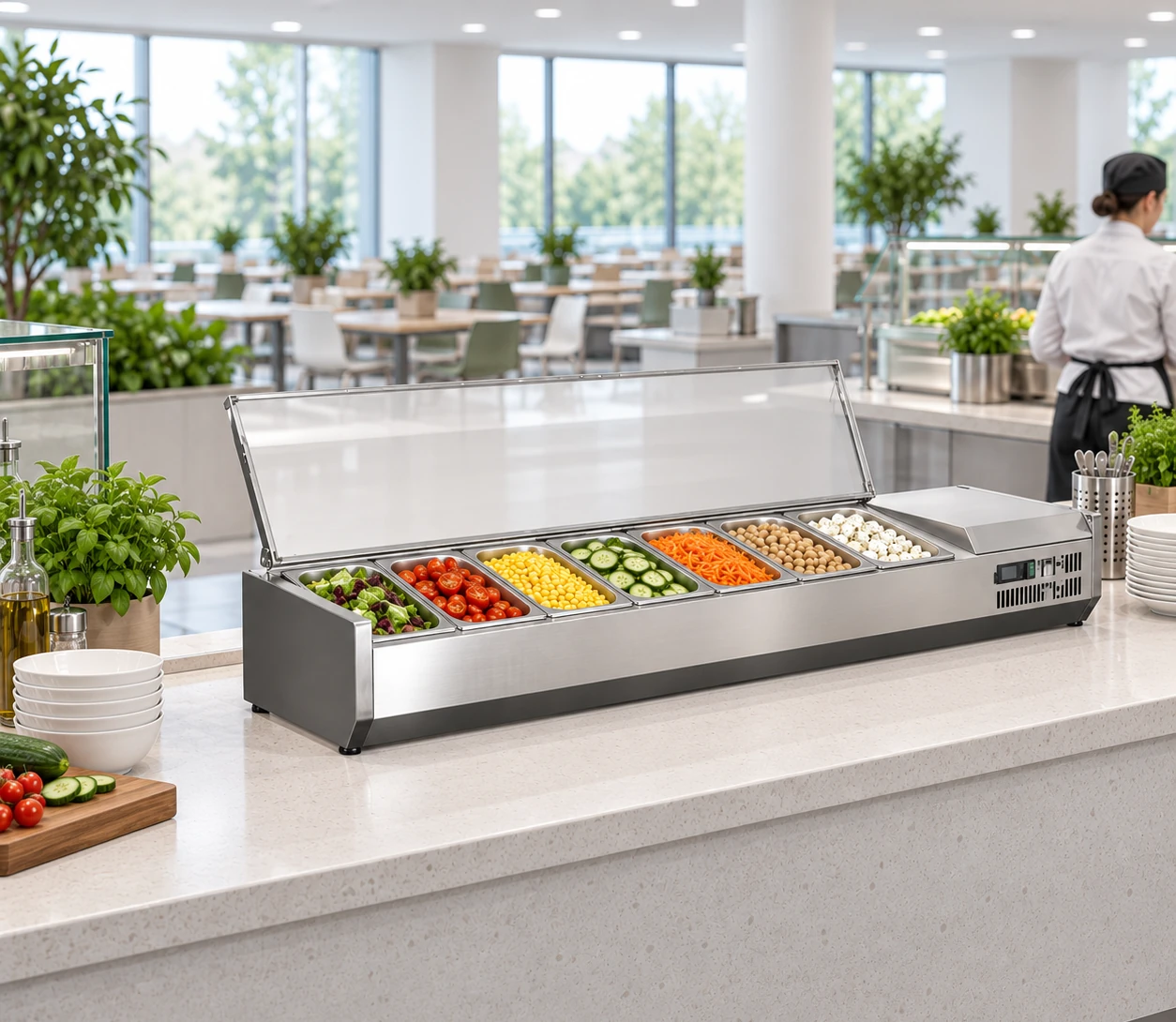
Does a sushi preparation counter pan count tell me what is supplied?
A pan-position record tells you the number and format of positions listed for that model. The four counters compared here record either seven or eight 1/3 GN positions. That specification is useful for an equipment shortlist, but it does not itemize the loose containers, individual container lids, support pieces or spare parts supplied with a particular offer. Put those items on separate response lines so each has a quantity and an identifiable description.
Start with the exact cabinet code. GN-1655SC and GN-1655SB both record seven positions, while GN-1830SC and GN-1830SB record eight. Keep the SC or SB suffix when asking for the component list. A photograph can help identify a part, but the written response should connect that part to the offered model and configuration.
Which cabinet records should be attached to the accessory checklist?
For the seven-position pair, record 1655 mm width, 405 mm depth and 72 L listed capacity. GN-1655SC stands 280 mm high with a hinged lift-up lid; GN-1655SB stands 450 mm high with a glass cover. For the eight-position pair, the width becomes 1830 mm and capacity becomes 82 L. The SC and SB heights remain 280 mm and 450 mm respectively. All four list a 220-240V/50Hz supply.
These are exterior and catalogue records. Copy them into the cabinet line, then place the proposed containers and support parts below it. The 175 mm increase between the two widths adds one recorded pan position. It does not establish the length of an individual support bar or the usable depth of a container. Those component dimensions belong in the returned configuration drawing.
How should the pans and individual lids be described?
Give the active container set a line identifier such as PAN-01. Enter the requested format, actual outside dimensions and depth, then state whether the request concerns new containers or buyer-owned containers. Add a photograph of the rim and underside when existing containers must be reviewed. Keep the number of containers requested distinct from the cabinet position count, because the purchasing list may include replacements held away from the rail.
Use a second line for individual pan lids. Ask for the lid reference, the matching pan reference and the supplied quantity. A hinged cabinet lid on an SC model and a lid fitted to an individual food pan are different components. Record each by name so a reply about the cabinet lid cannot be mistaken for an answer about seven or eight loose pan lids.
What should the supplier response say about supports and the cabinet cover?
Create a support line that asks for the pieces used by the offered pan arrangement, with their identifiers, quantities and an annotated drawing. The catalogue position count alone does not describe every support component. If the intended containers differ from those in the offer, ask for the arrangement to be reviewed against those actual containers. Retain the returned drawing beside the component response so the order record has one identifiable configuration.
For the cabinet cover line, use the recorded access description: hinged lift-up lid for SC or glass cover for SB. Ask the response to identify the offered assembly and its relevant drawing. Keep any requested replacement cover parts on separate lines. This prevents a spare-part request from silently changing the cabinet quantity or the cover arrangement selected for the station.
How does the worked seven-position request reconcile active and spare pans?
The downloadable example requests seven active containers and two spare containers for an illustrative GN-1655SC purchasing brief. The requested container total is nine, calculated as seven plus two. Only seven belong in the active-position row. The two spares have a separate storage-location field and do not become two extra cabinet positions. Example quantities express a buyer request; the checklist makes no statement that those components are included with the cabinet.
The example also requests seven individual pan lids on their own row. That creates three distinct quantity questions: seven active pans, two spare pans and seven pan lids. A complete response identifies each item and states whether its quantity is included, offered separately or excluded. Record the response document and revision beside every line so a later amendment can be checked against the same request.
What changes when moving the request from GN-1655SC to GN-1830SB?
Keep the earlier request as revision A and create revision B with GN-1830SB as the cabinet reference. The recorded position count changes from seven to eight, width from 1655 to 1830 mm, height from 280 to 450 mm and access arrangement from hinged lift-up lid to glass cover. Depth remains 405 mm. Those changes give the supplier specific fields to reconcile instead of an instruction to supply a similar counter.
If the buyer still requests two spare pans, the revised requested container total becomes ten: eight active plus two spare. Review the pan-lid quantity separately rather than automatically copying seven into the new version. Ask for the support arrangement and cover reference to be returned against revision B. The example shows purchasing arithmetic; the final component list comes from the actual offer.
How do I use the checklist when comparing two equipment offers?
Keep one common request and place each offer reference beside its response. Compare the full model code first, then the active pan set, individual lids, support arrangement, spare containers and cabinet cover reference. A component described differently should have a drawing or item reference that allows the buyer to reconcile it. Retain the original wording in the response record rather than changing both offers to one vague accessories label.
Send Shaanxi Jinyu Kitchenware Co., Ltd. (陕西金宇厨具有限公司) the selected model, component request and current station drawing through the inquiry page. Include existing-container photographs where applicable. Carry the agreed item identifiers into the order equipment schedule and use the packing list for receipt. This connects the buying decision to identifiable components without treating a display photograph or a position count as a packing list.