How do I keep one equipment order clear across separate pickups or deliveries?
Keep one accepted equipment schedule, then give each collection or delivery its own movement reference. An order line identifies the model and total quantity requested. A movement row identifies which part of that line is allocated to a particular handover. Connect the two using a stable line reference rather than describing each load simply as kitchen equipment.
The worked example below has six equipment units: two GN-660RT countertop displays, one GN-1200RT countertop display and three GN-1200L open-front chillers. Movement M1 allocates three units; M2 allocates the other three. These are illustrative quantities for planning a split order. They describe neither an available transport service nor an actual shipment. Keep proposed allocations separate from observed collection and destination receipt so an uncollected item cannot disappear from the outstanding balance.
Which model details help identify the equipment in each movement?
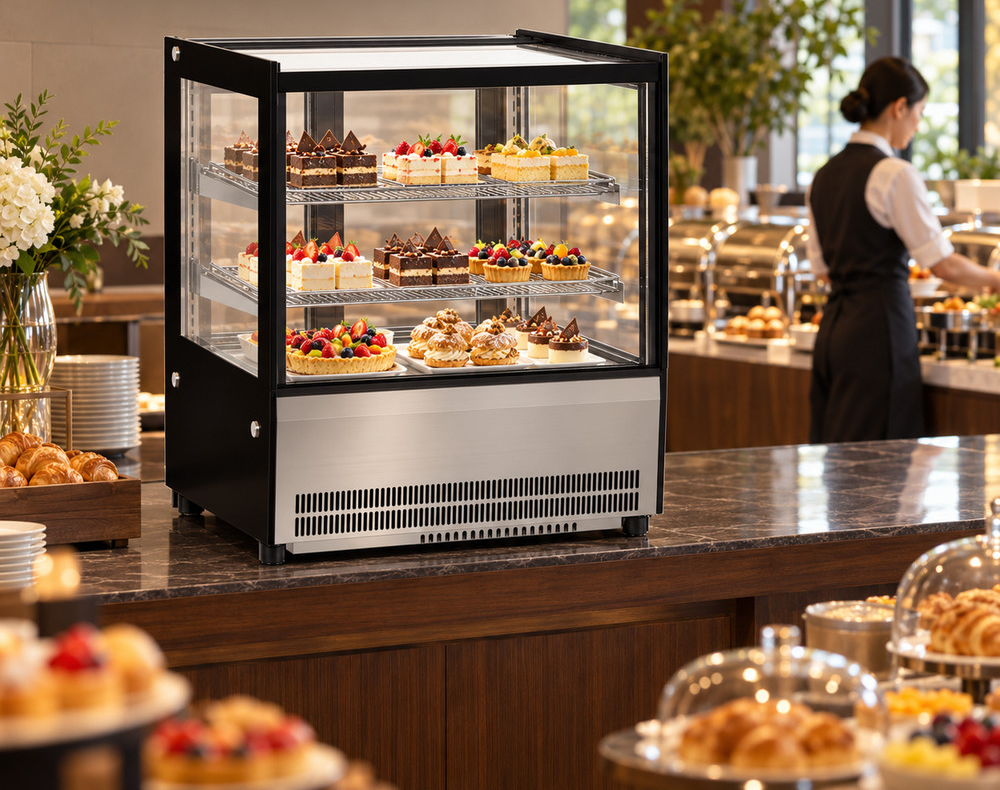
GN-660RT measures 660 × 530 × 730 mm and lists 102 L. GN-1200RT measures 1200 × 530 × 730 mm and lists 190 L. Both are countertop cabinets. GN-1200L is a freestanding open-front cabinet measuring 1200 × 740 × 1400 mm with 295 L listed capacity. Carry the full model code from the accepted equipment schedule into every movement row.
The two 1200 mm models illustrate why a width label is insufficient at handover: their depth, height and installation format differ. The comparison table gives recorded cabinet dimensions to support model identification. Obtain shipment-specific packed dimensions, gross weights and package counts for the allocated units separately. Equipment body measurements cannot supply those shipping figures, and one equipment unit should not automatically become one package on the carrier record.
How does the six-unit allocation reconcile before collection?
Line A orders two GN-660RT units, with one allocated to M1 and one to M2. Line B orders one GN-1200RT, allocated entirely to M2. Line C orders three GN-1200L units, with two allocated to M1 and one to M2. For every line, the two proposed movement quantities sum to the order quantity. M1 totals three equipment units and M2 totals three.
Use a separate package schedule for each movement. Link its package references to these order lines and identify any accessory packages with the equipment they accompany. A shared order reference does not make two package schedules interchangeable. Before acknowledging a collection arrangement, compare the nominated movement revision with the package schedule returned for that movement. Preserve the earlier revision when an allocation changes so the receiving team can identify which version accompanies the load.
What remains outstanding after only movement M1 is received?
In the example, assume the destination records receipt of one GN-660RT and two GN-1200L units from M1. The outstanding equipment balance is then one GN-660RT, one GN-1200RT and one GN-1200L: three units in total. The table calculates that balance by subtracting the illustrative M1 receipt from the accepted order quantity, line by line. It does not mark M2 as received merely because M2 has an allocation.
If the actual receipt differs, retain both the allocated quantity and the observed quantity. Record the package identifiers, model labels and supporting photographs beside the observation. Keep an expected item, an item collected by a carrier and an item received at destination in separate columns. This makes a partial receipt visible without silently changing the original order or treating a collection record as destination evidence.
Can buyer-arranged pickup and arranged delivery share the same order?
An equipment schedule can describe both proposed movements, while each movement still needs its own accepted transport scope. Identify the collecting or delivering party, collection point, destination and handover endpoint for M1 and M2 individually. Attach the package schedule and site contact for the relevant movement. Ask the proposed provider to acknowledge its own scope against that reference.
For buyer-arranged pickup, retain the collection observation separately from destination receipt. For a proposed arranged delivery, identify whether the endpoint is the receiving entrance, an unloading area or another named location in the written offer. Record any onward indoor movement separately. The allocation worksheet can track either arrangement; it does not establish which transport options JINYU offers for a particular destination or include positioning, unpacking or installation within a delivery description.
How should I record an accessory or document arriving separately?
Give the item its own sub-reference under the equipment line, describing the supplied-item list entry and the movement expected to carry it. For example, line C can retain its three-cabinet quantity while a separate entry tracks a document set identified in the accepted schedule. Use the actual supplied-item description; an illustrative worksheet is not evidence that an accessory is included.
If a package contains items for more than one equipment unit, record all linked line references rather than increasing the cabinet count. At destination, reconcile the labelled package first, then record unpacked observations against the supplied-item list. Preserve unresolved entries when another movement arrives. Close each entry using its own receipt or response record, keeping equipment counts, accessory quantities and document receipt distinct throughout the handover history.
What should I send JINYU for a split pickup or delivery inquiry?
Send the accepted or proposed model schedule, quantity by line, destination and the intended allocation across movements. Name the contact and handover endpoint for each movement. Include site access information and distinguish any proposed carrier pickup from a delivery arrangement you want reviewed. Ask for the offered transport scope and shipment-specific package schedule against those movement references.
Address the inquiry to JINYU, Shaanxi Jinyu Kitchenware Co., Ltd. (陕西金宇厨具有限公司). Attach the current allocation revision and identify any equipment, accessory or document entry still unresolved. Keep the response with that revision, then use separate collection and destination records when equipment moves. The resulting file connects the original inquiry, the accepted equipment lines, each physical handover and the final outstanding balance without replacing one stage with another.