Buyer planning guide
Commercial Kitchen Equipment Receiving Checklist: Pickup to Delivery
Record package counts, model labels, visible condition, accessories and discrepancies when commercial kitchen equipment changes hands after pickup or delivery.
Map equipment to packages and reconcile split pickup or delivery movements →
Receiving record: fields and supporting evidence
Use one record for each handover. Keep the package count, unpacked contents and later commissioning checks separately identifiable.
| Check | Record | Compare or attach |
|---|---|---|
| Handover | Location, date, time, observer and transport reference | Collection record or destination receiving record |
| Package count | Expected and observed count, with each package identifier | Shipment package list and overview photographs |
| Identity | Order line, expected model, observed model and serial identifier | Accepted equipment schedule and cabinet-label photograph |
| Outer condition | Observed wrapping, crate or pallet condition by location | Wide view and labelled detail photographs |
| Unpacked contents | Documented and observed accessories; separate-box identifiers | Supplied-item list and unpacking photographs |
| Discrepancy | Expected item, observed difference, quantity and requested response | Affected line reference and supporting images |
| Follow-up | Contact route, report reference, response and resolution date | Purchase/transport documents and retained correspondence |
| Commissioning | Responsible person, instruction reference and later check record | Selected configuration installation documents |
What should I check when commercial kitchen equipment arrives?
Start with the package list and accepted equipment schedule. Match each package label to an order line, count the packages and photograph their visible condition before packaging is removed. Record the receiving location, date, time and person making the observations. Keep the transport document reference beside the photographs so the record identifies a particular handover.
Separate three checks: what arrived, what is visibly present after unpacking, and what an installer later verifies during commissioning. A complete package count does not establish that every accessory is inside or that refrigeration operates correctly. The checklist below follows those stages. It can accompany nominated-carrier pickup or supplier-arranged delivery; the written transport arrangement identifies where responsibility for each movement changes hands.
Does the receiving checklist change for pickup versus delivery?
Use the same equipment and package identifiers at each handover, but name the location and observer separately. With nominated-carrier pickup, the collection record describes what the carrier received at the collection point. The destination record describes what the restaurant or warehouse received later. With arranged delivery, record the endpoint actually reached, such as the loading area or equipment room, against the agreed transport scope.
Keep collection photographs and destination photographs in separate dated folders. They document different moments. If an indoor movement provider takes over after unloading, add another handover entry using the same package identifiers. A receiving checklist records observations; it does not define insurance cover, change agreed delivery terms or establish that installation is included. Carry those written arrangements alongside it.
How do I match a cabinet to the correct model and order line?
Copy the full model identifier from the cabinet label into the receiving record, then compare it with the accepted equipment schedule. Record any serial identifier as a separate field. A package number, order-line number and model code serve different purposes: one follows the package, one follows the purchase and one identifies the equipment configuration. Retain all three where available.
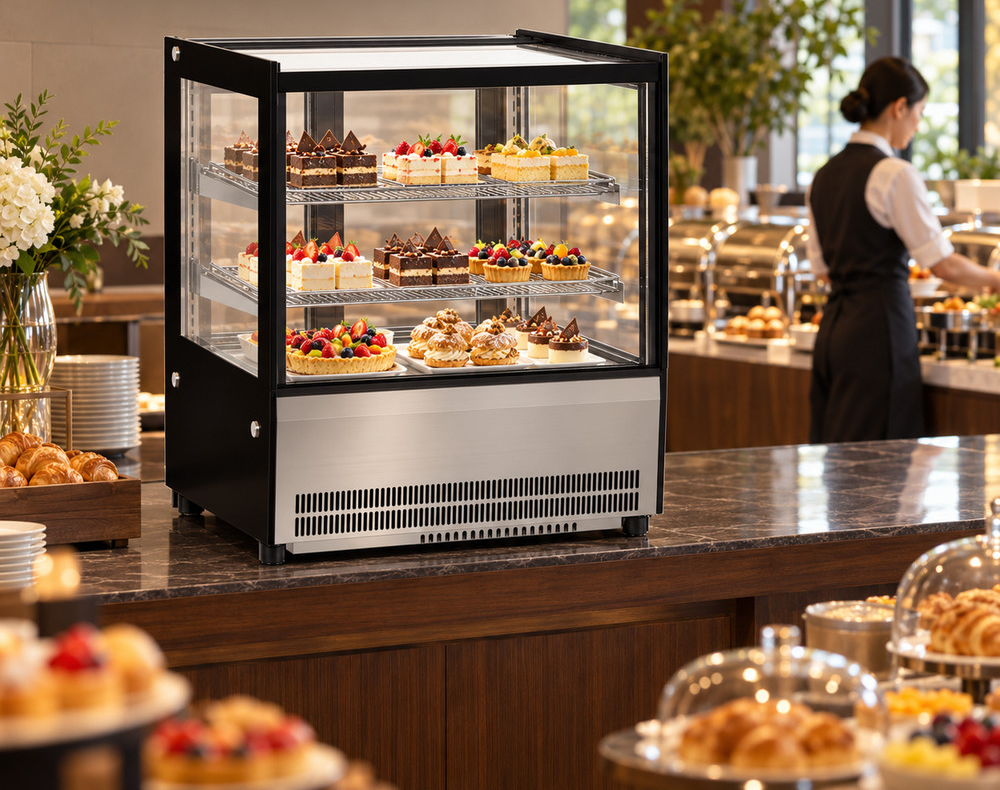
For a concrete JINYU comparison, GN-660RT is listed at 660 × 530 × 730 mm and GN-900RT at 900 × 530 × 730 mm. Both are countertop cake displays, yet their widths differ by 240 mm. A photograph of similar straight front glass is therefore insufficient to identify the ordered model. These are cabinet dimensions; use the shipment's package schedule for packed measurements.
Which photographs make a visible-condition report useful?
Begin with a wide view showing the complete package at the handover location. Add views of each accessible side, the package identifier and any visible damage. For a crushed corner, photograph both the whole corner and a closer view of the affected area. Note whether the observation concerns wrapping, an outer crate, a pallet or the exposed cabinet. Do not describe cabinet damage solely from a mark on packaging.
Use filenames that connect the image to the record, such as line-02-package-B-front and line-02-package-B-corner-detail. After authorised unpacking, keep the removed packaging identifiable and add photographs of the corresponding cabinet area. Write observations such as torn wrapping or chipped glass rather than guessing the cause or the point during transport when it happened.
How should I check shelves, accessories and separate packages?
Compare the unpacked contents with the supplied-item list for the accepted configuration. Give each separate box or accessory pack a row, including its identifier and the order line it belongs to. Record the observed quantity beside the documented quantity. Photograph small components together with their label so the receiving team can trace them after the main cabinet packaging has been moved.
Use the packing list rather than counting items from a catalogue photograph. Food, trays, pans and display props shown in product images do not establish supplied contents. If a shelf or fitting is absent from the unpacked area, first check the separate-package entries and documented packing locations. Record an unresolved difference against the exact item description; avoid marking the entire shipment complete while that row remains open.
What belongs in a shortage, wrong-model or damage report?
Identify the order reference, affected line, package identifier and observed model label. State the expected item from the accepted document, then describe what was actually received. Include quantities for shortages and a location description for visible damage. Attach the relevant photographs and identify the packing-list or equipment-schedule revision used for comparison. Keep unrelated observations on separate rows.
For example, a wrong-model record could state that line 02 calls for GN-900RT but the observed cabinet label reads GN-660RT, with a label photograph attached. It should request a response against that line without silently changing the equipment schedule. Send the record through the contact route specified in the purchase and transport documents. Follow their reporting procedure and retain the response with the original evidence.
Can the receiving team switch refrigeration on immediately?
Receipt and commissioning need separate records. Package count, model identity and visible condition can be documented at handover without treating a power-on as an acceptance test. Use the selected cabinet's installation and handling instructions to plan placement, electrical connection and startup after transport. A generic checklist cannot supply a settling period or installation clearance for every refrigeration configuration.
Record who will review the instructions and who will perform the commissioning checks. Keep the model label, available installation documents and site electrical information together for that person. Where a display reading or operational check is recorded later, attach the test conditions and date. Avoid converting a brief receiving observation into a claim about refrigeration performance, food temperature or long-term reliability.
What should I retain after the delivery handover?
Keep one indexed record linking the accepted equipment schedule, package list, transport reference, handover observations, photographs and any discrepancy response. Preserve the original observations when an issue is resolved, then add the resolution date and supporting document. This lets the purchasing team distinguish receipt of a package from completion of a missing-item request or a later commissioning check.
Request the offered packing details, supplied-item list and installation documents for that configuration. Use the linked pickup-or-delivery guide to compare transport scope, and this checklist to prepare the people who will receive and identify the actual shipment.
Reference sources
- Plan unpacking and receiving space
- Reconcile buyer-arranged pickup packages at handover
- Compare pickup and delivery quotation scope
- Compare pickup and delivery scope
- Measure the collection and receiving route
- Keep packed and unpacked dimensions separate
- JINYU GN-660RT model record
- JINYU GN-900RT model record
- Plan pickup or delivery when the kitchen site is not ready
Regional references support general planning; model-specific specifications come from the published JINYU model tables.