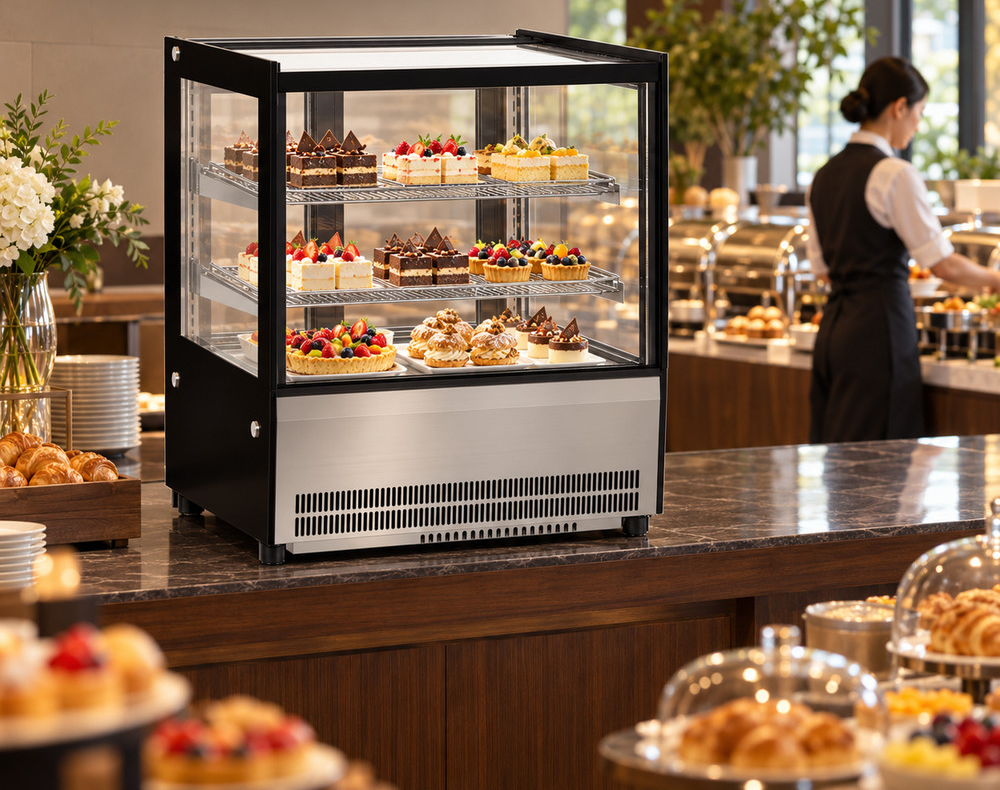
How do I convert display fridge dimensions from millimetres to centimetres and inches?
Divide each millimetre measurement by 10 for centimetres or by 25.4 for inches. Keep the original width, depth and height labels beside every result. GN-900RT measures 900 × 530 × 730 mm, so its outside body is 90 × 53 × 73 cm, or approximately 35.43 × 20.87 × 28.74 inches. Convert the three axes individually; a single width conversion does not describe the complete cabinet.
The chart below retains millimetres as the recorded specification and shows inch values to two decimal places. Those decimal places describe the conversion, not a manufacturing tolerance. When requesting a drawing, send the full model code and original millimetre dimensions alongside your local-unit notes. This keeps a rounded planning number connected to the cabinet it represents.
Which countertop display fridge sizes can I compare in the same units?
The RT straight-glass range in this chart has widths of 660, 900 and 1200 mm. All three bodies are 530 mm deep and 730 mm high. Their listed capacities are 102, 140 and 190 L respectively. The CT curved-glass models are 900 and 1200 mm wide, also 530 mm deep and 730 mm high, with listed capacities of 120 and 162 L.
A 900 mm countertop position therefore has two different glass-profile references with matching outside dimensions: GN-900RT and GN-900CT. Their listed capacities differ by 20 L. Converting both cabinets into inches leaves the outside dimensions identical. Keep glass profile and capacity in separate comparison fields, then request shelf and opening measurements for the actual trays. Exterior size alone does not establish the arrangement inside the glass.
Does a 47-inch counter provide the same width as a 1200 mm cabinet?
A 47-inch span converts to 1193.8 mm because 47 × 25.4 = 1193.8. It is 6.2 mm shorter than the recorded 1200 mm cabinet width. Rounding 1200 mm to a whole-inch label of 47 inches hides that difference. GN-1200RT and GN-1200CT both have a recorded width of 1200 mm, equivalent to approximately 47.24 inches. Use the original measurement when comparing either cabinet with a constrained opening.
For an illustrative measured span of 48 inches, the conversion is 1219.2 mm, leaving an arithmetic body-width difference of 19.2 mm. That remainder describes the two measured widths only. Add the selected model's documented installation spacing, access needs and the site's measurement accuracy to the placement review. Record the measured span rather than treating a nominal furniture size as the finished opening.
How do I compare a countertop cabinet with a freestanding CF2 display?
GN-1000CF2 measures 1000 × 730 × 1200 mm, or 100 × 73 × 120 cm. GN-1500CF2 measures 1500 × 730 × 1200 mm, or 150 × 73 × 120 cm. Their listed capacities are 265 and 345 L. Both are freestanding curved-glass cabinets with two glass shelves. Their 730 mm body depth equals the countertop models' 730 mm body height, so retain the axis label when copying either number.
A GN-1200RT is 120 cm wide, 53 cm deep and 73 cm high. The GN-1000CF2 is 20 cm narrower but 20 cm deeper and 47 cm taller as a cabinet body. A countertop unit also sits on a support surface. For its top height above the floor, add the measured support height to the 730 mm cabinet height; the CF2 body height starts at the floor.
Can converted exterior dimensions tell me which trays will fit?
The conversions describe the cabinet body. They do not supply usable shelf width, shelf depth or the clear service opening. GN-1200CT and GN-1200RT share a 1200 × 530 × 730 mm exterior, while their listed capacities are 162 and 190 L. Preserve those separate facts when making a tray plan. A litre figure or an outside width is not a tray-layout drawing.
Measure the actual tray including its rim and handles, and label width, depth and the height of the loaded product. Send those dimensions with the selected model code. Request a dimensioned shelf and opening drawing for that configuration, then compare the tray's removal path as well as its resting position. If the tray record uses inches, retain the original values and add millimetres in a neighbouring column so the person checking the drawing can follow the conversion.
What units should I use for the delivery route and package dimensions?
Use one unit consistently on each route drawing and label it in the title. For a site recorded in inches, convert the clear doorway width, clear height and turning-space measurements separately. Keep those route observations distinct from both cabinet dimensions and the shipment's packed dimensions. The package can have a different outline; request its actual schedule rather than calculating it from the body chart.
For example, GN-1000CF2 has a 730 mm body depth, approximately 28.74 inches. That single measurement does not describe a turn through a corridor, the package outline or the handling arrangement. Include photographs showing the measuring points, thresholds, door hardware and changes of direction. Attach the shipment-specific package dimensions and gross weight when available, with units and revision date, so receiving and transport teams use the same cargo record.
What should a dimension-conversion inquiry include?
Start with the JINYU model code, the original W × D × H specification and the unit used on your site drawing. Add your measured position, support height for countertop equipment, nearby fittings and the intended tray dimensions. The worksheet below keeps recorded cabinet facts separate from site observations and shipment information. Each row should identify the drawing or photograph from which the measurement came.
For a GN-900RT inquiry, retain 900 × 530 × 730 mm as the body reference even if the floor plan is in inches. Write the converted values alongside it and identify which drawing dimension is restrictive. Send the worksheet to Shaanxi Jinyu Kitchenware Co., Ltd. (陕西金宇厨具有限公司) through the inquiry page. Request the selected configuration's installation and shelf drawings to resolve the remaining placement and product-access questions.