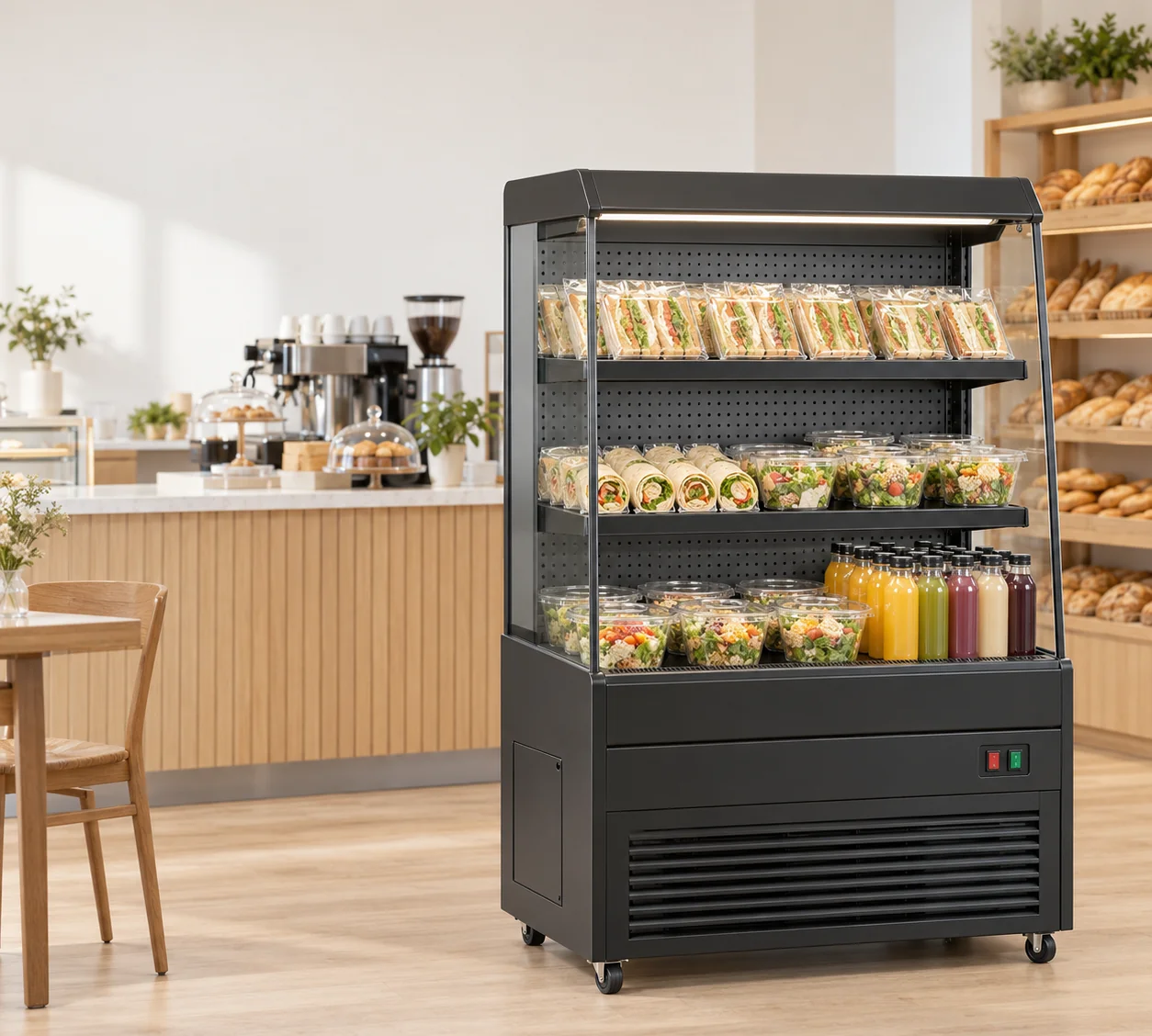
What does the grab-and-go counter specification download include?
The CSV contains twelve JINYU models from the L, LG, FRO and FCO open-front families. Each row keeps the model code, series, outside width, depth and height, listed capacity, temperature range, shelf description, side-glass description, rated power and voltage/frequency together. Separate numeric columns identify millimetres, litres and watts in their headings. A product URL returns you to the model page for photographs and the complete specification record.
Download the file before sorting or annotating it in your spreadsheet. Keep an unchanged copy beside the working shortlist so another person can trace a selected row back to the published record. The download is a model comparison, not a shipment packing list. Add your project quantities, site references and requested documents in separate columns rather than replacing the recorded model fields.
How do I use the file to compare counters at one width?
Filter the width column to 1000 mm to compare GN-1000L, GN-1000LG, GN-1000FRO and GN-1000FCO. Their listed capacities are 245, 230, 390 and 535 L respectively. Their outside heights are 1400, 1350, 1300 and 1300 mm. The L and LG bodies are 740 mm deep, while FRO and FCO are 730 mm deep. Read across the complete row after filtering; matching frontage does not establish matching interiors.
For a 1200 mm position, repeat the comparison with the four 1200 mm models. Preserve the full suffix when discussing a response. An FCO proposal cannot be recorded as an FRO merely because the outside dimensions match. Use the model link to review the photographs, then request the shelf drawing for the actual candidate.
Why does the download retain the exact shelf descriptions?
A shelf count alone can hide an important difference in the recorded configuration. GN-1000L and GN-1000LG list two shelves. Other L and LG records explicitly describe two shelves plus a base deck. FRO records two glass shelves plus a base deck, and FCO records three shelves plus a base deck. The export preserves those descriptions instead of supplying an extra deck wherever a photograph appears to show one.
When planning an assortment, create a separate row for each proposed display level and identify the drawing that supports it. Enter pack width, depth and height, including lids and projecting labels. Ask for usable shelf dimensions and retrieval-opening measurements. Neither an outside cabinet height nor the listed capacity establishes whether a particular upright bottle can be placed on a selected shelf.
Can I calculate a cabinet lineup from the downloaded widths?
Yes. Multiply each selected model width by its requested quantity, then add those body widths. One GN-900L and one GN-1200LG total 2100 mm of cabinet frontage. Their listed capacities total 515 L: 235 plus 280 L. Their body depths are both 740 mm, while their heights differ by 50 mm. Keep those unequal heights in the layout drawing instead of treating the pair as one continuous cabinet.
On an illustrative 2600 mm equipment run, subtracting 2100 mm leaves 500 mm of width balance. That number describes only the unused body frontage. Locate both cabinets and any packing surface on the measured plan, then review the surrounding installation and operating space against the model documents. The CSV gives cabinet dimensions; it does not provide the required site clearances.
How should I compare the rated-power and supply columns?
The power column contains the recorded rating in watts, with supply text retained in a separate column. GN-900L and GN-1200LG record 820 W and 950 W, so their arithmetic sum is 1770 W. Retain the two individual lines when passing the equipment schedule to the person reviewing the site connection. The sum is a list total, not a circuit specification or a measurement of simultaneous operating demand.
All twelve listed configurations record 220-240V/50Hz. A different offered configuration needs its own electrical documentation beside the response. Rated power also does not establish daily electricity consumption. If energy use is part of the comparison, request the relevant measurement conditions and result for the proposed model rather than converting the watt rating directly into a daily running-cost claim.
Does a shared temperature range make the models interchangeable?
The records show a 2-8 temperature range, with the original unit notation retained in the table and CSV. This shared range does not remove differences in cabinet outline, shelf arrangement, glass profile or listed capacity. GN-1000FRO and GN-1000FCO share the same 1000 × 730 × 1300 mm outside dimensions, yet their recorded capacities are 390 and 535 L and their supplied shelf descriptions differ.
Add the intended food or packaged-drink assortment to the comparison request. Keep its storage requirements with the operating plan and ask for the exact model documents. A published cabinet range does not describe the temperature of every product during a service period. Use the download to identify equipment candidates, then connect each candidate to the proposed loading arrangement and the site's operating review.
What should I send with my completed model shortlist?
Send Shaanxi Jinyu Kitchenware Co., Ltd. (陕西金宇厨具有限公司) the selected model codes, quantities and destination, together with the measured equipment position. Attach your pack dimensions, proposed shelf allocation and available site supply. Label additional spreadsheet columns as buyer entries so the response can distinguish project information from the exported cabinet record. Keep the source product URLs in the working copy.
Ask for a model-specific drawing, shelf dimensions, supplied-item description and electrical documents against each selected line. Record proposed substitutions in a new response column, preserving the original request. If a substitution changes width, height or shelf arrangement, update the layout and assortment review together. Shipment dimensions belong in a later packing schedule, where package identifiers and gross weights can be tied to the actual movement.