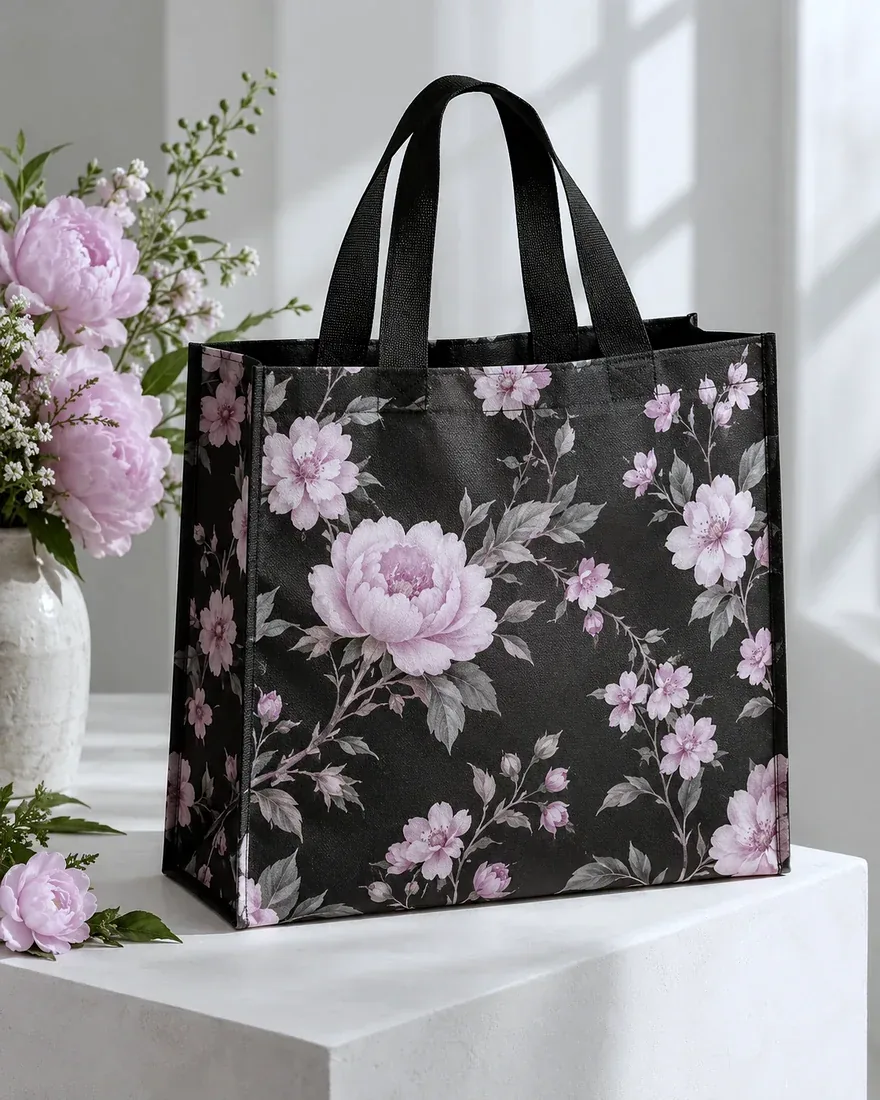
How do I compare two sizes in the non-woven bag size chart?
Select a catalogue reference for A and another for B. Each selection includes the product name, SKU and variant code, so two styles with an S label remain distinguishable. The result shows width, body height and recorded gusset depth in separate rows. The last column subtracts A from B: a positive number means B has the larger recorded dimension on that axis. Choose centimetres or millimetres to display the same comparison in your drawing unit.
The starting comparison uses Non-Woven Takeaway Bag S and M. S is 21 × 24 × 12 cm and M is 23 × 25 × 14 cm. Moving from S to M adds 2 cm in width, 1 cm in body height and 2 cm in depth. Read all three changes before selecting a sample; the size letter alone does not explain them.
Does a larger bag on one axis mean a larger bag overall?
Compare the axes independently. The Non-Woven Takeaway Bag L is 25 × 26 × 18 cm, while the Loop-Handle Non-Woven Tote STD is 38 × 42 × 10 cm. The tote has 13 cm more width and 16 cm more body height, but 8 cm less recorded depth. One reference therefore cannot be described as larger in every direction. The right shortlist depends on the intended contents and the construction being considered.
Keep the closed contents dimensions beside the comparison. A broad, shallow item and a narrow stack use the body differently. The displayed differences do not establish loading clearance, weight capacity or the number of items carried. Use the product links to review the construction and then record observations from the selected physical samples.
How should I compare a flat bag with a gusseted variant?
Select the Loop-Handle Non-Woven Tote FLAT and STD references to see the distinction. Both list a 38 × 42 cm body. STD also records a 10 cm gusset depth; FLAT has no recorded gusset depth. The depth comparison consequently says Not comparable rather than reporting a ten-centimetre gain from a measured zero-depth bag. The catalogue uses zero as a flat-format marker, not as a measurement of the bag when loaded.
Width and body height can still be compared for that pair. Keep the construction names in the brief because identical front-face dimensions do not imply identical loaded shapes. If the receiving proposal changes a flat style to a gusseted construction, retain both product references and request the corresponding body and opening drawings.
Can I switch from centimetres to millimetres without entering the sizes again?
Yes. The unit selector converts the recorded catalogue values and their differences together. The initial S-to-M comparison becomes 210 × 240 × 120 mm versus 230 × 250 × 140 mm, with changes of +20, +10 and +20 mm. It does not reinterpret the catalogue numbers as a different unit. The column headings state the active unit, and the selected product references remain the same.
Use one unit throughout each drawing and label the dimension order. Width × body height × gusset depth differs from a box supplier's width × depth × height sequence. Copy the axis names alongside the values when transferring the result into a spreadsheet. This keeps a 240 mm body height from being mistaken for a base-depth requirement.
Are these external bag dimensions or usable internal clearances?
These are recorded outside body dimensions. Body height excludes separate loop handles, and the depth field describes the recorded gusset. Seams, closures, handle attachments and the opening shape can affect the usable space. The comparison does not subtract an assumed seam allowance or derive an internal dimension from the outside body. It also does not turn the three measurements into a usable litre rating.
For a rigid box, measure the finished package including lid overhang and wrapping. Show the direction in which it enters the bag and the direction in which it rests. Test insertion, seating and removal with the actual sample. Keep those observations beside the SKU and variant code so they refer to the same construction as the numerical comparison.
What should I record when choosing between the two samples?
Give each sample a reference that includes its catalogue SKU, variant and any returned drawing revision. Record the measured body width and height using labelled endpoints, then record the opened gusset separately where present. Photograph the empty sample, the intended contents and the loaded arrangement. Handle drop and loading-opening dimensions belong on their own lines rather than being added to body height.
Use the comparison to identify the differences your trial should examine. When B is narrower but deeper, photograph both the base arrangement and the opening during loading. When only body height changes, record where the contents sit relative to the top edge and handle attachments. A dimension difference describes the catalogue pair; the trial record explains how those particular samples behave with your contents.
What do I send with an inquiry after comparing the variants?
Send both product links, SKU and variant codes, the selected dimensions and your intended quantities by reference. Add the contents measurements, loading photographs and any artwork file as separate attachments. State which reference you prefer and which dimension or construction difference needs a reply. Address the inquiry to Shaanxi Jinyu Kitchenware Co., Ltd. (陕西金宇厨具有限公司).
For small non-woven quantities, ask about available stock for those specific references. The catalogue comparison does not establish present stock or a custom production commitment. Keep requested changes separate from the published size, and ask the response to identify the offered reference. Use the full chart download when comparing more than two variants, or the dimension filter when you first need a shortlist from minimum body dimensions.