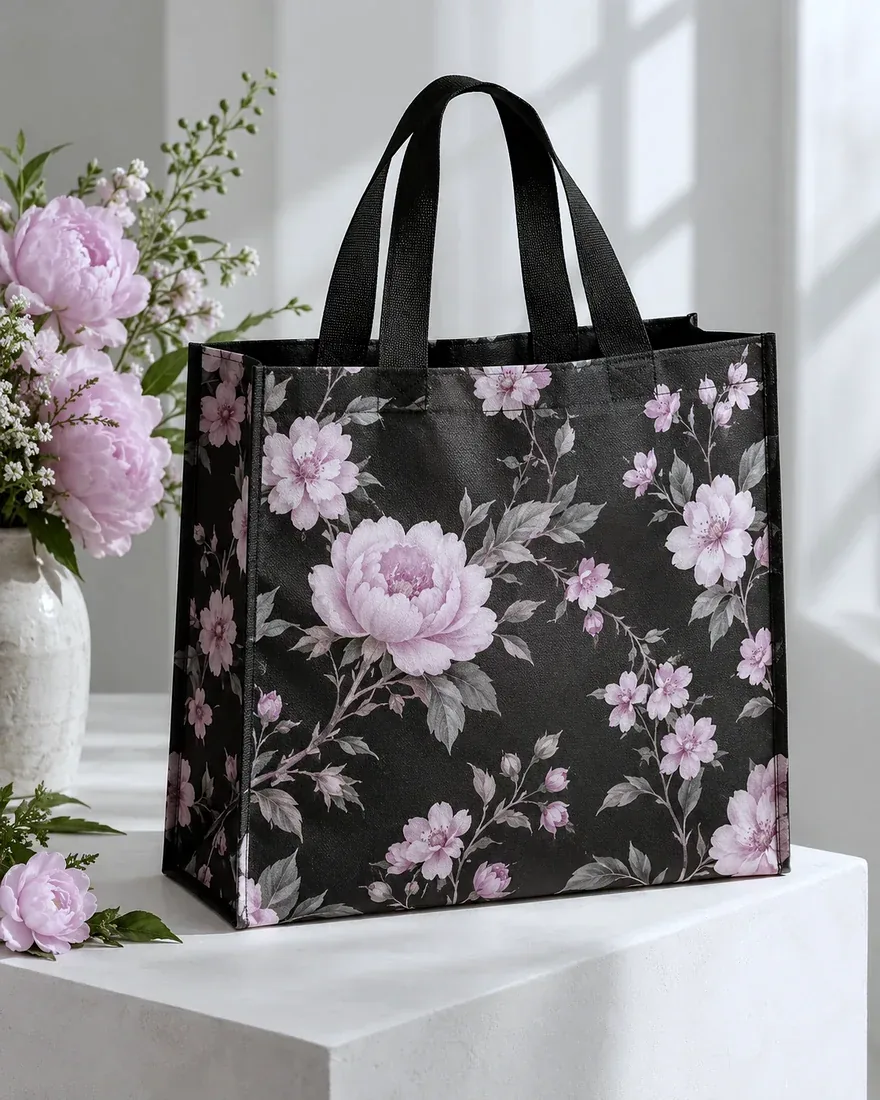
How do I compare a round container with a non-woven bag size chart?
Record the container's maximum outside diameter and total height, then compare diameter against both bag width and gusset depth. Compare container height against bag body height. Include the lid rim, clips and any outer sleeve in the diameter measurement. A cylinder seen from above occupies a circular footprint, but its bounding rectangle still needs space in both horizontal directions.
For an illustrative upright container 18 cm in diameter and 15 cm high, the comparison envelope is 18 cm wide, 15 cm high and 18 cm deep. The six catalogue references below are recorded JINYU bag bodies. The container is an arithmetic example, not an included product or a statement of usable internal bag clearance.
Why does a round tin need a separate depth check?
The takeaway L reference measures 25 × 26 × 18 cm in width, body height and gusset depth. Against the illustrative 18 × 15 × 18 cm envelope, its signed dimensional differences are +7, +11 and 0 cm. The zero depth difference leaves no nominal allowance on that axis. The M reference is 23 × 25 × 14 cm, giving +5, +10 and -4 cm; the negative depth difference identifies a conflict despite the positive width and height differences.
Do not treat a positive width difference as space that can automatically be transferred to depth. Flexible construction changes shape under a load, but the catalogue dimensions do not describe that reshaping. Use an identified bag sample to examine the actual opening, base and seams with the complete container.
How should two upright round containers be arranged?
For two identical upright cylinders placed side by side, the rectangular product envelope has width equal to twice the diameter, depth equal to one diameter, and height equal to the complete container height. With illustrative 12 cm diameter containers that are 16 cm high, the envelope is 24 × 16 × 12 cm. The alternative orientation across the base swaps width and depth, producing 12 × 16 × 24 cm.
The worksheet uses the first arrangement and compares it consistently with each recorded bag body. Draw the intended row direction on the packing sketch. Include any divider, sleeve or protective wrap in the measured envelope. The geometry represents touching containers, so it supplies no separation or handling allowance for a real packing arrangement.
Can I stack two round containers to reduce the base footprint?
Stacking keeps the diameter footprint while adding the complete heights. Two illustrative containers of 12 cm diameter and 16 cm height produce an upright stack envelope of 12 × 32 × 12 cm. This is the third arrangement in the table. Compare the 32 cm stack with body height, then examine the opening, handles and closure using the actual packed sample.
Whether the containers can be stacked depends on the contents and container construction. Record the intended stacking arrangement in the inquiry rather than assuming every lid can support another item. If the contents must stay upright, retain that handling requirement on the drawing. Keep any separator or outer packing in the measured stack height used for the sample review.
Does a cylinder volume calculation establish the bag size?
A cylinder's volume and its rectangular packing envelope answer different questions. For an illustrative 18 cm diameter, 15 cm high cylinder, the geometric cylinder volume is pi × 9 squared × 15 cubic centimetres, approximately 3.817 litres. Its 18 × 15 × 18 cm bounding envelope is 4.86 litres. Neither number establishes whether the opening and base of a particular bag admit the container.
The catalogue records outside body dimensions rather than a measured liquid capacity. Use the three axis comparisons for the initial shortlist and the complete container for the physical observation. If comparing litre figures elsewhere, preserve the formula and the object it describes. A cylinder's calculated volume should not be entered as a bag's measured usable capacity.
What photographs and measurements help review a round-container request?
Provide a top view with the diameter endpoints visible, a side view showing total height, and a photograph of the lid or clip that projects furthest. Identify each container and record whether the measurements include its sleeve. For multiple containers, add an overhead arrangement drawing and a side view of any stack. Label the intended carrying direction on both views.
With a bag sample, record its style, variant and sample identifier. Photograph insertion, the seated arrangement and the accessible handles. Keep observed opening and internal base measurements separate from the catalogue body dimensions. The CSV has blank fields for sample identification and observations so the returned evidence can be connected to the same arrangement row.
What should I send JINYU when requesting bags for round containers?
Send the container references, maximum diameters, complete heights and intended quantities per bag. Select the catalogue style and variant codes you want reviewed, and include the arrangement sketch and photographs. State whether you are asking for available plain non-woven stock or a custom bag specification. Identify any wrapping, divider or closure that changes the full packing envelope.
Shaanxi Jinyu Kitchenware Co., Ltd. (陕西金宇厨具有限公司) can review those references against the intended contents. Keep the signed dimension comparison with the inquiry, including any zero or negative axis difference. The catalogue comparison narrows the discussion; the identified construction and sample observation supply the evidence for the actual packing arrangement. Retain both records when the bag or container revision changes.