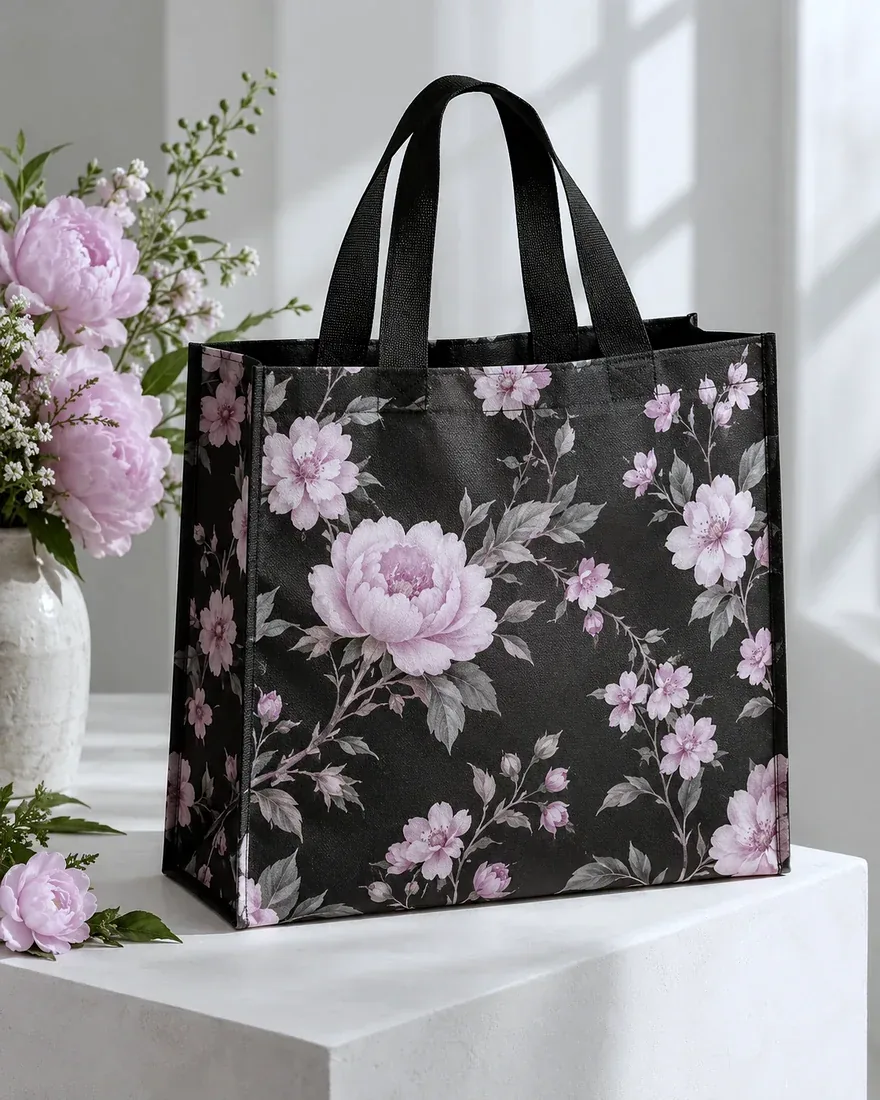
What shoe-box measurements belong in a non-woven bag size chart?
Measure the closed box containing the shoes, with its lid, retail sleeve and any outer wrapping in place. Record the longest base edge, the other base edge and the height. Use centimetres throughout the comparison. The example on this page starts with a hypothetical box measuring 33 × 20 cm across its original base and 12 cm high. These are worked planning dimensions, not a standard shoe-box specification.
Assign those measurements to bag width, body height and gusset depth before subtracting them. Keeping the original base underneath gives W33 × H12 × D20 cm. A product name or footwear size does not provide these measurements. Different boxes for the same shoe size need separate records when their packed outlines differ. Label the measured box so the sample trial can be repeated with the same contents.
Which recorded bag sizes clear the upright dimensional comparison?
The six rows use dimensions from the JINYU stock catalogue. Shopper STD is W40 × H35 × D15 cm; TALL is W38 × H42 × D15 cm; XL is W44 × H48 × D14 cm; RETAIL40 is W40 × H45 × D12 cm. Each has a recorded depth below the upright example box depth of 20 cm. A larger front panel therefore leaves an unresolved depth conflict.
Grocery US-13 is W33.02 × H38.1 × D25.4 cm and AU-33 is W33.2 × H35 × D22 cm. Both have positive differences on all three outside-dimension axes for the upright example. Their width differences are only 0.02 cm and 0.2 cm respectively. Those narrow numerical balances make the actual opening and seam positions essential to the sample review. Neither row establishes that the box can be inserted or carried.
Can I turn a shoe box onto its side to use a shallower shopper?
The side arrangement places the same example box at W33 × H20 × D12 cm. Shopper STD then has differences of +7 cm width, +15 cm height and +3 cm depth. Its original upright comparison had a depth difference of -5 cm. The change comes entirely from assigning a different box edge to the vertical direction; the bag has not become deeper.
Ask the person responsible for packing whether this orientation suits the actual shoes, tissue, lid and presentation. Record that decision beside the arrangement code S. A loose lid or contents that shift during rotation deserve a direct trial with the finished box. Photograph the seated position and the route through the mouth. A positive body comparison provides a reason to examine that sample, rather than an instruction to rotate every shoe box.
How do two stacked shoe boxes change the size calculation?
Two identical example boxes stacked on their original bases occupy W33 × H24 × D20 cm before extra wrapping. The footprint stays 33 × 20 cm while the height doubles from 12 to 24 cm. Use row T to compare that arrangement with the recorded bag bodies. Grocery US-13 has differences of +0.02, +14.1 and +5.4 cm in width, height and depth; AU-33 has +0.2, +11 and +2 cm.
Measure the complete stack again after adding tissue, a gift sleeve or a spacer. Check how the upper box is removed while the lower one remains seated. Record the actual combined mass separately from the three dimensions. The catalogue body size and the calculated box envelope do not supply a carrying-load rating or establish the behaviour of the handles under that packed arrangement.
What should the physical opening and handle check record?
Identify the bag sample, its style and variant, then measure the mouth in the position used for loading. Show where the box corners pass the seams and handle attachments. Record whether the box enters on its final base or is rotated after insertion. The path into the bag can demand space that is absent from a drawing of the final seated outline.
Once the box is seated, bring the handles into the intended carrying position and photograph the box rim relative to the mouth. Keep body height separate from handle drop. An open top does not provide an enclosed cover above the box. Record insertion, removal and handle observations against the same arrangement code so the person reviewing the inquiry can distinguish each part of the trial.
How do I use the downloadable shoe-box worksheet?
The CSV contains eighteen calculated comparisons: six catalogue references multiplied by three example arrangements. Each row identifies the style, variant, bag body, box arrangement and signed differences in width, height and depth. Negative values identify an outside-dimension conflict. Zero leaves no numerical allowance on that axis. Positive values remain a dimensional screen until a physical sample and its opening are reviewed.
Copy the rows for the intended arrangement into your own inquiry record. Add the measured box identifier, sample identifier and photo references in the final columns. Replace the illustrative box dimensions with your measurements and recalculate the differences before using the worksheet for a different box. Keep the original catalogue dimensions alongside the revised calculation so the recipient can trace which values describe the bag and which describe your contents.
What should a stock-bag inquiry for shoe retail include?
Send the selected style and variant references, complete packed-box dimensions, permitted orientations and the number of boxes per carrier. Attach the worksheet and sample photographs. Identify colour preferences and quantities by reference so availability can be answered for each stock line. The catalogue chart describes recorded sizes; the inquiry establishes which existing stock choices are available for the request.
For a custom canvas tote, backpack or travel bag, use the corresponding custom category and supply a separate construction brief. Keep a proposed custom size separate from a recorded non-woven stock reference. JINYU is the brand of Shaanxi Jinyu Kitchenware Co., Ltd. (陕西金宇厨具有限公司). Use the inquiry page to send the selected references and the box record together.