What should a pizza preparation counter replenishment plan describe?
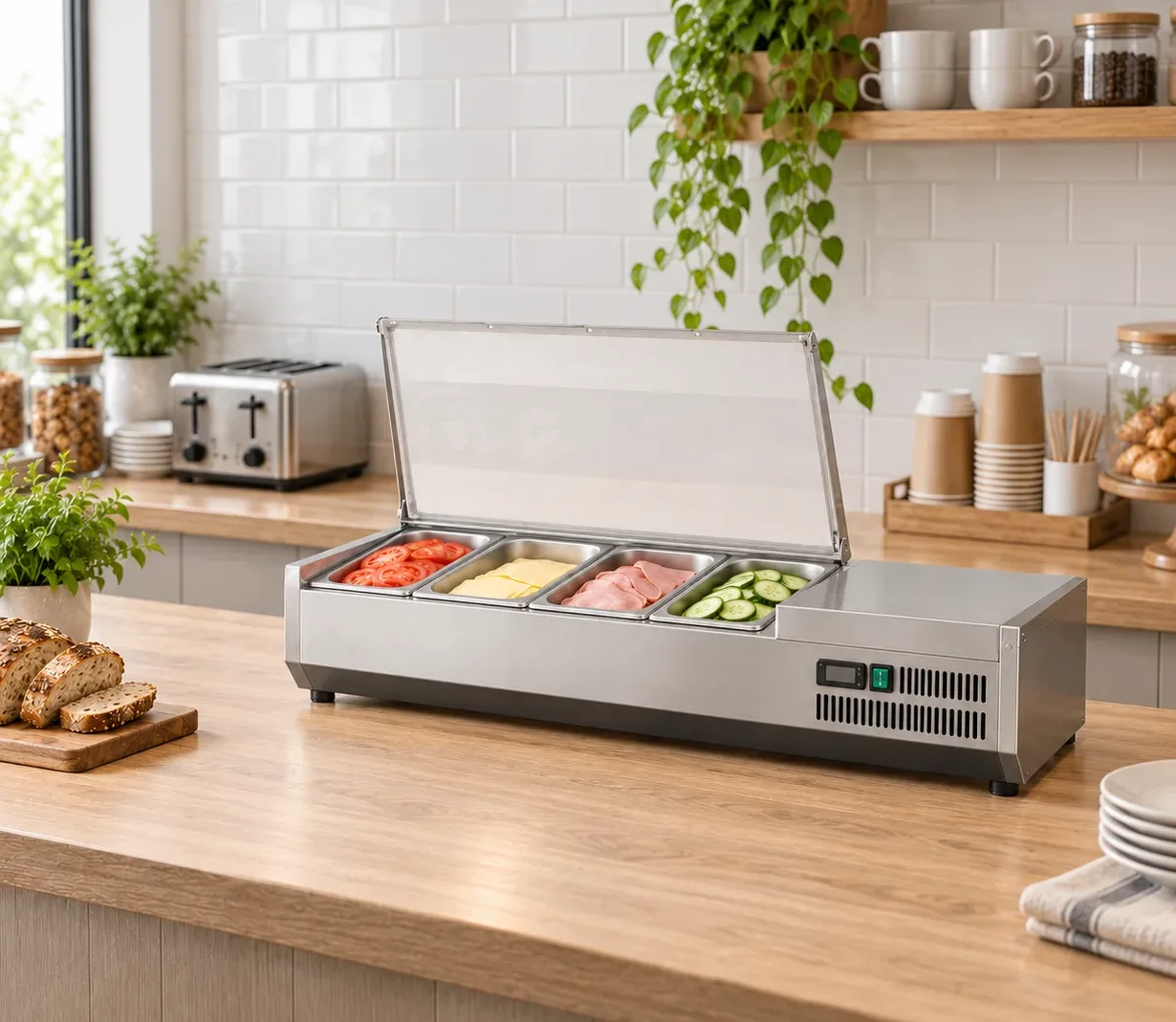
Describe the active ingredient row and the containers waiting to replace it. A pizza preparation counter may be a refrigerated topping rail on a separate worktop; that arrangement leaves dough assembly, reserve refrigeration and the supporting table as separate equipment decisions. Record which part of the station each proposed purchase supplies. The model number on the ingredient rail should not become shorthand for a complete preparation table.
Start with a menu period, such as one observed lunch service. Give every ingredient a row in the schedule and record the opening usable quantity, the quantity issued during that period and the desired quantity at the next opening. Keep quantities in one unit per ingredient. Record the replacement-pan identifier alongside the ingredient so staff can distinguish a container exchange from a loose ingredient top-up.
How do four, five and seven active positions compare?
JINYU GN-1130SC measures 1130 × 405 × 280 mm and lists four 1/3 GN positions with 42 L capacity. GN-1305SC measures 1305 × 405 × 280 mm and lists five positions with 52 L. GN-1655SC measures 1655 × 405 × 280 mm and lists seven positions with 72 L. All three have a hinged lift-up lid. Their exterior widths differ by 175 mm between the first two models and by 350 mm between the second and third.
An extra position can hold another active ingredient or a second container for an ingredient already present. Decide which use your menu requires. Seven positions do not establish seven identical ingredient quantities: pan depth, actual filling and the ingredient itself affect the contents. The listed litres describe cabinet capacity; use measured ingredient quantities for the replenishment calculation.
How much replacement stock does the worked example require?
The worksheet uses three illustrative ingredients measured in kilograms. ING-A opens with 4.0 kg, issues 2.8 kg and has 0.2 kg recorded as removed from usable stock. Its usable remainder is 1.0 kg, so restoring the 4.0 kg opening target requires 3.0 kg. ING-B opens with 2.5 kg, issues 1.7 kg and records no removal: 0.8 kg remains and 1.7 kg is required. ING-C opens with 1.8 kg, issues 1.1 kg and removes 0.1 kg: 0.6 kg remains and 1.2 kg is required.
These examples total 5.9 kg of replacement ingredients. That total is an inventory calculation, not a counter load rating or a menu forecast. Use observed figures from your own kitchen and record why material leaves usable stock. Your food-handling procedures determine whether any remainder is retained; the worksheet simply uses the usable quantity entered.
How do ingredient quantities become a replacement-pan schedule?
Keep the ingredient mass calculation separate from the number of containers. For the illustrative 5.9 kg requirement, a buyer might assign two replacement containers to ING-A and one each to ING-B and ING-C. That makes four proposed reserve containers; it does not specify how many kilograms fit in any particular pan. Add each container's actual dimensions, intended fill quantity and destination position before treating the list as an equipment brief.
Identify the reserve location separately from the rail. Record the external container outline including its lid, the storage shelf used and the route to the preparation station. An active four-position rail does not imply that four reserve containers can be stored inside or beneath it. Ask for an accessory list showing the pans, supports and lids included with the selected model, then reconcile that list with your proposed active and reserve containers.
What measurements matter when exchanging a pan during assembly?
Draw the topping row, the dough assembly surface and the place where an incoming container waits. Mark where the outgoing container goes before it leaves the station. Include utensils and the lift-up lid in the drawing; a closed exterior height of 280 mm is not the open-lid working envelope. Request the selected model's open-lid drawing and the space needed to lift its intended containers clear of their supports.
Walk through one replacement while the assembly area contains the board or tray normally used. Note whether the incoming container crosses that area or blocks access to another ingredient. Record the measured positions and the sequence in the equipment brief. This exercise establishes the questions for a layout review; it does not establish a service-speed claim or a universal clearance dimension.
Can I size reserve refrigeration from the topping rail's capacity?
Use a separate container schedule for reserve refrigeration. The 42 L, 52 L and 72 L figures belong to the three SC rails listed here. They do not describe an undercounter cabinet, the volume occupied by closed replacement pans or the amount of ingredient storage your service requires. Record the actual containers, their lids, their intended quantities and the number present together at the busiest replenishment point.
Separate unopened stock, prepared replacement containers and containers returning from the station in the storage plan. List the reserve equipment already available and the dimensions that purchasing needs from any additional cabinet. If the active rail and reserve storage are quoted together, ask for separate model codes and separate accessory schedules. Keep both linked to the same menu-period calculation so the equipment scope follows the stock plan.
What should I send JINYU for a model-specific review?
Send the selected SC model, the ingredient worksheet, the active position map and the reserve-container schedule. Attach a dimensioned worktop plan showing dough assembly, incoming and outgoing pans, the replenishment route and overhead obstructions. Include the destination and site electrical supply. The three models list 220-240V/50Hz; their recorded rated powers are 130 W, 135 W and 150 W respectively. Keep the model-specific electrical figures beside each candidate.
Ask JINYU, Shaanxi Jinyu Kitchenware Co., Ltd. (陕西金宇厨具有限公司), for the proposed configuration drawing, open-lid dimensions, pan-support details and included accessories. Identify the supporting table and reserve refrigerator as separate lines in the request. When the response arrives, match each drawing to its model code and revision, then update the quantities and container identifiers that changed.