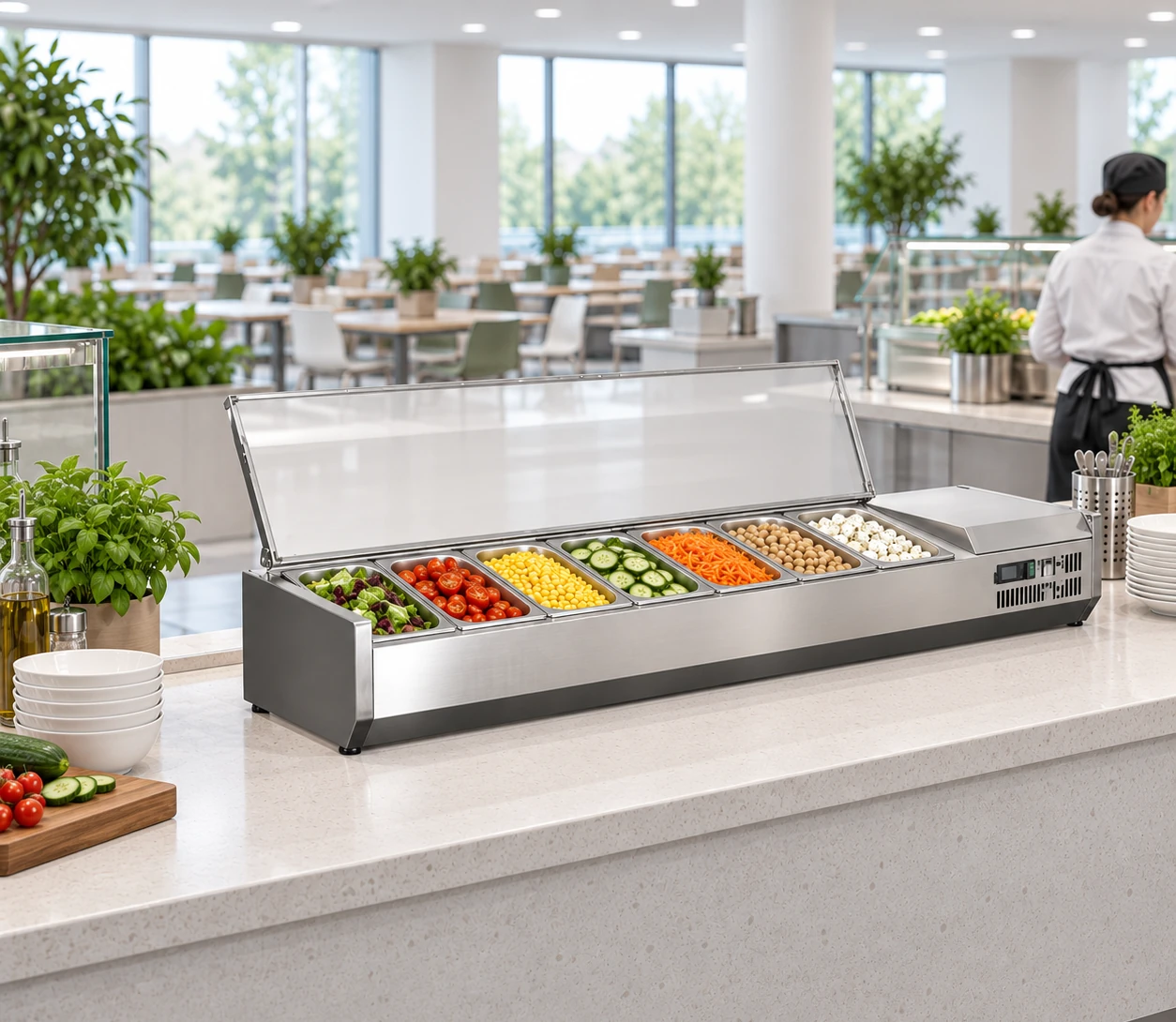
What should a sushi preparation counter handover identify?
Identify the station, cabinet model and numbered ingredient positions before listing loose containers. A shift handover connects the arrangement used by one team with the arrangement expected by the next. Give the station a short location code, such as S1, and keep that code on the layout, pan register and accessory photographs. Record the layout revision beside the outgoing and incoming names so a later reader can reconstruct which arrangement was handed over.
The worked example uses GN-1655SC with seven recorded 1/3 GN positions. It follows the equipment and container identities only. Ingredient disposition, cleaning methods and temperature records belong to the kitchen's operating procedures and the equipment instructions. Keep those records linked by station and date rather than treating a completed pan count as evidence that food or equipment is ready for service.
Which SC and SB specifications belong on the station header?
GN-1655SC measures 1655 × 405 × 280 mm and lists 72 L. Its recorded cabinet access is a hinged lift-up lid. GN-1655SB shares the 1655 mm width, 405 mm depth, seven 1/3 GN positions and 72 L capacity, while its height is 450 mm and its cover is glass. The 170 mm height difference matters when identifying the station from a drawing or photograph; retain the complete suffix on the register.
GN-1830SC measures 1830 × 405 × 280 mm and records eight 1/3 GN positions with 82 L capacity. Its additional position requires an eighth register row. All three model records specify 220-240V/50Hz. Copy the actual unit identification into the station header and retain the relevant equipment documents with it. Nominal pan format alone does not identify pan depth, individual lid reference or the loose components supplied.
How can I number the pans without losing their identities?
Number the physical positions from the same viewing side every time. In this example, P1 is at the operator's left and P7 at the right. Mark that viewing direction on the station sketch. Give each loose pan a separate container identifier; the position label describes a place, while the container identifier follows a particular pan when it moves. An individual lid can carry its own reference in the adjacent column.
The example begins with containers A01 through A07 occupying P1 through P7. Four retain their positions. Three outgoing containers, A03, A05 and A07, leave the active layout, and B03, B05 and B07 replace them. These identifiers are illustrative buyer records. They describe neither a standard accessory package nor the handling required for an ingredient. Record those decisions in the kitchen's applicable procedure and link the record reference to the affected position.
How do I reconcile seven positions with three pan exchanges?
Count occupied positions separately from container movements. The example starts with seven occupied positions, removes three containers and places three replacements. Its final occupied count is 7 - 3 + 3 = 7. The number of positions is unchanged, even though ten distinct container identifiers appear across the outgoing and incoming layouts: seven original containers plus three replacements.
The downloadable register preserves both identities on every row. P3 changes from A03 to B03, P5 from A05 to B05 and P7 from A07 to B07. Four rows have the same identifier on both sides. Add the destination record for each removed container and the origin record for each replacement. Keeping those references beside the movement allows the incoming team to trace a change without inferring that every pan at the station was replaced.
How should individual lids and cabinet covers be recorded?
Record an individual container lid against its pan reference. Keep that reference separate from the cabinet's hinged lid or glass cover. Seven occupied ingredient positions do not establish the number of individual lids available, nor do they establish whether a particular lid fits the container currently in that position. Use the accepted accessory list and the actual component references to identify what belongs at the station.
For a replacement pan, retain the outgoing lid reference and enter the incoming one when they differ. If the same lid is reassigned, record that movement explicitly. For cabinet components, use the equipment drawing reference and a photograph locating the part. This gives the purchasing contact a specific part to discuss with JINYU when an additional container, lid or support component is needed.
What should the incoming team check against the register?
Compare the physical position labels with the drawing first, then read the container identifier at each position. Check the three changed rows against the replacement records and compare the four retained rows with their existing identifiers. Read the linked operating records separately, including the kitchen's ingredient and cleaning records. A matching equipment register establishes identity and arrangement; each operating record answers its own service question.
Enter observations against the affected row rather than replacing the outgoing entry. For example, if P5 contains B06 instead of the recorded B05, preserve the planned B05 entry and record the observed B06 with the time and photograph reference. Resolve the drawing or container assignment in a dated revision. Both teams can then distinguish a transcription correction from a physical change to the station.
What information supports an accessory inquiry after handover?
Send the complete model code, station location, position label and existing component reference to JINYU, Shaanxi Jinyu Kitchenware Co., Ltd. (陕西金宇厨具有限公司). Include photographs showing the component in context and its identifying details, together with measured pan depth and any part drawing already supplied. State the quantity being requested as a separate inquiry field.
Attach the affected register rows instead of sending an unexplained photograph of the whole counter. Ask for the offered component reference and its relationship to the selected cabinet configuration. Retain the returned drawing or accessory schedule beside the station register. When a replacement is accepted into the station, give it a container identifier and update the relevant position row so the next shift receives the revised equipment record.