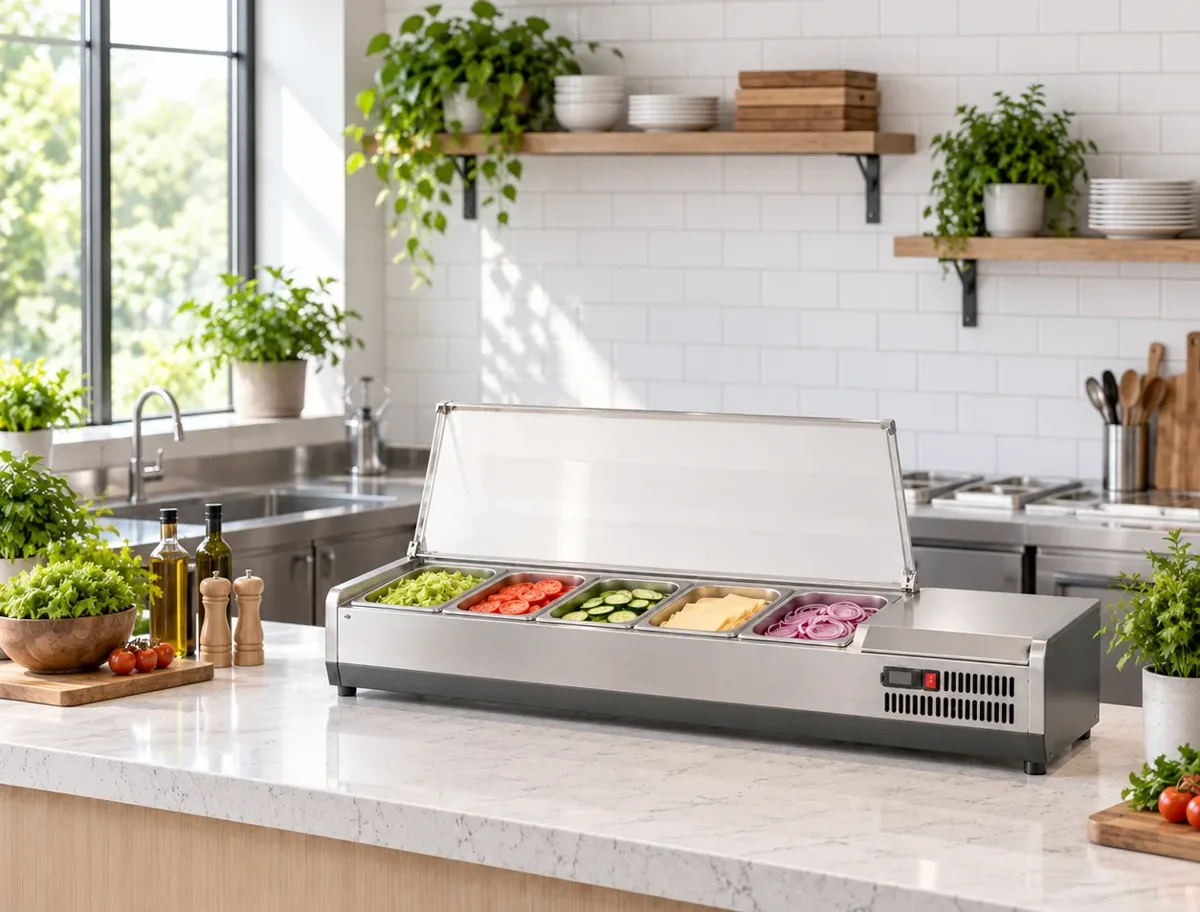
How many topping fridge positions do two menus actually need?
Start with the containers that must be available at the same time. In this illustrative lunch menu, sandwiches use shredded lettuce, diced tomato, sliced cucumber and grated cheese. Salads use shredded lettuce, diced tomato and sliced olives. Adding the two recipe lists gives seven ingredient appearances, but lettuce and tomato occur in both lists. If staff draw each shared ingredient from one common pan, the combined menu needs five occupied positions. The matrix below records those five distinct ingredient lines. Its menu names and ingredients are buyer examples, not a supplied food package.
The distinction matters when comparing GN-1130SC and GN-1305SC. The first has four 1/3 GN positions; the second has five. A four-position rail can represent the sandwich menu alone in this example, while simultaneous sandwich and salad service needs a fifth position for olives. Make this count before comparing cabinet capacity in litres. A recipe appearance, an ingredient identity and a physical pan are three different entries in the purchasing brief.
What happens when a shared ingredient needs a second serving pan?
A common ingredient can still occupy two positions. Suppose the sandwich worker and salad worker each need a dedicated tomato pan during the same service period. Keep I02 as one ingredient identity, but change its simultaneous pan count from one to two. Lettuce, cucumber, cheese and olives still occupy one position each. The resulting physical count is six. This duplicate-pan case is shown separately from the five-position shared-pan case so the equipment comparison can be reconstructed.
GN-1305SC has five recorded positions, leaving a one-position shortfall for that six-pan arrangement. GN-1655SC has seven, leaving one unallocated position. Decide what the remaining position is for and record it on the drawing. It does not automatically create a suitable utensil holder or another storage zone. The example measures position demand only; it establishes neither staff throughput nor separation controls for particular foods. Describe any handling requirements alongside the numbered pan map.
Which documented SC models cover the four, five and six-pan cases?
GN-1130SC records four 1/3 GN positions, a 42 L capacity and a 1130 × 405 × 280 mm body. GN-1305SC records five positions, 52 L and 1305 × 405 × 280 mm. GN-1655SC records seven positions, 72 L and 1655 × 405 × 280 mm. Each uses a hinged lid. The comparison below subtracts occupied pans from those recorded position counts for the four-pan sandwich menu, five-pan shared menu and six-pan duplicate-tomato arrangement.
Moving from the four-position model to the five-position model adds 175 mm of cabinet length. Moving from five to seven positions adds another 350 mm. There is no six-position SC model among these three records. Compare the seven-position cabinet with the measured counter and the planned use of its spare position rather than assuming that six occupied pans require a six-position product. Keep the body dimensions with the selected code; the ingredient count alone does not describe counter fit.
Can I reduce the count by changing pan sizes or swapping ingredients?
The three model records specify positions for 1/3 GN pans. This planner assigns one such position to each physical pan. It does not convert a position into two smaller containers or assume that bridging bars, dividers and alternative pan arrangements are supplied. If a different layout is proposed, send its pan rim measurements, body measurements, depth and accessory drawing for a model-specific compatibility review. Record the returned arrangement separately from the documented position count.
Sequential menu service is another possible change to the buyer plan. Sandwich-only service uses four example pans; salad-only service uses three. Those figures can be recorded as separate operating periods when the menus genuinely do not overlap. If they run together, retain the five-pan shared arrangement or the six-pan duplicate arrangement. A pan stored elsewhere for replenishment is also a separate inventory line: count it in the rail only when it actually occupies an active position. The worksheet makes these assumptions visible without deciding a food-handling procedure.
How do I connect the pan map with counter dimensions and lid access?
Take the selected model outline to the counter drawing. For an illustrative 1500 mm-long counter span, GN-1130SC leaves 370 mm of total length difference and GN-1305SC leaves 195 mm. GN-1655SC exceeds that span by 155 mm. These values are simple body subtractions. They do not include installation allowances, adjacent equipment or the area used for assembling an order. Show where any remaining length is allocated instead of splitting it equally by default.
All three bodies are 405 mm deep and 280 mm high, but the hinged lid and pan-removal movement need a separate review. Measure the supporting surface, overhead shelves and nearby equipment, then ask for the offered configuration's installation and opening details. Attach a photograph of a pan being lifted at the proposed working position when reviewing existing containers. A length match cannot establish the lid-opening envelope, pan depth compatibility, support requirements or the staff approach.
What should I send with the completed menu-overlap worksheet?
Download the CSV and replace the illustrative ingredient names with your menu lines. Preserve an ingredient reference across menus, then record the number of physical pans required simultaneously. Mark shared pans, dedicated duplicates and separate service periods explicitly. Add the occupied-position total for each arrangement and identify which one the equipment proposal must cover. The file includes the three documented models and the worked position balances so the purchasing contact can trace the comparison.
Send the chosen model code, pan measurements, counter plan, destination and electrical supply to Shaanxi Jinyu Kitchenware Co., Ltd. (陕西金宇厨具有限公司). These SC records specify 220-240V/50Hz. Request the offered configuration's supplied-item list and installation documents; the position count does not establish that pans are included. Keep the returned pan arrangement with the current menu revision. When a new menu adds an ingredient or duplicates a shared pan, change that line and recalculate the occupied positions before carrying the earlier model selection forward.