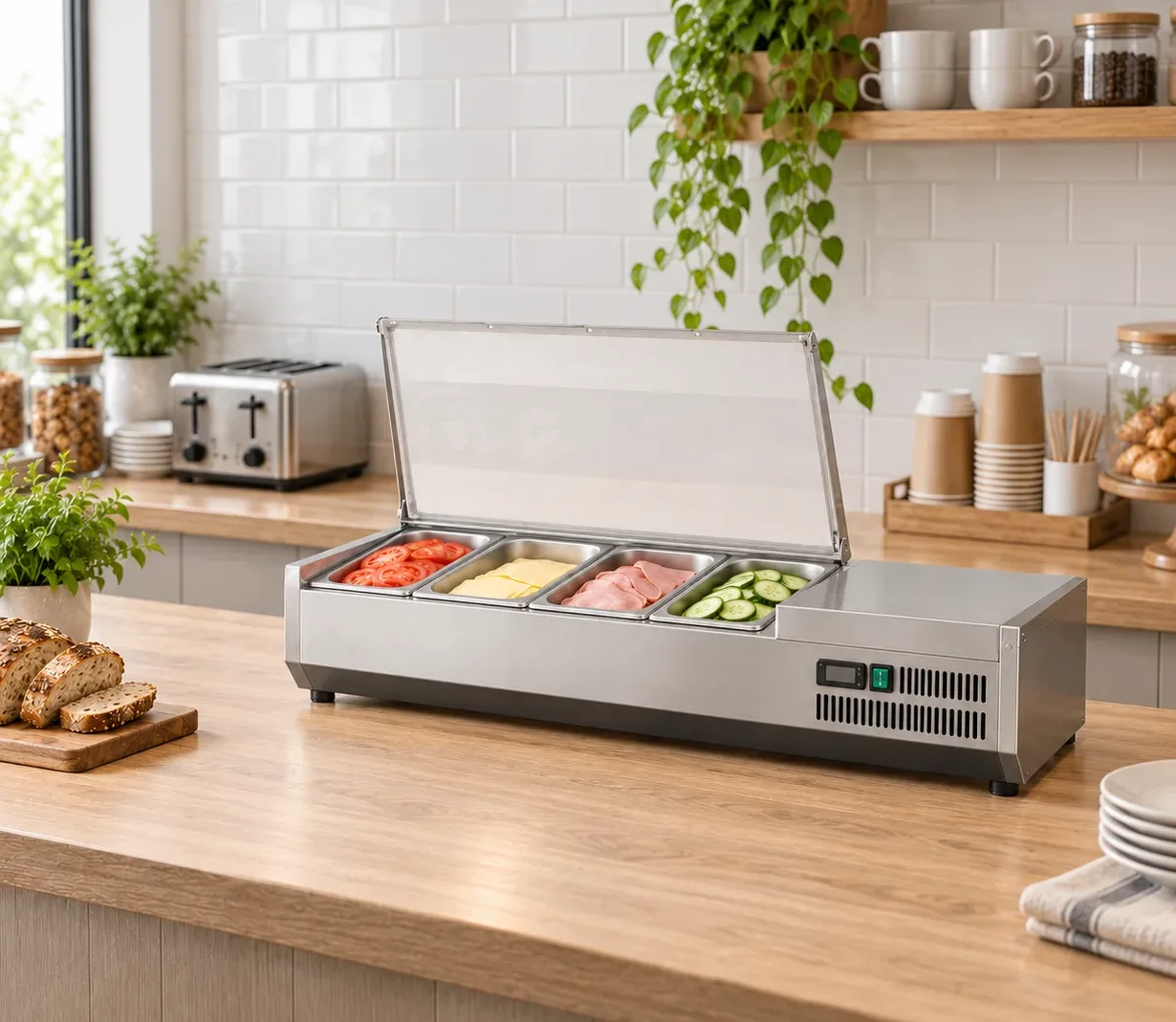
What temperature range is recorded for these topping fridges?
All six JINYU SC topping fridges in the comparison record a 2-12°C temperature range. The range stays the same from the four-position GN-1130SC to the ten-position GN-2180SC. Each model also records static cooling, automatic defrost and a hinged lift-up lid. Choosing a longer rail changes the pan-position count and cabinet capacity; it does not change the recorded temperature range in this catalogue.
Use the range as one field in a model comparison. It does not identify the temperature of every ingredient during service, a permitted holding period or the room conditions under which the cabinet was tested. Send the intended application and site conditions with the model request, then obtain the operating instructions for the offered configuration. Keep those instructions beside the restaurant's own food-handling procedures so the purchasing record and the operating plan refer to the same equipment.
How do pan count and cabinet length change across the six models?
GN-1130SC provides four 1/3 GN positions in a 1130 mm body, while GN-1305SC provides five in 1305 mm. GN-1655SC has seven positions in 1655 mm; GN-1830SC has eight in 1830 mm. GN-2005SC and GN-2180SC provide nine and ten positions in 2005 and 2180 mm respectively. Every body is 405 mm deep and 280 mm high. The six capacities are 42, 52, 72, 82, 92 and 102 L in the same order.
Count ingredients that need separate containers before selecting a rail. For example, a seven-container layout can be compared with GN-1655SC without treating its 72 L figure as a container count. Put finished pan dimensions and intended positions on the response sheet. The stated 1/3 GN layout identifies positions; it does not provide pan depth, the supplied-accessory list or the usable internal dimensions of a particular container.
Does a higher rated power mean a colder topping fridge?
The recorded powers increase from 130 W for GN-1130SC and 135 W for GN-1305SC to 150 W for GN-1655SC, 165 W for GN-1830SC, 170 W for GN-2005SC and 183 W for GN-2180SC. All six retain the same recorded 2-12°C range and 220-240V/50Hz supply. There is no separate cooling-capacity or daily-energy-consumption measurement in this comparison. The watt figures therefore cannot rank the models by ingredient cooling speed or daily electricity use.
Carry the full model code, rated power, voltage and frequency together into the equipment schedule. If the project needs consumption data or a performance comparison under specific conditions, request the relevant model documentation with those conditions identified. A longer cabinet's larger electrical rating is a specification difference, rather than evidence that it can accept a warmer product load or maintain a different ingredient temperature.
What should I ask about the lid and the room around the rail?
The recorded 280 mm height describes the cabinet body. It does not give the hinged lid's open height or its distance from an overhead shelf. Draw the support surface, nearby cooking equipment, the staff side and the intended pan-lifting movement. Label the lid-open and pan-removal dimensions requested from JINYU on that drawing. The 405 mm cabinet depth belongs on the same plan, with installation allowances taken from the selected configuration's instructions.
Keep room conditions separate from the catalogue temperature range. A 2-12°C line describes the recorded cabinet range, not an ambient-room rating. State the proposed indoor position and describe nearby heat sources when requesting the installation and operating information. Include photographs tied to the drawing. This gives the respondent a location to assess and keeps an open-lid dimension from being mistaken for the closed body height in a counter design.
How can I compare a supplier response with the downloadable sheet?
The CSV below keeps one line per SC model, with dimensions, capacity, pan positions, temperature range, cooling description, defrost description, lid, rated power and supply. It draws those fields from the same records as the visible table. Start by selecting the requested model code, then keep a copy of the response and its drawing revision beside that line. Separate a different offered configuration into its own comparison record so changes remain visible.
For a worked substitution, moving from GN-1830SC to GN-2005SC adds 175 mm of body length, one pan position, 10 L of listed capacity and 5 W of rated power. Depth, height, supply and recorded temperature range stay the same. This arithmetic helps identify changed fields in a quotation. It does not establish that the existing support, installed circuit, pans or lid-opening space are suitable for the substituted unit. Review those items against the offered configuration documents.
What information makes a topping-fridge inquiry specific enough to answer?
Send the selected model code, the number of separate ingredients, the intended pan arrangement and the destination supply details. Attach a counter plan with measured width and depth, a side elevation showing overhead furniture, and photographs of the proposed position. Include the outside dimensions of existing pans if they will be reused. Describe the application and the operating information required, rather than asking whether an unspecified topping fridge is suitable.
Shaanxi Jinyu Kitchenware Co., Ltd. (陕西金宇厨具有限公司) uses the JINYU brand on this catalogue. A useful response record connects that model to the offered specifications, installation drawing, lid movement, accessory list and operating instructions. Keep each answer attached to the relevant request field. If the offered model changes, compare its dimensions, pan layout, range and electrical data as a complete line before updating the purchasing schedule.